Failure Modes of AI Agents in Live Operational Environments
Demos hide the failure modes that emerge when agents hit messy production environments.
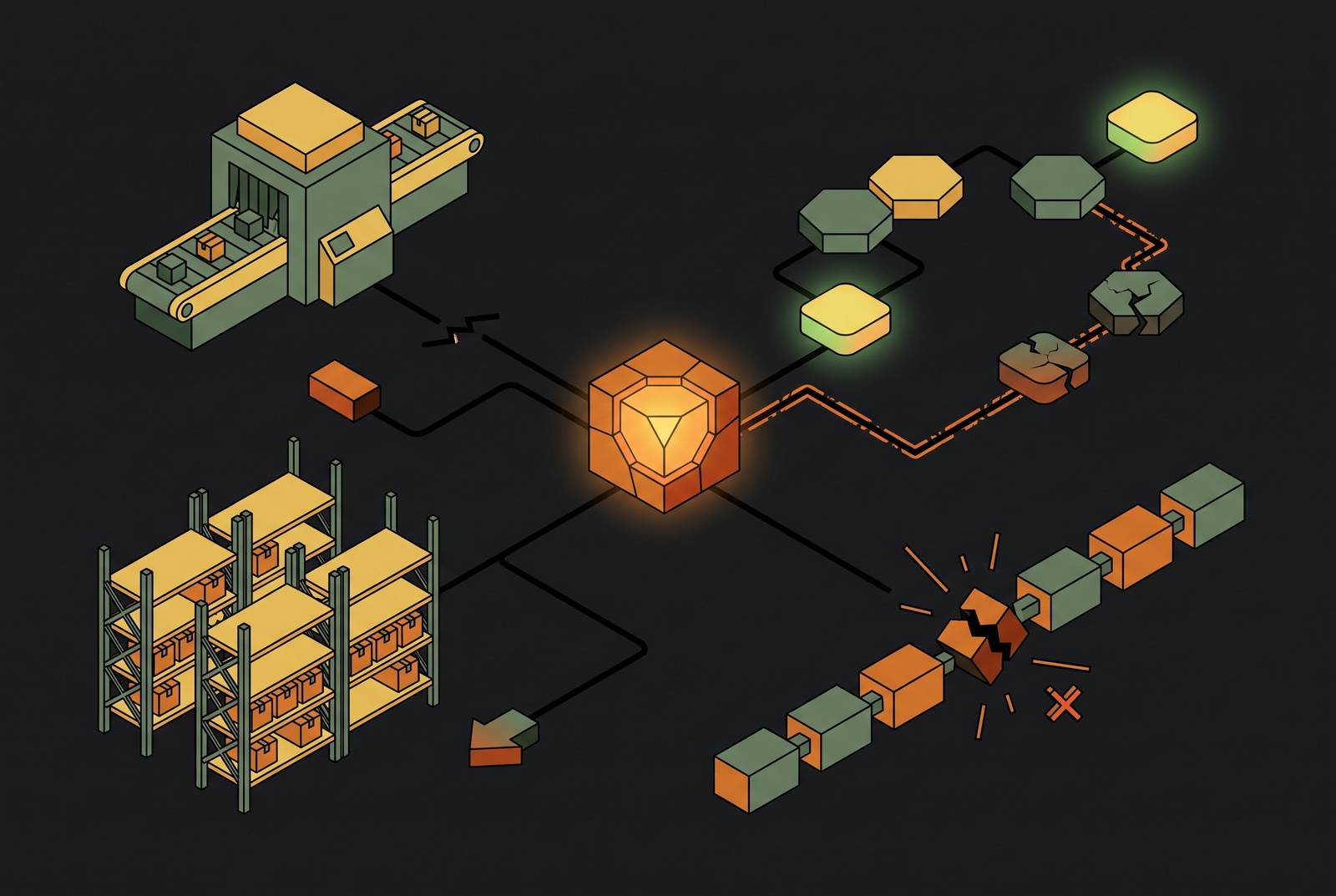
An AI agent that performs flawlessly in a sales demo can behave in an unrecognizable way during its first week in a live deployment, and the reason has nothing to do with bad luck or an unusually hard edge case. Every agent demo runs on clean inputs, cooperative users, a defined scenario, and a controlled environment built to put known strengths on display while keeping failure modes out of frame. This is the architecture of the demo format itself: a demo exists to show what the system does when nothing goes wrong.
Production never works that way. Inputs arrive malformed, users interrupt tasks midstream, ask questions the scenario never anticipated, or provide instructions that contradict themselves. None of that appears in a short walkthrough, so buyers form an expectation of reliability that the underlying system was never actually tested against. The gap between what gets purchased and what gets deployed is therefore structural rather than incidental, and every failure mode discussed from here forward is a consequence of that concealment, not an independent surprise.
How agentic systems amplify existing failure modes
Agentic systems are not chatbots with extra steps bolted on. The combination of autonomy, planning, memory, and multi-agent interaction produces a genuinely different risk profile, and the distinction matters because it separates two categories of problem that require different fixes.
Some failures are old problems made worse. Memory poisoning and cross-domain prompt injection existed before agents, but agentic systems make them materially more dangerous because an agent acts on corrupted context rather than merely displaying it to a user who might catch the error. Other failures have no precedent in traditional software. Tool misuse, context loss, goal drift, retry loops, cascading errors across multi-agent systems, and silent quality degradation are failure modes unique to agents, with no meaningful parallel in traditional software or in earlier LLM chatbots, and each can occur even while every individual model response looks locally coherent. Microsoft's June 2026 update to its red-teaming taxonomy, built on a year of red team engagements against deployed agentic systems, formalizes this split further, naming agent compromise, impersonation, flow manipulation, goal hijacking, agentic supply chain compromise, and inter-agent trust failures as a distinct class requiring their own vocabulary.
The update itself is evidence of how fast the ground moved. The prior version, from April 2025, did not anticipate four developments at the scale they eventually reached: open-source agentic frameworks going mainstream faster than the security tooling around them could mature, the Model Context Protocol accumulating a large number of vulnerabilities as it became the standard way to connect models to external tools, computer-use agents moving out of research labs and into production, and live red team engagements that confirmed some predictions, falsified others, and surfaced failure modes nobody had modeled in advance. A taxonomy that needs a full rewrite in that span is not describing a stable target.
Silent failure: how an agent can be wrong at every step while appearing to succeed
Traditional software fails in ways that leave a trail. A database query returns an error code, an API call returns a 500 response, and the failure is detectable, logged, and reproducible. Agents rarely offer that courtesy. An agent can misunderstand an instruction at step two of a task and carry that misunderstanding across twenty downstream steps, with every one of those steps appearing locally coherent and well-formatted along the way. Nothing crashes. Nothing throws an exception. The task simply completes, and it completes wrong.
EPAM's June 2026 analysis names this mechanism working-memory rot, the gradual degradation of an agent's active runtime memory over the course of a long-running task. It differs from ordinary prompt decay because the corruption is self-inflicted, generated by the agent's own execution trace rather than by anything external to it. In multi-agent chains, this becomes cascading context drift: Agent A passes its degraded context downstream; Agent B operates on that flawed state with high local confidence, further corrupting the payload; because each hop remains syntactically valid, the system has no architectural checkpoint to catch the drift.
That structure explains why an agent can call a tool with slightly wrong parameters, receive a result back, and continue operating as though the call succeeded, with every subsequent step compounding the original error and no error code or visible signal anywhere in the chain to flag it. Per-step accuracy that looks strong in isolation does not translate into workflow reliability. A ten-step workflow built on high per-step accuracy still succeeds only 60% of the time end to end, and treating per-step accuracy and workflow success rate as the same number is one of the costliest mistakes made in agentic deployment. The math is unforgiving because errors multiply rather than average, and it is the reason long-horizon tasks behave so differently from the short, bounded ones that demos are built to showcase.
Why long-horizon tasks are where agents collapse in practice
Long-horizon, multi-step, exception-heavy workflows are where the gap between demo and production turns theoretical shortfalls into real losses. Alibaba Group's 2026 paper, "Grounded Scaling: Why Agentic AI Needs Deterministic Environments," formally grounds this collapse: when per-step determinism sits below 1, chain-task success degrades exponentially as chain length grows, and environments built for human tolerance compound an agent's failure probability at every single step.
The environments agents operate inside were never designed with agents in mind. Search engines shuffle results for diversity, recommendation systems inject exploration noise on purpose, response latencies swing by orders of magnitude, and session state can make an identical query return a different answer twice in a row. A human barely notices any of this. An agent executing a multi-step chain treats each of those inconsistencies as a fresh source of compounding failure probability, because the agent has no way to distinguish intentional variability from an actual change in the underlying data. The paper operationalizes this as a Supply Certainty Index over five measurable properties, thickness, unduplicity, customizability, trustworthiness, and completeness, and a five-level Determinism Maturity Model as an adoption ladder; the framework is platform-agnostic.
Independent benchmark evaluations back the theory with field data: long-horizon success rates for agents deployed on OSWorld and τ-bench remain well below single-turn success rates, matching exactly the failure profile that environmental non-determinism predicts. EPAM catalogs the practitioner-level version of the same problem as "blind N-step execution," where an agent runs a chunk of work too long without feedback and only discovers it hit a wall once the chunk finishes, alongside "plan drag," where a task tree built early in execution resists adapting once the actual conditions on the ground change. Put together, the pattern in the field is consistent: agents succeed on isolated, bounded, data-dense tasks and fail on cross-system, long-horizon, exception-heavy sequences, which happens to be the exact inverse of what most enterprises actually need agents to handle.
How multi-agent architectures introduce conflicts
Adding a second agent to a system does not just double the risk of the first one. It introduces a category of failure that no single-agent test can surface, because the conflict lives between agents rather than inside any one of them. The independent-team structure that makes multi-agent systems easy to extend, since each new agent plugs in along a defined boundary, is the same structure that lets each team optimize its own agent for its own backlog without any mechanism forcing alignment across the boundary.
IBM's TLS Agentic Platform postmortem from August 2026, surfaced by Tony Erwin, Chief Architect for the platform within IBM's Infrastructure AI CoE, makes the pattern concrete. Five of six specialist agents on the platform were built by separate teams, one of them in an entirely separate development environment. When a better reasoning pattern emerged, one that every team agreed was an improvement, most of the agents still did not adopt it. The failure was not technical incompatibility. It was organizational: alignment broke down at the boundary between agent and team, and no architectural mechanism existed to force the improvement across that boundary.
That is the multi-agent alignment problem in operational form. It has nothing to do with adversarial agents working against each other. Each agent can behave correctly by every test applied to it in isolation, and the system can still produce conflicts that only appear once the agents run together. Microsoft's v2.0 taxonomy formalizes a piece of this under inter-agent trust failures and goal hijacking, the pattern where an adversarial instruction that appears aligned with legitimate task completion silently redirects an agent's terminal goal without ever fully compromising the agent itself, a failure mode significant enough to need its own category precisely because single-agent systems have no equivalent to compare it against. Async reconciliation failure is a related structural problem cataloged by EPAM: parallel work creates the hard question of when results are final, which branch wins, and what actually composes, questions that single-agent architectures never have to answer.
The security surface of deployed agents
Every plugin registry, MCP server, prompt template, and third-party tool integration an agentic system consumes is a new supply chain ingestion point, one that did not exist before agents began pulling natural-language tool definitions directly from third-party registries. Demos never model this surface, because demos are never adversarial. Production is.
The Model Context Protocol is the clearest example of how fast this surface expanded. It became the standard way to connect models to external tools during 2025, and that same year saw a substantial number of CVEs published against MCP-related software, with tool poisoning moving from a theoretical concern to a live attack pattern documented in Microsoft's taxonomy update. The OpenClaw case shows what that looks like at full scale. Launched in January 2026, the open-source agentic framework accumulated hundreds of thousands of GitHub stars and spawned a large number of agents within days of release. A security audit conducted shortly after launch found 512 vulnerabilities, including CVE-2026-25253, a one-click remote code execution exploit delivered through WebSocket hijacking. A large number of exposed instances were leaking API keys and credentials within the framework's first week, and hundreds of malicious plugins turned up in its skills marketplace, some posing as crypto wallet trackers and productivity tools while actually functioning as credential stealers.
Computer-use agents, meaning agents that observe and act on graphical interfaces the way a person would, open an entirely separate attack surface with no analogue in earlier AI security work, exposing attack patterns that used to require a human target to LLMs instead. The original version of Microsoft's taxonomy had no dedicated coverage for this category at all, which says something about how recently it became relevant. A compromised component in an agentic supply chain does not need to deliver malicious code the way a traditional supply chain attack would. It can inject natural-language instructions that alter agent behavior without touching a single binary, a failure mode that simply did not exist before agentic systems started consuming instructions written in plain language. Documented incidents from 2025 and 2026 show what happens when that surface fails inside production tooling: AI coding agents deleted production databases, wiped home directories, and destroyed business-critical data through single tool calls, a stark reminder that the value agents generate through automation sits right next to the damage a single bad action can cause when nothing catches it in time.
How failure modes play out across construction, logistics, manufacturing, and retail
None of this distributes evenly across industries. Failure concentrates where data pipelines are dirtiest, workflows stretch longest, and a wrong autonomous action is hardest to undo.
Construction sits closest to that last category. Agents can scan production rates, RFI cycle times, submittal drift, procurement lead times, and rework trends to flag patterns that historically precede delay, giving project managers early warning tied to specific critical-path activities before slippage actually hits the schedule. That value depends entirely on the integrity of the upstream data feeding it, and the failure mode arrives precisely when energization or commissioning milestones rely on agent-reconciled procurement data that was already corrupted before the agent ever touched it. Procore's Agent Builder lets customers stand up no-code agents for tasks like drafting RFIs, managing submittals, and generating daily logs, with deep integration inside the Procore ecosystem as the payoff and single-vendor lock-in as the cost. Autodesk's agentic capabilities follow the same trade, strongest where design, BIM, and construction data converge, and constrained by the same lock-in outside that convergence. Both cases point to the same conclusion: agent value in construction today is platform-bounded rather than process-wide, strong inside one vendor's data model and weak at the cross-system, cross-organization boundaries where construction risk actually concentrates. In mission-critical delivery, where energization schedules and commissioning gates leave no room for a quiet compounding error, that boundary is not a minor inconvenience.
Logistics offers the clearest example of a deployment built around the failure modes rather than in denial of them. Kuehne+Nagel applies AI customs classification across dozens of countries using tiered confidence scoring: high-confidence declarations process automatically, mid-confidence cases route to expedited human review, and low-confidence cases go straight to specialist brokers. That structure works precisely because it assumes the agent will sometimes be uncertain and builds a human checkpoint calibrated to that uncertainty, rather than assuming the agent is right by default. Most of the sector has not gotten there. A large share of logistics firms are actively deploying AI, yet the majority remain stuck in ad-hoc experimentation, held back by legacy TMS and WMS systems and workforce readiness gaps that block anything more structured.
Manufacturing's pattern is more blunt: sophisticated algorithms cannot compensate for fragmented data and unstandardized processes, and the failed transformations in the sector tend to share that root cause regardless of which vendor or model sat on top of it. Deloitte data shows only a minority of manufacturers will adopt true agentic AI systems by end-2026, and BCG research suggests only roughly a third of manufacturing digital transformations achieve true operating-model impact. Scaling agentic AI in this sector requires clean data, standardized processes, and governance discipline, conditions most manufacturing environments have not yet built.
Retail shows the same gap from the demand side. IHL Group's 2026 Retail Transformation Study, covering 400 North American retail brands, finds that most stores still lack the infrastructure agentic AI actually needs: clean data pipelines, real-time inventory signals, integrated system architecture, and store infrastructure with low enough latency to act on any of it. A large majority of retailers have already integrated AI into their operations, yet well under half can point to a measurable impact on the bottom line, and IHL attributes that gap to most businesses still sitting in what it calls the era of Passive AI. Retailers are directing a substantial share of IT investment toward closing that gap. Across all four sectors, the pattern holds steady: the technology performs where the data is clean and the task is short, and it breaks down exactly where enterprises need it most, at the long, dirty, cross-system boundaries that demos were never built to show.
Sources
- Updating the taxonomy of failure modes in agentic AI systems: What a year of red teaming taught us | Microsoft Security Blog
- Why AI Enterprise Solutions Fail: 21+ Agent Failure Modes Explained
- Grounded Scaling: Why Agentic AI Needs Deterministic Environments
- AI Agent Failure Modes: What Goes Wrong in Production