Why Platform Architecture Determines Whether a Logistics Operation Is Running Live AI in Week Six or Still in Discovery
Pre-built system connectors determine whether logistics AI launches in weeks or quarters.
Fast deployment of logistics AI depends on native connections to operational systems. A platform with pre-built, bidirectional TMS, WMS, and ERP connectors can put a clearly scoped workflow into production in weeks, while one that requires custom integration can spend months in discovery. The route to live AI by week six is to evaluate integration architecture first and begin with one painful, measurable workflow.
Why deployment speed in logistics AI is an architecture question, not a capability question
Six months into an AI project, a logistics team can still be in “discovery,” reconciling carrier updates with warehouse events and ERP records. No operational workflow has gone live. The team is still working out how the information needed for a decision will reach the agent and how its decision will reach the system that executes it. What looks like slow AI development is an unresolved connection between the platform and the operation.
To reschedule an appointment, an agent needs to interpret the request correctly, access the relevant operational information, and have a way to write the change back. Depending on integration depth, those connections are either already in place or must be built before the workflow can run.
Yet vendor evaluations typically emphasize model outputs, use-case breadth, and pricing. A convincing demonstration can show what an agent understands without showing whether it can execute a decision inside the buyer’s specific TMS, WMS, or ERP. Vendor evaluations should also establish whether the platform has pre-built, bidirectional connectors to those systems.
Consequently, two operations with identical ambitions and budgets can reach production at radically different speeds. One begins with connections that support the intended workflow, while the other begins with custom integration work. Both may have a capable model. Their timelines diverge because only one has the architecture needed to turn that capability into operational action.
What logistics AI agents actually do inside a connected stack
A deployed logistics AI agent perceives, reasons, and acts across operational systems and carrier networks without requiring human instruction at every step. Its value depends on what it can read and write. Reading provides the context for a decision, while writing allows that decision to change an operational record or move a workflow forward.
This distinguishes agents from RPA and rule-based automation. Those systems execute fixed sequences and break when conditions deviate, whereas an agent interprets context and handles novel exceptions. Logistics rarely follows an entirely expected sequence. A disruption may call for a two-minute reroute, a customer notification, or a planner’s judgment. Exception triage separates those responses, and getting that classification right accounts for much of the value.
An appointment-rescheduling agent checks dock availability and rebooks a slot before detention charges begin to cascade. Freight document retrieval locates delivery confirmation records, bills of lading, and customs paperwork with a permissions check. Carrier and rate enquiries use capacity checks and quote requests against rate tables, and unusual cases are escalated.
Under a human-in-the-loop model, a planner approves every action. Over time, human-on-the-loop operation allows the agent to execute routine decisions while the planner supervises. Deployment should move incrementally between those modes, with full autonomy deferred beyond launch. The agent’s authority should grow within a defined escalation path, so that deploying a useful workflow does not require delegating every decision it touches.
How integration architecture determines whether deployment takes weeks or quarters
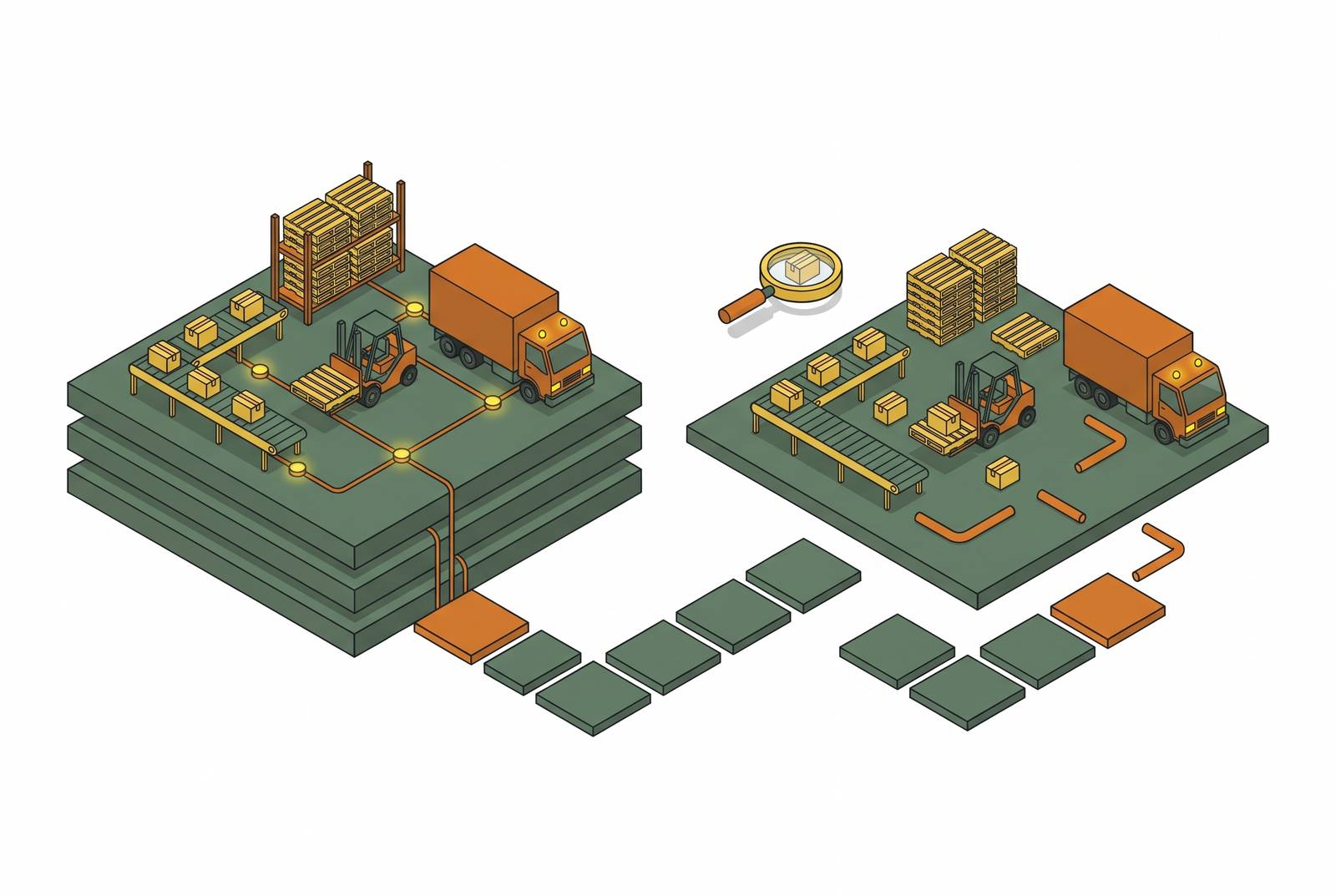
Deployment often takes four weeks when the platform already has bidirectional connectors for the systems the operation runs, or twelve months when each integration must be developed. An API connection alone is not enough. A TMS or WMS integration involves middleware development, data transformation, and bidirectional synchronization. Custom work across those requirements consumes time before an agent can complete its first operational task.
Data transformation is particularly demanding because logistics systems do not describe or report the operation uniformly. Carrier updates, ERP records, WMS events, and IoT signals arrive in different formats, on different cadences, and with different data models. Those inputs must be harmonized to make information from separate systems usable within the same operational context before an agent can reason across them.
A production-ready platform therefore needs more than an integration library. It also needs an intelligence layer that maintains context across connected systems and a governance layer that logs every autonomous decision for audit and compliance. These layers serve distinct purposes. A platform missing any one of them is not ready for enterprise logistics deployment.
There is a serious objection to putting architecture first. An organization cannot deploy successfully if it cannot name the workflow, its owner, and its baseline metric, however well connected the platform may be. Process clarity is necessary, but it is not a substitute. A clear workflow on a poorly integrated platform still requires months of custom work, while the same definition on a natively connected platform can support deployment in weeks. Process understanding accelerates what the architecture enables.
Why starting with one painful, well-scoped workflow is the correct deployment strategy
Given those dependencies, the operational starting point should be one high-friction workflow. A bounded workflow limits the systems, decisions, and escalation rules that must work together before production begins. It also gives the business a specific outcome to measure.
The strongest first candidates involve high volumes of repetitive, low-ambiguity interactions. Often, the answer already exists in the TMS. A human is being paid to retrieve it, interpret a routine request, or pass the result to someone else. The workflow should have one business owner who measures the baseline before and after deployment. It also needs a defined escalation path that separates decisions the agent can make from those requiring human review.
RTS Labs’ 2026 platform overview describes a top-50 U.S. freight broker that was losing revenue to manual load matching and gut-instinct pricing. The broker had an AI-powered freight matching engine deployed in 10 weeks. The overview reports a significant revenue increase, a substantial reduction in empty miles, and a dramatic reduction in match time. This was a scoped workflow with measurable baseline metrics. It illustrates what a focused deployment can produce, rather than establishing a universal promise of production in under 60 days.
Broad launches expose more ways for a pilot to stall. Clean, bounded pilot datasets may not survive production volume, governance may remain undefined, and operational teams may be unprepared to work with AI outputs. As the pilot extends beyond its planned timeline, executive sponsorship can wane. One workflow should be proven before expansion into adjacent ones. That first deployment builds the data foundation, trust within the business, and care with governance that are missing when workflows launch all at once.
How can an operation evaluate a logistics AI platform before committing to it?
The review should start with the integration library and bidirectional sync architecture, before a demonstration of what the model can do shapes expectations. Which specific workflow must run first, and which systems does it touch? The review should next establish whether the agent can write back to those systems or only read from them. A serious architecture discussion connects the proposed action to the specific TMS or WMS in which it must be executed.
How does the platform handle different formats, cadences, and data models, and who maintains the abstraction layer that reconciles them? The distinction between “pre-built” and “configurable” deserves particular scrutiny because configurable integration means custom development before the workflow can move. Production volume belongs in the same conversation. A requirement to finish data cleaning or normalization before deployment begins signals that the platform is not yet absorbing operational data as it arrives.
Governance is the next approval condition. Is every autonomous decision logged, explainable, and auditable? Enterprise procurement and compliance teams need that answer before deployment can be approved. The evaluation should also establish how the agent distinguishes autonomous decisions from cases requiring human review, and how those thresholds are configured.
The proposed timeline should be tested against these dependencies. A vendor that leads with model capability before asking about the first workflow has not yet established the basis for a deployment estimate. A schedule that runs to quarters rather than weeks suggests that the architecture needs custom work, especially when the integration work has yet to be clearly laid out. For operators in regulated markets or those that handle sensitive freight data, where the platform will run may rule out some vendors even earlier. On-premise or sovereign requirements should be established before vendor discussions, including whether the platform can operate without routing data through a third-party cloud.
The compounding cost of delayed deployment — and why the gap widens the longer a decision waits
A logistics operation running agents in production begins accumulating something that a later platform purchase cannot supply. It gains experience with its own volume, exceptions, and carrier behavior. As an agent refines predictions against those conditions, the operation develops a data and decision-quality advantage specific to its work. Deploying later on a better platform does not reproduce the operational learning that has already occurred elsewhere.
The learning also extends beyond predictions. A first workflow in production lets the business build its governance and escalation practices around real decisions. Those practices matter more as agents move from simple automation to making their own decisions in transportation routing, warehouse management, and freight optimization. Expansion then has an operational foundation. An organization without a first deployment must establish that foundation while also addressing the demands of the next workflow.
This makes delay more than a period of unrealized efficiency. It postpones the start of operation-specific learning and the development of the controls needed to use it. Platform and scope decisions made in the next quarter therefore influence whether the operation is accumulating that advantage or still catching up in two years. The argument concerns the deployment clock. This holds even when some workflows are not ready for autonomy, and speed still calls for strong governance.
Leaders should begin with a process audit to identify one genuinely painful workflow, measure its baseline, and confirm who owns its outcome. They should then evaluate platforms against the specific systems that workflow touches and the actions it must execute. Done in weeks rather than quarters, it turns an open-ended AI initiative into a defined path from operational pain to a live workflow.