Root Cause Patterns in Enterprise AI Rollout Failures
Most AI failures stem from broken processes, not broken models.
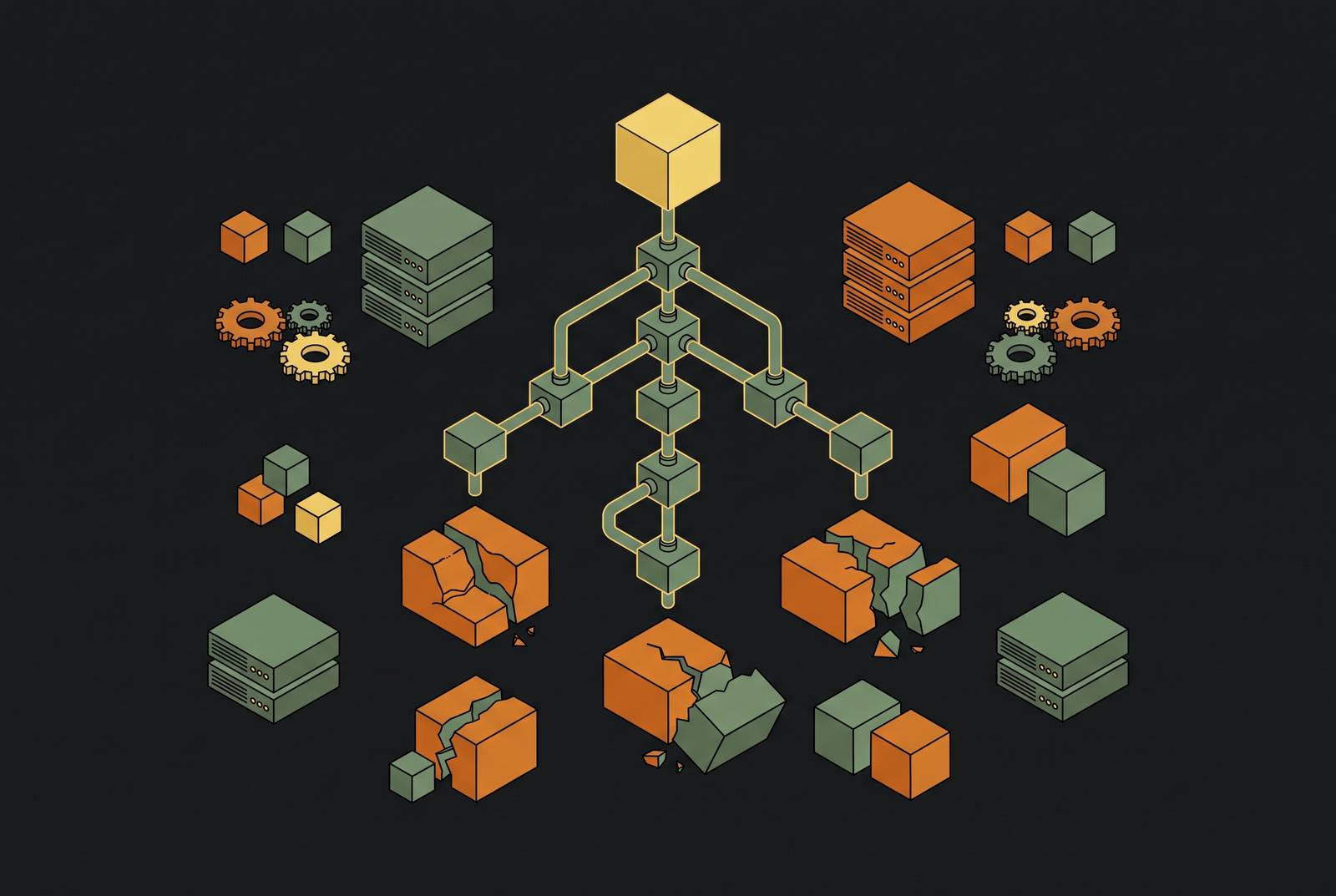
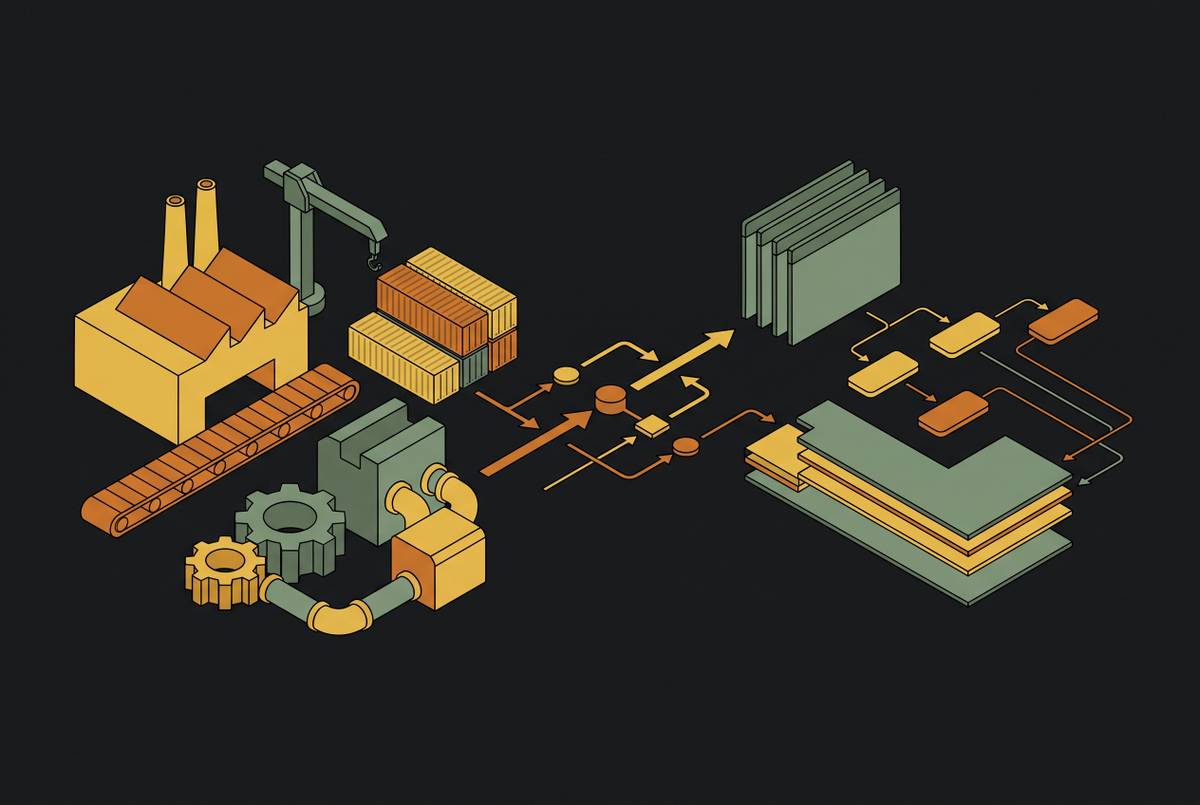
When an enterprise AI rollout fails, the first explanation offered is almost always technical: the model hallucinated, the outputs were unreliable, the tool wasn't ready. But look across healthcare, finance, retail, and government, and the evidence tells a different story with unusual consistency. What went wrong was rarely a glitch inside the model itself. It was a convergence of planning failures, data failures, organizational failures, and integration failures, all operating upstream of anything the model actually computed. If you blame the technology, you send the organization back to the model, when the real fix sits somewhere else entirely, in how work gets structured, handed off, and verified before an AI system ever touches it.
How Automating Broken Processes Locks in Failure
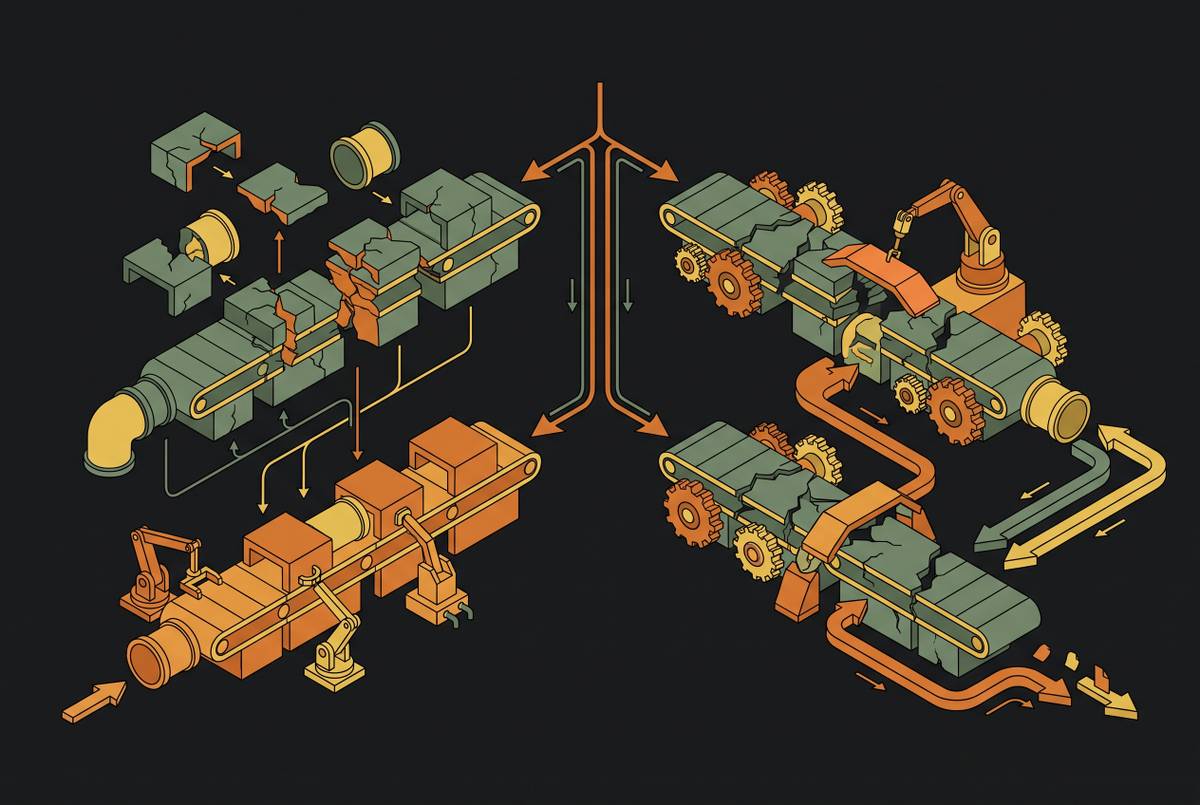
If a process doesn't work, AI applied to it does not fix it. It speeds up the breakdowns already built into it and makes them harder to catch. A document AI extracts fields from an invoice or a claim form, but if the downstream team still re-enters that data into a separate system by hand, the handoff failure that caused the problem in the first place has not been removed. It has just been moved one step earlier in the chain. A forecasting model produces sharper predictions, but if planners keep overriding those outputs based on habits formed under the old system, the real gap, who actually holds decision authority, remains exactly where it was. A customer support assistant can draft responses in seconds, but if agents still check every line by hand before sending, handle time barely moves, because drafting speed was never the bottleneck.
Enterprises across industries have underestimated how complex integration actually is, misjudged whether their data was ready, and failed to tie projects to a clear business outcome. In each case, the assumption was the same: the process architecture is fine as it stands, and the AI will quietly compensate for whatever it lacks. That assumption is what turns a rollout into a trap. A manual process that fails is visible, because someone has to notice the delay and chase it down. An automated process can fail quietly, so its outputs look plausible for months before anyone checks whether they're correct, and by then the cost has already compounded.
The Pilot-to-Production Gap
Pilots run under conditions production will never see again, so passing a pilot shows almost nothing about whether the process can handle AI at scale. Pilots run on data that's been cleaned ahead of time, on a narrower slice of the workflow than the full operation, with senior people paying close attention and users who are more patient than the rest of the organization will ever be. It's the equivalent of demonstrating a new piece of equipment on a freshly swept floor while the rest of the warehouse, with its backlog, its exceptions, and its improvised workarounds, stays entirely out of frame.
Bain's late-2025 survey captured this gap precisely: executives reported that 80% of generative AI use cases met or exceeded expectations, yet only 23% could tie those initiatives to new revenue or lower costs. The distance between "met expectations in a pilot" and "produced a measurable financial result" is the pilot-to-production failure in numerical form. Pilots systematically avoid the conditions that actually break processes: the messy edge cases that real traffic throws off constantly, the exception-handling burden that lands on a human the moment the model can't decide, the drag of integrating with legacy systems at full data volume and real pipeline latency, and the slow creep of model drift once the engineering team that built the pilot has moved on to something else. Early, widely publicized wins, document review running faster, customer replies going out automatically, created an expectation that AI would transform outcomes quickly across the board. Those early wins were genuine, but they were genuine inside a controlled setting, and they did not hold up once they met the full complexity of daily operations.
The costliest part of this pattern is that it repeats. A pilot succeeds. The organization scales it. The process underneath buckles under full production load. The project gets quietly shelved. Six months later, a new pilot launches, often for a different team, with the same structural problems unresolved, because nobody went back and asked why the last one failed once it left the sandbox.
Data Readiness Failures as a Symptom of Skipped Process Redesign
Bad data gets blamed constantly, and it sounds like a technical prerequisite problem: clean the data, then deploy the model. That framing gets the causality backwards. Data unreadiness happens when an organization has spent years running workflows that were never built to produce the kind of structured, usable data that AI systems need, and then treats the resulting mess as an infrastructure problem instead of what it actually is: a process design problem.
The pattern recurs because vendor demos run on curated datasets with clean schemas and sensible volume, while the organization's actual production environment runs on years of inconsistent records that nobody has ever had a reason to clean before. Legacy workflows were built to move work from one department to the next, not to generate auditable, machine-readable records along the way, so the data those workflows throw off is exactly as disorganized as the process that created it. The research on this is explicit that the causes of enterprise AI failure cluster around leadership, data readiness, governance, and workflow redesign, and those aren't four independent problems. So data readiness and workflow redesign are the same problem, just described from two different angles.
Manufacturing makes this concrete. Maintenance history sits in one system, production schedules sit in another, and shift supervisors have been filling out paper forms with their own private conventions for years. The inconsistency originated in how the work itself was organized, making it a workflow design failure that no amount of data infrastructure spending will fix. Cleaning that data without redesigning the process that generates it buys a temporary fix. The same data gets dirty again within a cycle or two, and engineering resources go toward cleaning it a second time, then a third, in a loop that never produces anything durable.
Sector-Specific Failure Mechanics
Construction, logistics, and manufacturing each produce a different surface-level symptom, but the same structural failure causes all of them: AI applied to a process nobody rebuilt first.
In construction, scheduling tools trained on declared project timelines inherit whatever unreliability already existed in those declarations. A P6 schedule records intent, not what you can actually achieve, so when a model trains on declared dates, it amplifies planning optimism instead of correcting it. The specific breakdowns cluster at scheduling and procurement handoffs: RFIs sit unanswered longer than they should, submittals age past the point where the critical path can still be protected, and payment applications turn into last-minute scrambles. None of these are model problems. They're coordination failures in how the handoffs themselves were designed. Energization readiness shows the same dynamic in sharp relief: grid constraints upstream of the jobsite routinely make declared completion dates meaningless in practice, and an AI scheduling tool that treats those declared dates as reliable will hand back a prediction that's unreliable from the start.
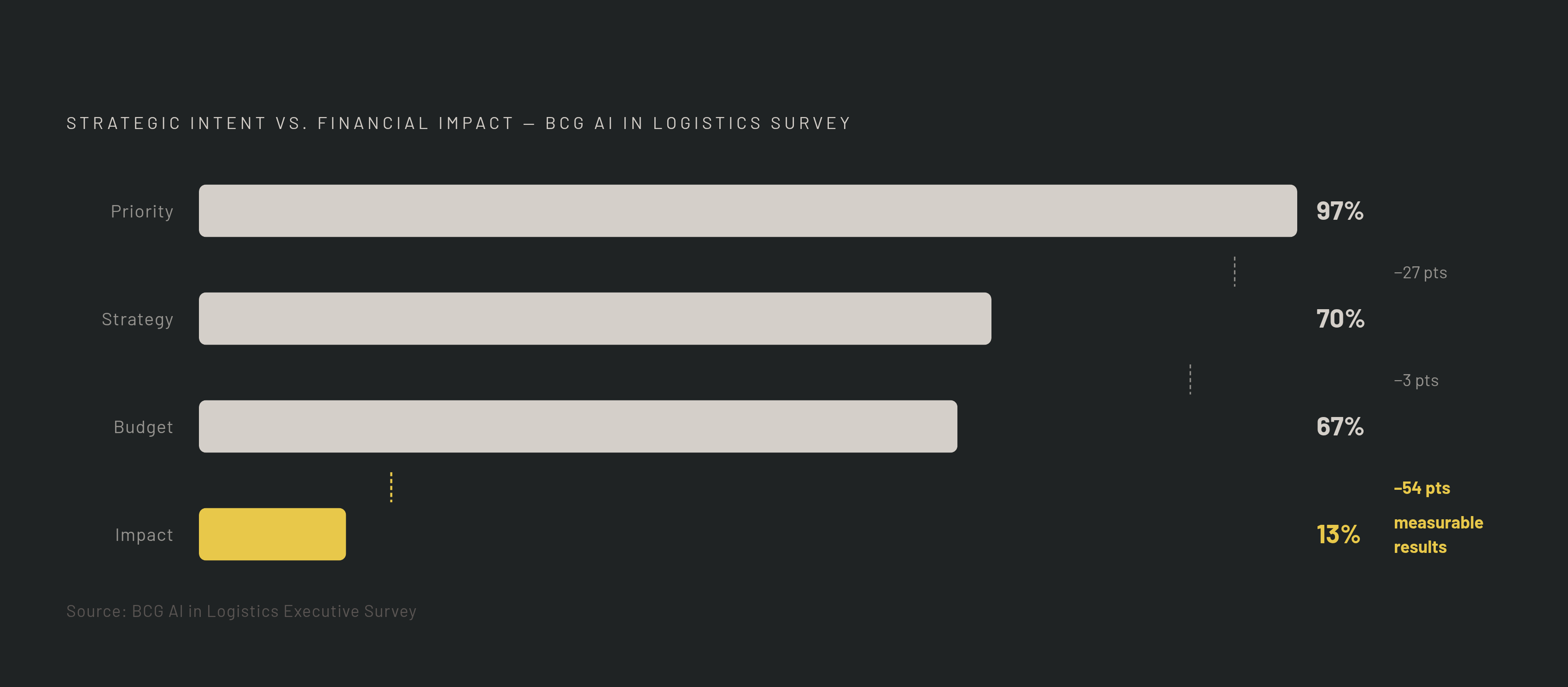
Logistics shows the pattern at industry scale. In BCG's AI in Logistics Executive Survey, 97% of executives ranked AI as a strategic priority, 70% had an AI strategy in place, and 67% had a dedicated AI budget. Only 13% said AI was delivering measurable financial impact. When asked to name their single most impactful AI solution, 80% pointed to one standalone tool, and only one respondent described anything close to an end-to-end capability built into a workflow. That gap between strategic enthusiasm and standalone-tool deployment is the bolt-on failure playing out at industry scale: organizations are dropping point solutions into processes they never redesigned, so the tool sharpens one task without changing what the surrounding workflow actually produces. The real bottleneck is retrofitting data pipelines into legacy ERP, WMS, and TMS systems, not training the model. That means the delay sitting in front of most logistics deployments is a process and infrastructure problem, not a capability gap.
Manufacturing shows what happens once trust breaks down. When workers stop relying on a tool and quietly route around it, you can see the underlying process was never redesigned. The AI got added as a layer sitting on top of the existing decision structure, and when the two conflict, the existing structure wins, because it's the one people were actually trained on and the one their incentives still reward.
AI Agent Deployments and a New Version of the Same Organizational Failure
Agentic AI doesn't sidestep this pattern. It makes it worse, because agents operating inside workflows that were never redesigned make decisions on their own, at a speed and scale that turns a slow-building process failure into one that's much harder to contain before it causes damage.
By early 2026, only a small share of enterprise AI agent pilots had reached production at real scale, and most failed to produce durable value. The reasons given were organizational bottlenecks, governance breakdowns, evaluation infrastructure that wasn't built out, and integration complexity, not any shortfall in the technology itself. Deployment is moving far faster than governance can keep up, and that mismatch is itself a process design failure: organizations are releasing agents into live workflows without having decided how those agents get supervised, corrected, or shut down if something goes wrong. It's the identical bolt-on mistake from earlier sections, now applied to systems that act on their own.
In 2026, agents produced incorrect, outdated, or harmful outputs that affected real decisions, including incorrect financial analysis, outdated risk scores, diagnostic misclassification without an audit log to catch it, and incorrect medication guidance. In each case, the workflow around the agent had no validation checkpoint built in before the output reached a person making a real decision. The instinct across the industry has been to assume that adding more agents to a workflow adds more capability. The evidence points the other way: without a redesigned workflow underneath them, more agents produce more coordination failure, because each additional agent is another point where an unvalidated output can slip through and compound the next agent's error. Multi-agent orchestration doesn't need a better model to solve this. It needs the same workflow redesign the single-agent evidence already calls for, but applied where the consequences of skipping it are larger and move faster.
The Gap Between Declared Plans and Actual Workflow Behavior as a Root Cause
There's a consistent gap between what an organization believes its process does, based on how it's documented, and what the process actually does on the ground. That gap is a cause of AI failure in its own right, because every AI system gets designed against the declared version of a process and then deployed into the real one.
Retail rollouts show this clearly. In planning, stores looked similar enough that teams expected a promotion to perform the same way across the network. Once rollout began, differences in data cleanliness, day-to-day operating practice, and product configuration, all of which had gone unnoticed during the pilot, became impossible to manage once the rollout reached full scale. The same gap appears in construction, logistics, and retail alike. Construction schedules declare energization and completion dates that field evidence doesn't support, and AI scheduling tools treat those dates as reliable anyway. Logistics route optimization trains on planned driver schedules that could never actually be executed within legal hours-of-service limits. Retail rollouts get budget approval, vendor selection, and tool deployment, but associate behavior on the sales floor stays exactly the same as it was before any of it started.
A process audit, actually watching how work moves through a department rather than reading how it's documented as moving, has to come before any AI deployment meant to change an operational outcome. An AI system designed against a declared process map will optimize for a process that doesn't exist. The model has no way to correct for a gap nobody ever showed it.
What Distinguishes Organizations That Convert AI Into Operational Outcomes
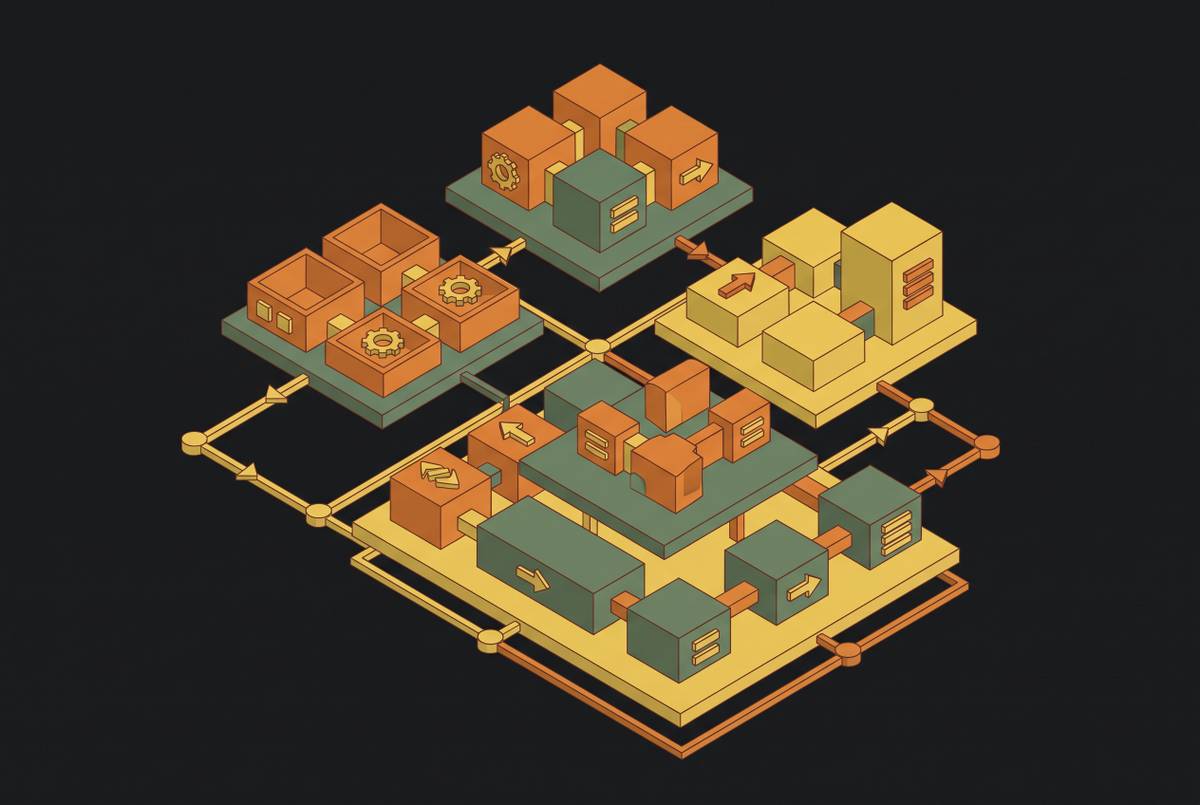
Sharper models or bigger budgets don't distinguish the organizations that get durable operational value out of AI. They're distinguished by sequencing. They pick a specific, painful process, audit how it actually runs on the ground, rebuild it with AI at the center rather than tacked onto the edge, and measure adoption before they ever measure output.
Dollar Tree is a case in point: it replaced a fragmented, manual procurement process with a procurement orchestration platform, Zip. Sequencing separates that outcome from a failed rollout. The process got rebuilt first, and the AI was centered inside it. McKinsey's research backs this up at a broader scale: high performers are twice as likely as others to report that senior leaders are visibly committed to AI initiatives and that the organization has defined processes in place to measure impact. The direction of causation matters here. Commitment and measurement frameworks are what make process redesign possible in the first place, not a substitute for doing it. McKinsey's broader research on this point is just as direct: out of 25 attributes tested across organizations of every size, workflow redesign had the largest effect on whether a company saw any EBIT impact from its use of generative AI at all, yet only a small minority of organizations using generative AI report having fundamentally redesigned even some of their workflows around it.
The right place to start is a specific process that's already causing pain, not a platform strategy, not a sweeping transformation roadmap, and not a pilot built mainly to show that the technology can work under favorable conditions. To find that process, look at where the work actually breaks down, not at wherever the organization's internal self-assessment happens to point. When the scope is chosen correctly and the process audit is honest about what it finds, a redesigned process with AI agents built into its center, rather than bolted on as a reporting layer, can go live in weeks. Long implementation timelines are usually a signal that the wrong process got picked, or that the organization is still designing against the process it believes it has.