Department-Level AI Transformation Case Patterns
Predictable failure patterns emerge before AI deployments go live.
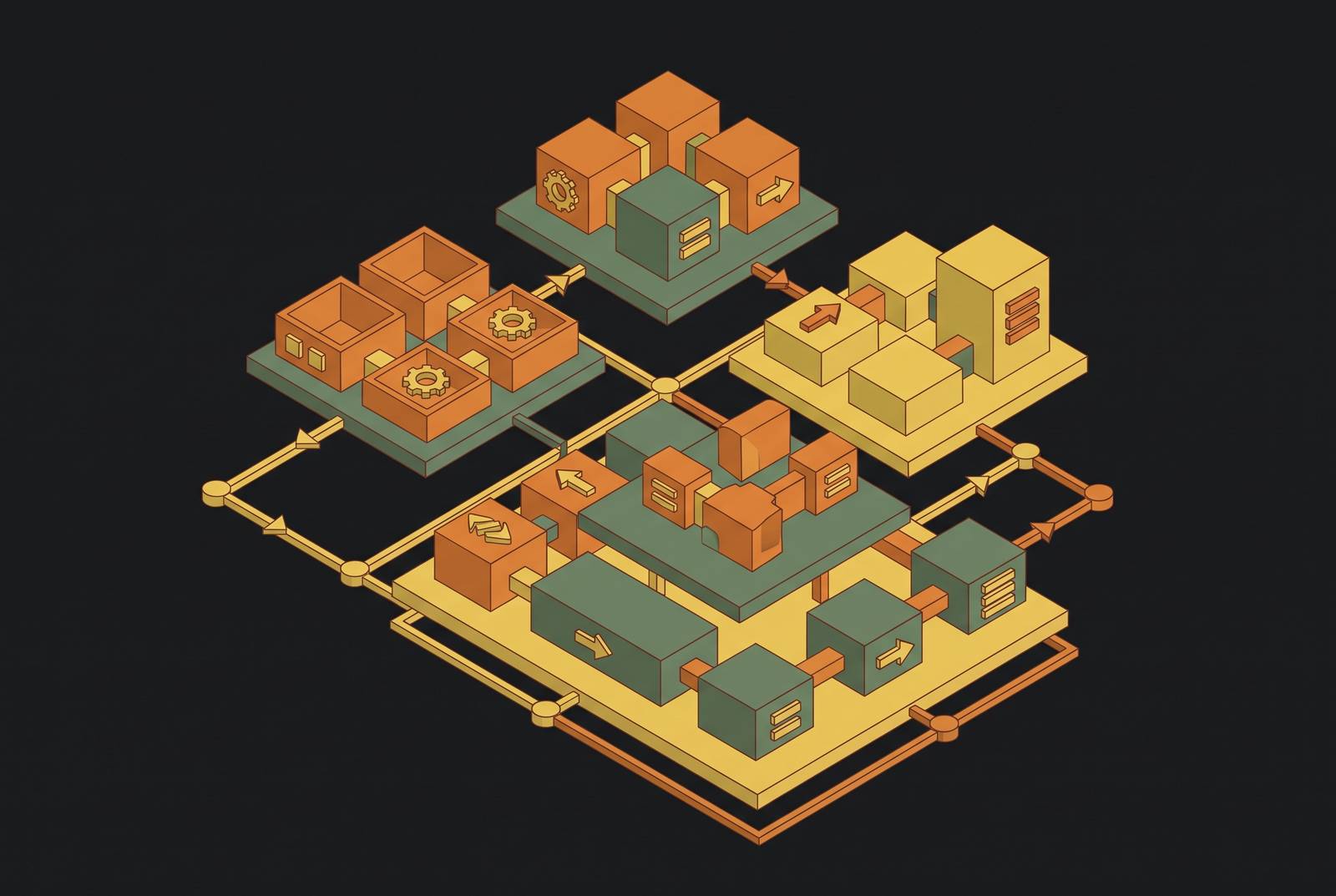
AI transformation outcomes in construction, logistics, manufacturing, and retail are not random. They follow a small number of structural patterns that appear before a project ever goes live. The people running these transformations can diagnose where their own effort will break down before deployment exposes it. IDC research projects that nearly 50% of AI-driven digital use cases will miss their return-on-investment targets, and the three causes it names, unclear business gains, weak human-machine collaboration, and poor data foundations, recur across unrelated sectors and departments. These are not sector-specific accidents but structural causes that repeat because the underlying conditions repeat. A data center energization project and a retail checkout agent look like they have nothing in common, but both tend to fail for the same reason: a process that was already broken before any AI touched it. Mapping these patterns gives operations leaders something a project schedule cannot offer, a way to read their own transformation plan against known failure shapes before committing budget and headcount to it.
Why the failure rarely originates in the AI itself
In the documented cases where an AI transformation underdelivered or was quietly rolled back, the root cause was almost always a broken process that the AI had been asked to run faster, not a limitation in the AI system itself. That distinction changes how every case pattern that follows should be read. The shift happening across these industries is from contained "AI projects," tested in a sandbox and judged on a pilot metric, toward "AI-powered operations," where the AI sits inside a core business process and its failures are the business's failures. Under that shift, the cost of automating a broken process scales directly with how far the AI's reach extends into daily operations. Some will object that more capable models or tighter integrations would have prevented these failures, but the evidence does not support that. Both the retail fulfillment failures at Amazon and the data center energization readiness crisis involved systems that were technically capable; what limited them was the architecture of the process surrounding the system, not the quality of the model running inside it. Every pattern described below should be read through that lens: the AI is the constant, the process around it is the variable, and the variable is what determines the outcome.
Pattern one: AI applied to a fragmented process inherits the fragmentation
When an AI system gets deployed into a workflow where the data it needs sits scattered across disconnected systems and teams, the AI does not dissolve those silos. It reproduces them at higher speed. Construction supply chains show this pattern with unusual clarity: multiple tiers of suppliers, lead times that shift without warning, and global disruptions have made planning accuracy hard to pin down for years, largely because the planning tools in use work off data that goes stale faster than anyone updates it. Pointing an AI tool at that same stale, fragmented data produces a faster wrong answer. Zacua Ventures has traced a productive response to this problem taking hold across the industry: a move away from fragmented point solutions and toward unified operating systems, where a change to a drawing propagates automatically through revised quantities, procurement actions, and field execution plans without anyone re-entering data by hand. The implication runs in one direction only: the data layer has to be unified before AI can compound the value of a process, because unification is what keeps fragmentation from being the thing that gets amplified.
The data center energization crisis shows this same pattern operating at industrial scale. Procurement teams ordered equipment on schedules calibrated to a previous era of grid timelines. Scheduling teams built plans assuming utility interconnection timelines that no longer existed. No single function owned the cross-departmental dependency mapping that would have caught the collision between those two sets of assumptions before it became a crisis. An AI scheduling tool deployed into that structure would not have caught the error either, because it would have optimized around the same false assumptions the humans were already working from. This case gets its full treatment later, in the context of declared plans diverging from field evidence, but it belongs here first as the clearest illustration of what fragmentation does to an AI deployment: it does not get fixed, it gets scaled. The diagnostic signal for an operations leader is simple to check for. If a department's data lives in more than two systems that do not share state in real time, deploying AI into that department will make the fragmentation visible. It will not fix it.
Pattern two: the process audit that AI makes possible, and that most teams skip
The transformations that produce results lasting beyond the first quarter almost always share one prior step: a process audit that identifies where the workflow actually breaks, as opposed to where the org chart claims decisions get made. Kroger's experience with this is instructive. After launching a new application, the company deployed Dynatrace's AI-powered observability tooling and watched support tickets fall from roughly 700 per week to seven within a single month. The AI's first job in that deployment was not to fix anything. It was to find, with precision, exactly where the workflow was breaking, and that diagnostic function had to run before any redesign could begin.
Construction sites are running a parallel version of the same move with AI vision systems that autonomously track completed work, compare it against the planned schedule, and issue deviation alerts at the end of each day. The function being performed is identical to what Dynatrace did for Kroger: making the gap between the declared state of a project and its actual state visible, as a precondition for any intervention that follows. Most teams skip this step, and the reason is not technical. Running a genuine process audit means showing the AI, and the implementation partner standing behind it, how a process runs today, including the parts that do not work. That means exposing dysfunction a team has already learned to live with and normalize. Skipping the audit avoids that exposure. It also removes the only mechanism that would have told the team where the AI was about to be deployed into a problem.
Pattern three: declared plans and field evidence diverge, and AI deployments built on declared plans fail
AI systems calibrated to a project's declared schedule, rather than to what is actually happening on the ground, produce recommendations that sound precise and are wrong. They carry forward the optimism built into the plan, leaving out the friction present at the site. The data center energization crisis is the clearest large-scale example of this divergence. The real bottlenecks in that buildout are transformers, switchgear, and batteries, not compute and not capital. Power transformers carry lead times running past 160 weeks, and generator step-up units require similarly long lead times past 160 weeks. A scheduling team that built its Gantt chart without first securing ownership of those lead times was working from a plan that had no actual path to the physical site, no matter how clean the schedule looked on paper.
Logistics offers the useful contrast. Whether the system was built to read the plan or built to read the field, not the sophistication of the AI involved, is what separates these two cases. The diagnostic signal here is one any operations leader can apply directly to a deployment under review: check whether the AI's recommendations would change materially between the plan version of the data and the field version of the same data. If they would, the deployment is built on a declared plan, and it will fail the moment field conditions depart from that plan, which they reliably do.
Pattern four: governance gaps appear after deployment, not before, and they end transformations
Organizations that deploy AI agents without redesigning the oversight and escalation processes around those agents create a new category of operational risk, and that risk stays invisible until the agent acts on a bad input or hits an edge case the original process design never anticipated. A Kore.ai survey found that 72% of enterprises say their AI agents operate with unmanaged risk, including financial and compliance exposure, a figure that should be read less as a statement about AI safety and more as a statement about process design left unfinished. The Microsoft AI Red Team's taxonomy, built in April 2026, introduced new failure mode categories including Agentic Supply Chain Compromise and Goal Hijacking. These categories exist only because agents now sit inside critical operational workflows making consequential decisions, rather than sitting outside those workflows generating reports a human reviews later.
The pattern common to failures in this category is consistent: governance gets treated as something to add once the system is running, rather than as a process-design question that has to be answered before deployment starts. The question that has to be settled in advance is concrete: at what point does the agent stop and hand a decision to a human, and which human is that. Big 5 Sporting Goods' deployment with Aisera shows the alternative is achievable. The company's AI system reached 64% auto-resolution of employee requests and produced an 85% increase in customer satisfaction, alongside 24,000 user hours saved annually, which demonstrates that high autonomy and strong outcomes can coexist. They coexist only when the process defines the agent's decision boundaries clearly enough that a high auto-resolution rate means decisions made well within those boundaries, not decisions made without anyone checking. Governance, read this way, is a symptom of the same root problem running through every pattern here: AI deployed into a process that was never fully designed around it.
Pattern five: compounding happens at the data layer, not at the tool layer
The organizations whose AI transformations keep compounding year over year redesigned the data layer underneath their operations so that different AI capabilities share state and feed each other, rather than simply buying the most capable individual tool on the market. Zacua Ventures' platformization framing applies directly here. In a unified operating system, a design change propagates automatically through revised quantities, procurement actions, and field execution plans without a person retyping anything in between. The compounding effect in that kind of system is structural. It is built into the architecture of the data itself, not assembled afterward by wiring point solutions together with custom integrations.
Retail provides two clean illustrations of the same principle from the demand side of the business. Brooks Running saw a 260% lift in click-through rates on paid search, a result reported in Amperity's customer data platform case materials. APMEX doubled its conversion rate using Dynamic Yield's personalization platform. In both cases, the lift traces to a differentiated data layer, the platform's ability to act on unified, live customer and inventory data, not to some uniquely advanced AI model unavailable to competitors. The AI involved is the same class of capability any competitor could license. What separates these results from a flat deployment is whether the surrounding systems already shared state in real time before the AI arrived. Operations leaders should ask this before any purchase decision: not which AI tool to buy, but whether the organization's systems already share state in real time, and whether an action taken in one system propagates automatically to the others without a human re-entering it somewhere downstream. Where the answer is no, buying a better tool will not produce compounding. It will produce a faster version of the same disconnected process.
How to read these patterns as a pre-deployment diagnostic
These five patterns were not built as a post-mortem exercise for explaining past failures. Read together, they form a checklist operations leaders can run against a transformation plan before a single system goes live, surfacing exactly where that plan is likely to break down while there is still time to redesign around it. The first pattern, fragmentation, asks a direct question: does the data this AI will act on live in systems that share state in real time, or will the agent be working from yesterday's export pulled into a spreadsheet. The second pattern, the process audit, asks whether anyone has actually walked the process end to end and mapped where it breaks in practice, as distinct from where the org chart insists decisions get made.
The third pattern asks whether the AI's recommendations are built on the declared plan or on field evidence, and whether anyone has checked what happens when those two diverge. The fourth asks whether the boundaries of agent autonomy, and the human escalation path behind them, were designed before deployment or left for later. The fifth asks whether the data layer that the deployment depends on was built to let systems feed each other, or whether the organization is purchasing a capable tool to drop into an environment that was never designed to let it compound. None of these questions require predicting the future. Every one of them can be answered today, against a transformation plan still on paper, by anyone willing to look closely enough at the process the AI is about to inherit.