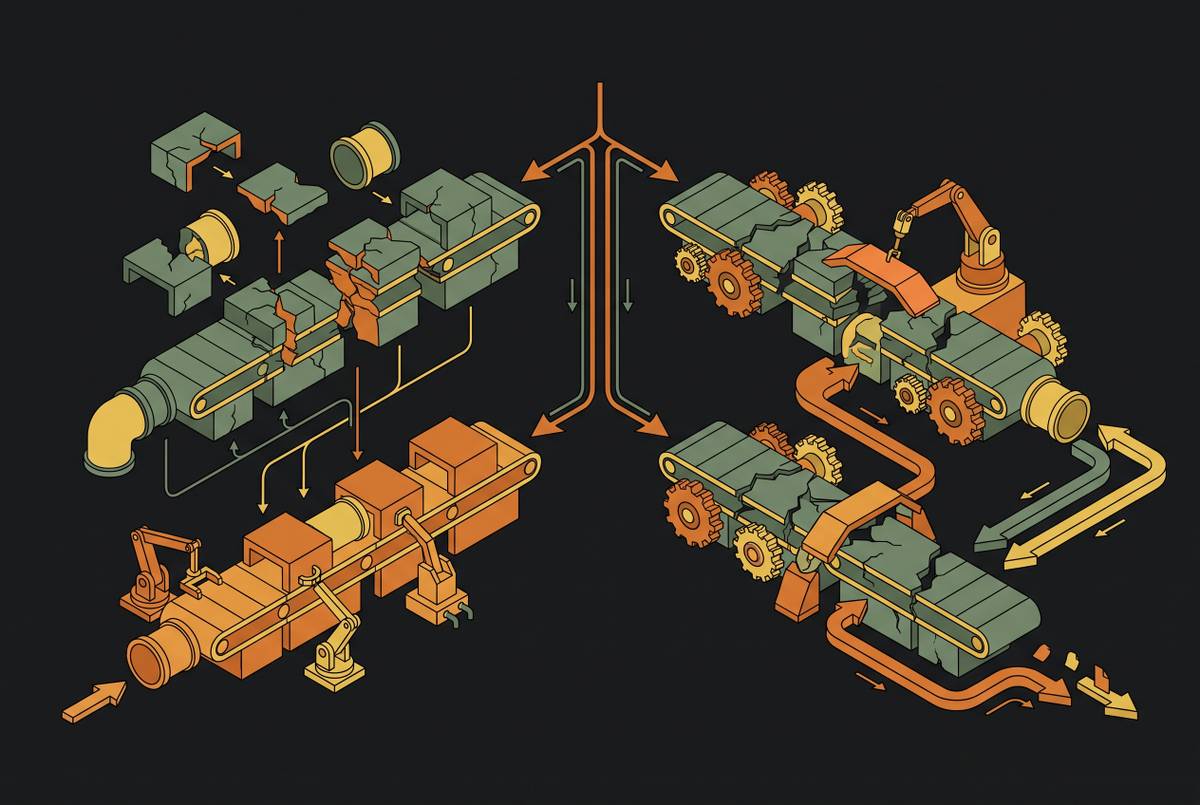
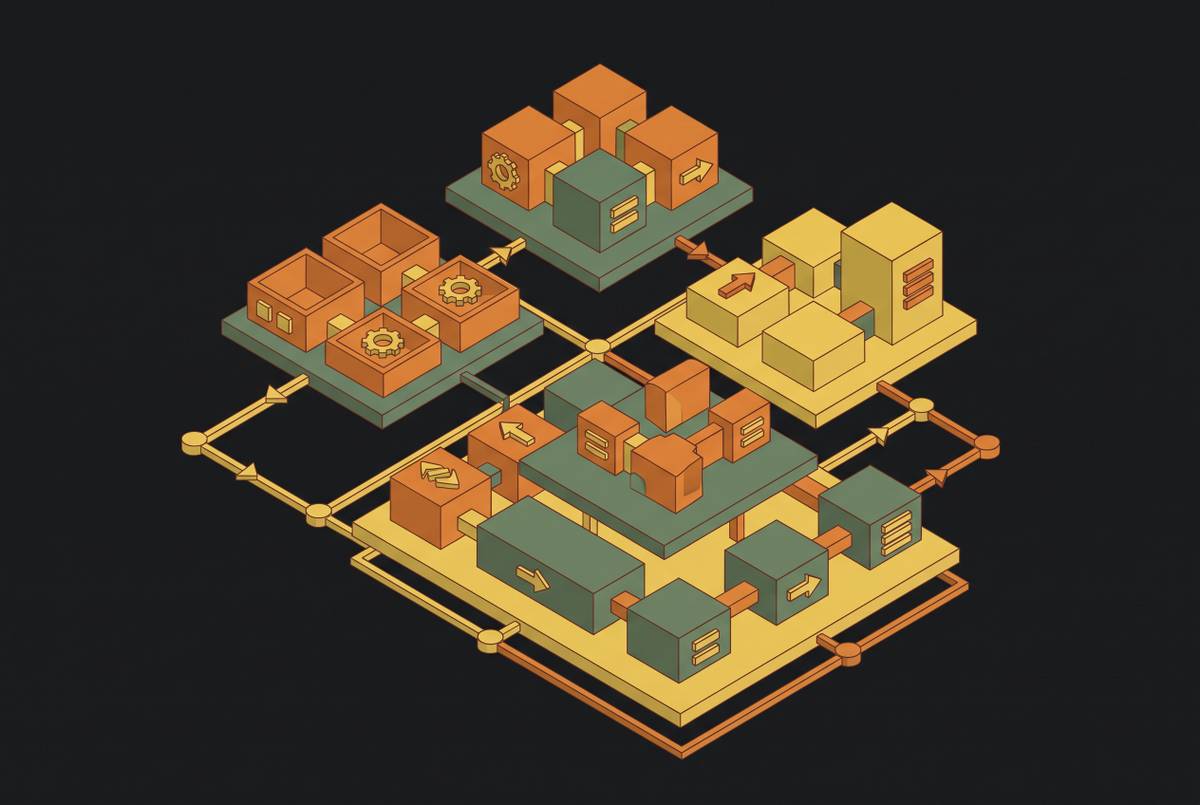
Process Redesign in Asset-Heavy Industries vs. Software Sectors
Asset-heavy industries need to redesign around physical constraints, not documented workflows.
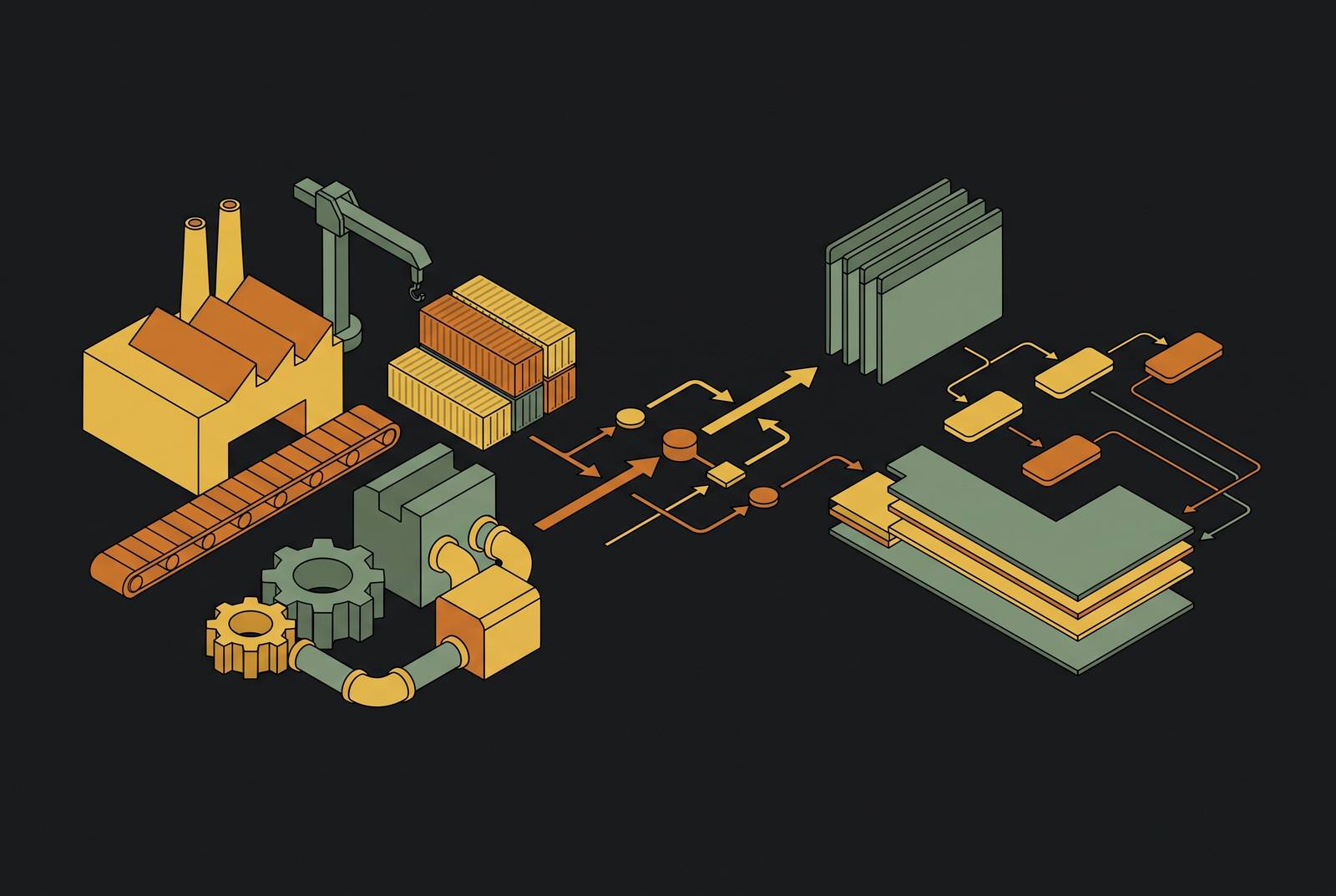
Process redesign in construction, manufacturing, and logistics keeps borrowing a playbook built for a different kind of system, and that borrowing causes a specific, traceable kind of failure. Factories that simply plugged electric motors into steam-era layouts in the early twentieth century saw almost no productivity gain from the new technology. Gains only appeared once manufacturers tore apart the physical layout of the plant itself and rebuilt it around what electric power actually made possible: smaller, distributed motors instead of one central drive shaft, machines arranged by workflow instead of by proximity to a belt. The same trap is open again now, with AI standing in for electricity.
In software, redesign is mostly a logic problem. Workflows live in code and data, constraints bend easily, and a change made this morning can be live in production by this afternoon. Symbols move at the speed of deployment, which is what makes fast iteration credible in software and is why a six-week sprint cycle or a quarterly transformation roadmap makes sense there.
Construction, manufacturing, and logistics do not work that way. A transformer with a multi-year lead time does not ship faster because the project team adopts better scheduling software. A commissioning crew booked three states away cannot be reassigned by a dashboard. A site without enough grid capacity does not energize on schedule no matter how confident the project schedule looks. Foundry Management & Technology put it directly in an October 2026 piece on manufacturing: a plant is not a spreadsheet. It involves different machines with their own quirks, operators with varying experience levels, maintenance histories that don't fit a clean model, supplier delays, strict quality thresholds, safety regulations, and customer commitments that a generic model simply cannot take in. The constraint in these industries sits in steel, labor, and physics, and no amount of software logic rewrites any of those three.
What "the physical world is the system" means for where redesign must start
If the physical world is the system, then the most dangerous gap in asset-heavy operations is between what the schedule says is happening and what is actually happening on site, on the line, or in the yard. Redesign that starts from the declared plan, the org chart, or the documented process map is redesigning a story the organization tells itself, not the operation it runs.
Audits across industries find that organizations can produce the policy, the procedure document, the training record, but struggle to produce evidence that any of it happened as written, a pattern this shows up constantly in process compliance work. Tasks go unassigned in practice even though they're assigned on paper. Controls go unverified even though a checklist says they were checked. Evidence sits scattered across inboxes, spreadsheets, and someone's memory, because the policy was never actually wired into the work itself. A nonprofit homebuilder coordinating volunteer labor and donated materials faces a milder version of the same problem that a large industrial contractor faces at scale: the build schedule on the wall and the build schedule happening in the field tend to diverge, and nobody notices the size of that gap until a delivery date slips.
That is why redesign in these industries has to start with a specific, painful process examined as it actually runs, not as someone wrote it down two years ago. This distinction between workflow and physical constraint is why most enterprise AI deployments in construction and logistics fail: they automate the declared process rather than rebuilding around what the physical world actually allows. Firms like Terminal Use start by auditing the real process, not the documented one, to find where the hard constraints actually sit before any redesign or AI agent deployment begins. The audit is the only way to find out what the real work is.
Procurement as the constraint that no workflow redesign can outrun
Once the audit is underway, the single most consequential physical constraint it tends to surface sits in procurement. The schedule problem that sinks most asset-heavy projects is rarely a coordination failure between teams. It is the gap between when a piece of equipment needed to be ordered and when the organization actually got around to ordering it.
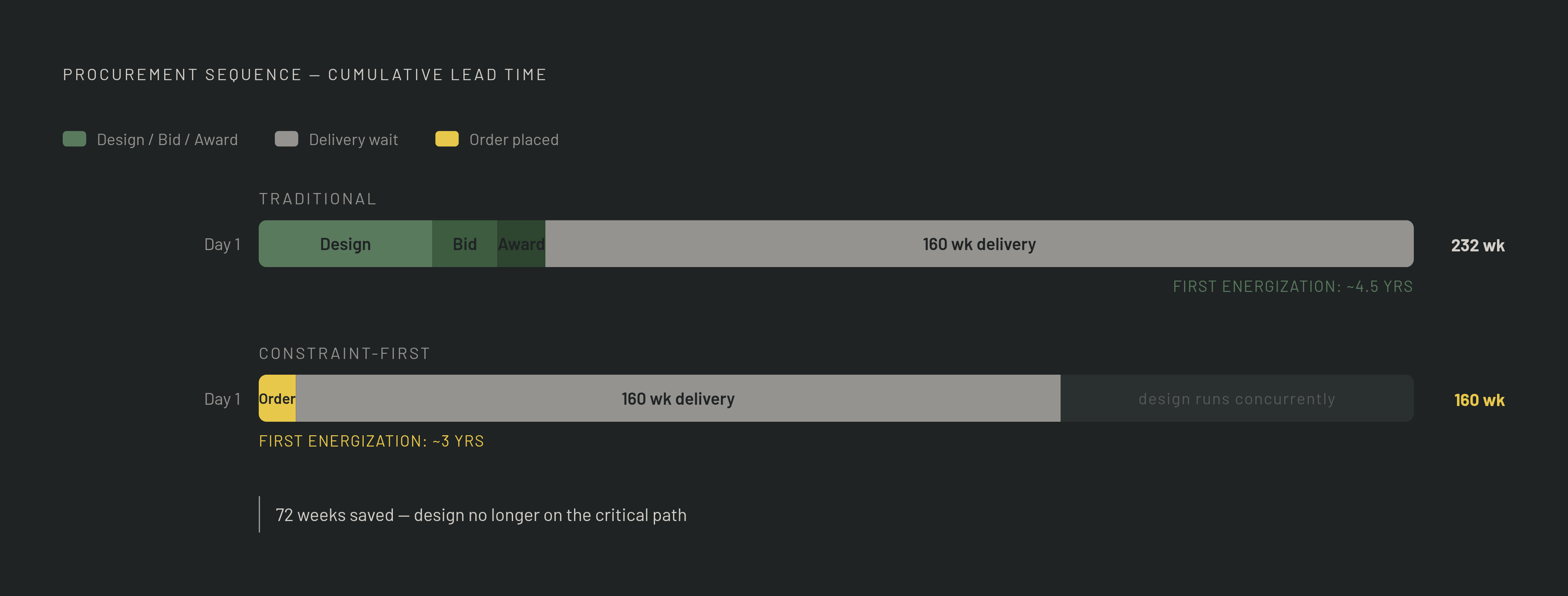
The substation transformer is the clearest example running right now. GRAA Inc.'s 2026 procurement analysis puts lead times at 160 weeks, up from roughly 140 weeks in 2023. That is just over three years from order to delivery, and climbing. No capital injection fixes that. No process improvement recovers a procurement decision made three months too late. The project does not speed up. It waits, for however long the gap between "should have ordered" and "actually ordered" turns out to be, and that gap compounds against a 160-week baseline that was already brutal before the delay.
The sequence most organizations still follow makes this worse by construction, not by accident: complete the design, competitively bid the equipment, award the contract, then wait for delivery. That sequence adds the full design timeline on top of the full procurement timeline. In a transformer market quoting 160 weeks, that traditional sequence pushes first energization years out from the day the project was conceived, before a single piece of equipment has even arrived on site.
The field-vs-declared-plan gap is the core diagnostic insight here: organizations write schedules and procurement plans that bear little resemblance to how equipment actually gets ordered and delivered, and that mismatch becomes the input for any automation or redesign layered on top of it later. Any process redesign in construction or manufacturing that does not begin by mapping procurement lead times against delivery commitments is redesigning the wrong end of the problem, and layering AI automation onto a misaligned process only makes the original failure happen faster. Redesign has to start by locating where the physical constraint actually originates, then work the entire sequence backward from that point. Even a project that gets procurement exactly right, ordering the transformer on day one instead of after design completion, still runs into one more physical wall before it generates a dollar of revenue.
Commissioning and energization as the last-mile constraint that procurement alone cannot solve
That wall sits at commissioning and energization. A project can clear permitting, receive its equipment on time, and finish construction on schedule, and still sit unpowered for months because the specialized crews who test and certify electrical systems before energization are booked on someone else's job. Crew availability is a constraint that almost no scheduling tool tracks explicitly, which means it stays invisible right up until it becomes the thing holding the whole project hostage.
Environment + Energy Leader documented this pattern, citing reporting from London Construction Magazine on the city's substation backlog: multiple London commercial developments reached full construction completion only to face grid energization timelines stretching years beyond their original handover targets, driven by substation capacity backlog and grid infrastructure shortages rather than anything happening on the construction site itself.
Manufacturing runs into the same wall earlier, at the site-selection stage. ARCO National's 2026 industrial and manufacturing outlook reports that power and utility infrastructure have become the main factor in site viability and project scheduling. Utility capacity is now shaping where a project gets sited, and energization timelines are determining whether a project can meet its operational deadlines. Coordination with utility providers needs to start at concept planning and budgeting, the report notes, not after design development is already locked.
The money at stake is not abstract. Industry analysis puts the cost of commissioning delays on a typical large data center at a substantial monthly sum in lost revenue and related costs for a 60 MW facility, with the majority of that coming from lost lease revenue alone. That figure rivals or exceeds the cost of the entire design phase that preceded it. A schedule that is technically correct about construction completion and silent about the handoff that turns a finished building into a revenue-generating asset has not actually scheduled the project. It has scheduled part of it.
Why AI agents deployed into unredesigned asset-heavy processes fail in a specific way
Faced with procurement delays measured in years and commissioning delays measured in months, the instinct inside many organizations is to reach for AI agents to speed up coordination. That instinct is not wrong on its face, but deploying an agent into a process that was never redesigned produces a specific failure: the agent executes bad coordination faster and with more confidence than a person ever would.
Foundry Management & Technology is direct about where most organizations currently sit: many are simply bolting AI onto legacy workflows to speed up reports or summarize data. That's a reasonable place to start, but it changes nothing about the underlying structure of the process, which means it cannot be the whole plan. The electrification parallel applies again here. Factories that plugged motors into steam-era layouts got noise and heat where they expected productivity. Organizations that plug AI agents into a procurement workflow that still sequences design before ordering get faster execution of a sequence that has already locked in years of delay. Speed applied to the wrong sequence does not produce a better outcome. It produces the wrong outcome sooner.
Fitting a tool to a plant's constraints changes whether a deployment succeeds or quietly wastes money. Foundry Management & Technology specifies that AI customization in manufacturing has to happen strictly within boundaries set by safety, quality, compliance, cybersecurity, and accountability, and that a tool which helps one plant cut scrap might be irrelevant, or even risky, in another. The question of whether a given tool fits a given plant's constraints comes before the question of which tool to deploy, and skipping that ordering is where a lot of enterprise AI spending in manufacturing quietly goes to waste.
AI agents belong inside a process that has already been rebuilt around its physical constraints, not bolted on top of the old one as a faster reporting layer. The inputs an agent reads, the steps it touches, and the physical handoffs it coordinates all need to be rebuilt before the agent goes live, not after.
What redesign requires in construction, manufacturing, and logistics that software transformation does not
Four things distinguish real redesign in asset-heavy industries from the software-sector version, and none of them are optional. The process needs an audit of how it actually runs, not how it is documented. The physical constraints that sit outside the workflow, like lead times, crew availability, and grid capacity, need to be mapped explicitly. The process sequence itself needs to be rebuilt around those constraints before any agent gets deployed. And the whole effort needs to start with one specific, painful process, not a platform strategy meant to cover every department at once.
The audit surfaces what field evidence actually shows, not what the declared schedule claims. Skip it, and a team ends up redesigning based on theory rather than the way work actually happens, and the space between those two versions of reality is exactly where delays, cost overruns, and commissioning failures come from.
Once AI can see patterns and adapt to context inside a plant, the way work gets structured changes on its own, Foundry Management & Technology notes. Maintenance shifts from a fixed calendar to predictive models that respond to how a machine is actually behaving. Quality control shifts from catching defects after they happen to identifying the conditions that precede them. That shift in how work is organized is the redesign. The tool deployment is just the occasion for it.
A European mechanical contractor that specializes in data center construction shows what this looks like when it's done in the right order. By adopting AI-augmented building information modeling and drone-based progress monitoring inside a coordination process that had already been redesigned, rather than layering the tools on top of the old one, the firm improved schedule predictability by a measurable margin and reduced material waste. Logistics operations that rebuild dispatch and routing around actual truck availability and dock constraints, instead of around the schedule someone wrote the week before, tend to see the same kind of result: the tool works because the process underneath it was already built to use it, and that built-to-use-it process is what produces the result.
Why operations leaders in asset-heavy industries should be skeptical of transformation timelines borrowed from software
The real risk in asset-heavy AI transformation is moving confidently on a timeline and a logic built for a different kind of system, because that confidence suppresses the process audit that would have caught the physical constraint before it turned into a delivery crisis.
A schedule that gets every workflow step right and says nothing about equipment lead times, crew availability, or energization sequencing is a declaration of intent with no physical ground underneath it, and asset-heavy industries cannot afford to confuse the two.
Early AI pilots will run into messy data, resistance, and outright failures, but each success along the way builds context, better data habits, and organizational trust that compounds over time, Foundry Management & Technology notes. The organizations that move carefully now, auditing before they automate, are building an advantage that lasts. The ones that move confidently on borrowed assumptions are compounding their exposure instead, and they usually don't find out how much until a transformer is three years late or a finished building sits dark for a year waiting on a substation.
None of this is an argument against AI in construction, manufacturing, or logistics. The argument is against transformation playbooks that have never been tested against the physical constraints of the specific plant, the specific procurement market, and the specific commissioning environment an organization actually operates in. An operations rebuilder's first move is always a process audit, walking the real workflow with the people who run it, to find the gap between what's declared and what's real before deciding what gets rebuilt. The right posture for an operations leader is to show how the process runs today and where it hurts, before deciding what to rebuild. The first rebuilt process should be live in weeks, not quarters. A timeline stretching into quarters is usually evidence that nobody has found the constraint yet.