The Six-Week Process Replacement That Skips Discovery and Ships Live AI to the Job Site
Skip months of planning by automating one bounded process in six weeks.
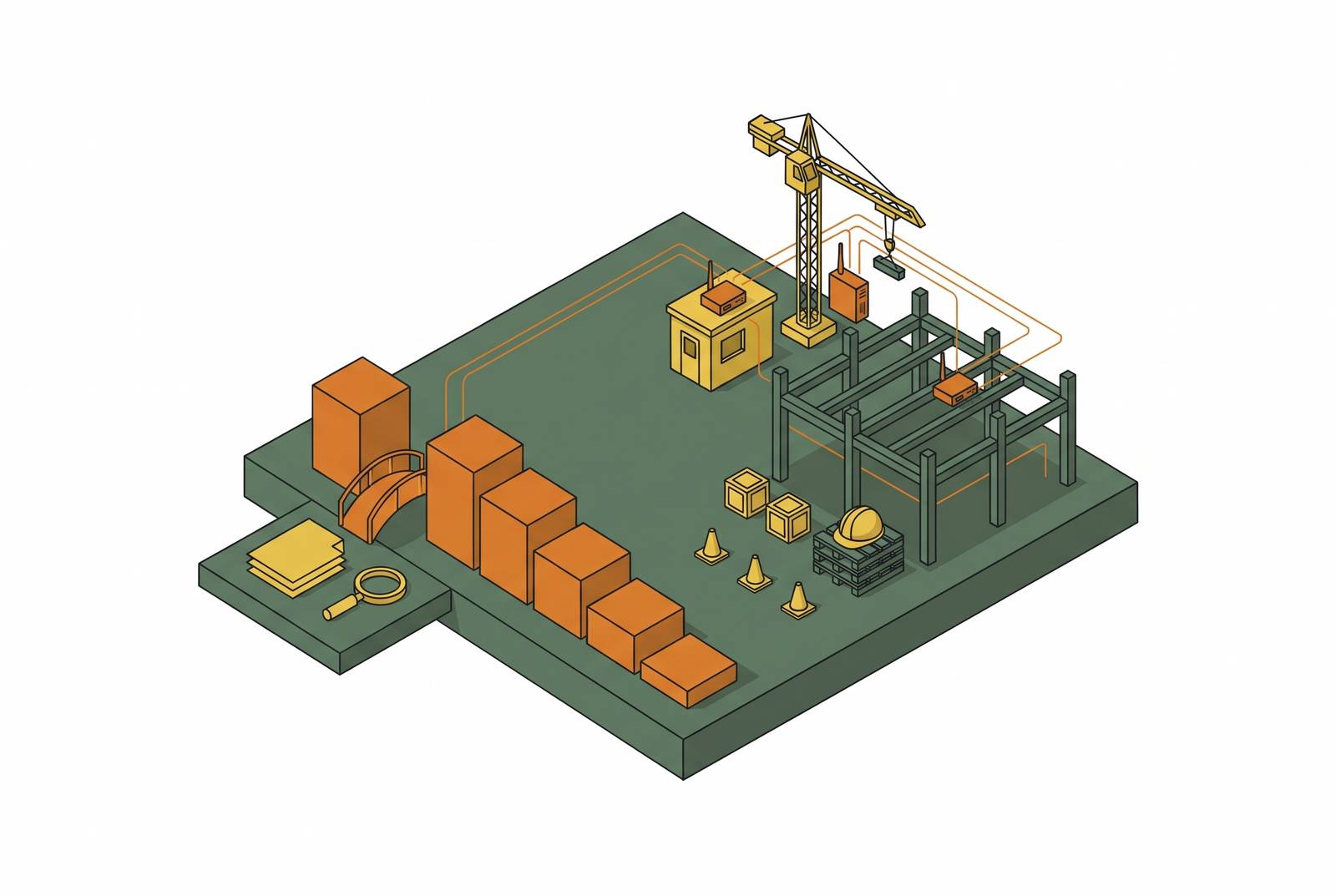
A construction operation can move a tightly bounded administrative workflow from definition to a live AI agent in six weeks when its inputs, outputs and authority limits are clear. The fastest route is process replacement. “Skipping discovery” means settling what to attempt before deployment begins, while retaining the process audit, integration work and human oversight needed to run it responsibly.
Why most AI deployments in construction take months to go anywhere
For a construction PM or operations lead, the pattern is recognisable. A plan to cut reporting work turns into a discussion about the platform strategy, then grows to take in other departments and workflows. Before the original process changes, the team is negotiating an enterprise transformation roadmap. A quick project has become a programme. Its dependencies now reach far beyond the person waiting for relief from the paperwork.
Mastt’s 2026 survey found that almost no construction teams were working with agents yet, though interest in AI was more widespread. That gap is between general-purpose assistance and an agent that runs a defined operational workflow. The deployment approach helps explain the distance. When AI is treated as a category to buy rather than a process to improve, implementation inherits the coordination burden of the business. Even when the technology is ready, the organisation can keep reopening the decision about scope.
What “skipping discovery” actually means — and what it does not
Traditional enterprise AI discovery often asks which workflows belong in scope, what the platform strategy should be and which department should go first. Those questions produce a roadmap before any process is touched. The six-week approach starts after that choice. One process and one pain point have already been selected, so the engagement begins with workflow mapping.
Process understanding remains essential to the work. The team still needs to know where information originates, how people handle it and what happens when it is incomplete. Preliminary selection must expose obvious complexity before commitment, while the week-one audit confirms whether the candidate qualifies. If that audit disqualifies the process, the six-week promise does not override the finding.
Which processes are genuinely compressible to a six-week track
The first qualifying characteristic is an administrative or document-handling core. Turning rough notes into finished documents, drafting compliance paperwork from descriptions, summarising long documents and comparing structured information all have identifiable inputs and outputs. They are language tasks with bounded results. A process that depends instead on physical coordination or open-ended site judgment has a different constraint. Calling it a reporting workflow does not make that constraint disappear.
The second characteristic is clean, structured input that an agent can read without extra work to transform it. Relevant prerequisites include standard cost codes, a single master schedule, clean RFI and submittal timestamps, and change events tied to the work breakdown structure. Where those records are inconsistent, deployment includes reconciliation work before dependable automation is possible. Clean inputs remove that obstacle, although they do not remove the need to review outputs.
The third characteristic is a defined authority boundary. An agent that drafts, flags or routes information operates within a more tractable envelope than one expected to exercise unrestricted judgment. That boundary sets what the team must build and what a human needs to approve. Without it, a seemingly small document task can conceal an unresolved decision about who is accountable. The scope must describe permitted actions and the desired result.
The fourth characteristic is acute, measurable pain. A GCC main contractor had a weekly reporting task with a clear part for an agent to take over. The contractor spent four to five hours every Sunday manually consolidating reports from seven active sites. The burden was visible and the output defined. Hidden complexity can still exist in such a task. Selection therefore needs an early audit.
What the six-week track looks like week by week
Week one establishes how the selected process actually runs. The team walks every step, handoff, data source and pain point. Scope is confirmed or the candidate is disqualified. The output is a workflow map that identifies inputs, outputs, decision points and current failure modes precisely enough to build from. This is not a search for something to automate, but an examination of a process already chosen.
Weeks two and three turn that map into a redesigned workflow and an agent specification. Steps that existed only because someone was moving or assembling information manually can be removed. Automating them unchanged would preserve the old burden. The specification therefore sets out what the agent drafts, flags, routes or decides, what it escalates and what requires human sign-off. It also defines the data sources to read, the systems to write to and the required audit trail.
Weeks three and four translate those decisions into the build and its integrations. The overlap follows the work, as defined parts of the specification become ready to implement. Data connections are established against the redesigned workflow. The authority envelope is enforced technically. With AI scheduling, systems connect to daily logs, progress photos and workforce check-ins so they can update schedules as field data arrives.
Week five moves the agent into a controlled live test on a real project. A human reviews every output during this period. The purpose is to expose edge cases in the operating environment, where information is less consistent and time pressure is greater than in staging. A successful test environment cannot answer all of those questions. Live testing puts the workflow in contact with the conditions it will actually face before any move to less-supervised operation.
Week six transfers ownership to the team running the process. Runbooks explain how to handle unexpected outputs, the escalation path is defined and the audit trail is accessible. The deliverable is a live agent with an operating model, with iteration continuing after the process is running.
What the agent is replacing on the job site and why that matters for adoption
The agent takes over the administrative work that comes with leading a site. It includes transcribing calls, generating meeting summaries, drafting daily reports from field data, syncing information between PM tools and sending follow-up summaries. These tasks take up the site leader’s attention without being what the leader brings to the job. Removing paperwork is a different proposition from claiming to replace the judgment of the person responsible for the site.
The GCC reporting example makes the human consequence concrete. The project director reported reading the reports properly for the first time because he was no longer exhausted from building them. Responsibility had not moved away from the director. The change was in the attention available for exercising it. A reporting agent can therefore improve the conditions for human judgment without taking over the judgment itself.
The agent leaves crew coordination, real-time site decisions, safety calls and subcontractor relationships to people. They depend on the physical and relational intelligence of experienced field leaders. CDM 2015 places duties with named dutyholders who can be held accountable, and an AI cannot be a competent person. Whatever the agent drafts in that context, a human signs.
Adoption becomes easier when that division is explicit. The field-side conversation can shift from concern about replacement to a practical question about when burdensome administration can stop. The performance incentive is equally concrete. By capturing calls, generating daily reports and surfacing schedule risks, an AI-assisted superintendent has better records to draw on when running the project.
The conditions that can break a six-week track and how to read them before starting
The first warning is a process that is really a symptom of failed coordination. A document may appear to be the output, but its production depends on someone repeatedly chasing, interpreting or reconciling missing information. That is a different replacement problem. If the information still does not arrive cleanly, the chasing returns to a human after deployment. The diagnostic is whether the current effort goes into producing the document or making its inputs usable.
A second warning is fragmentation between cost, commitments, progress and change control. Records can look orderly within separate tools while disagreeing across the workflow. An agent cannot resolve that contradiction merely by reading faster. Mastt’s survey identified trust in AI accuracy as the biggest adoption barrier, which makes input consistency especially consequential. Where the data architecture cannot support a dependable output, the short track includes an unresolved prerequisite.
A third warning is permission without a clear authority boundary. If the agent can write to a system of record but no one has defined which actions require human review, the missing decision concerns governance. IT oversight cannot be an afterthought here. Agentic systems that run without it put compliance and security at risk. The readable sign is a specification that describes what the agent can access but leaves what it may do unsettled.
A fourth warning is scope that crosses incompatible operating environments. One report can depend on several departments or sites that use different data standards, so there is much more to connect than the output suggests. A narrow name can conceal broad dependencies. The appropriate response is to re-scope to one site or one team’s data environment before committing to the track, rather than assuming more time will make the operating environments compatible.
These conditions belong in the initial qualification and the week-one audit. An audit that identifies more than one of these conditions is a signal to re-scope or re-select. AI cost forecasting, for example, can help teams make decisions earlier, but only when accurate information reaches the workflow in time to support them.
How do you choose the first job site process for a six-week AI deployment?
The practical starting move is to ask the people doing the work which recurring task consumes the most time while producing the least value for the project. Asking where AI could add the most value instead invites the broad scope debate back into the room. A task that fits has pain that comes up often, structured inputs and an output that people already know how to define.
In construction, candidates include RFI response drafting, daily report compilation, submittal log tracking, schedule risk flag generation and cost forecast updates from procurement data. An RFI drafting task still needs records it can use and a clear sign-off boundary, while a forecast update needs procurement inputs that agree.
Once a candidate is selected, have the people responsible demonstrate exactly how it runs today. The audit should reveal where it slows, which information arrives late or inconsistently and what people do when that happens. The actual work is the evidence. If it clears the administrative-work, clean-input, bounded-authority and measurable-pain filter, the six-week track is a suitable frame. If it does not, the audit identifies what needs fixing before the commitment is made.
For an uncertain operations leader, the first task with a persistent burden and structured data behind it is a concrete place to begin. Selection then has something firmer than enthusiasm behind it. When the first process runs well, it gives the team evidence for the second about how good the inputs are, what needs review and who should own the work. That evidence accumulates faster than a roadmap can predict, because it comes from work already running on the job site.