How Departments Sequence a Ground-Up AI Workflow Rebuild Without a Rollback Plan
Sequencing and handoff design must replace rollback as your risk control when rebuilding workflows.
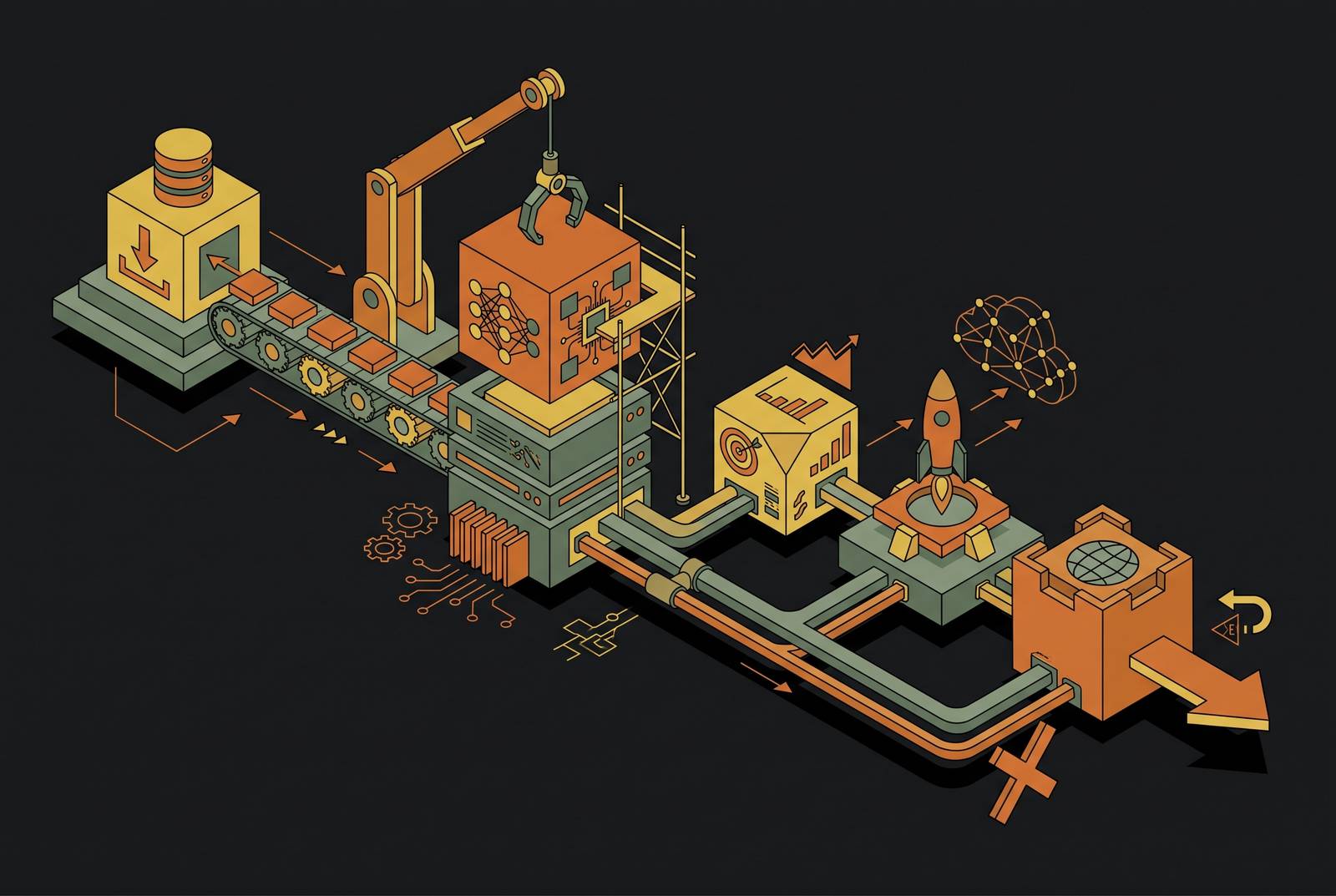
Rebuilding department workflows with AI agents from scratch, without a rollback plan, makes sequencing the primary risk management tool. A department must begin with a contained process, define its handoffs before changing adjacent processes, and expand only after live outcomes show that the rebuilt workflow holds. Human intervention remains available, but it must correct or constrain the rebuilt process.
Why removing rollback forces sequencing to become the primary risk tool
A rollback plan lets a department reverse a change after discovering that its replacement cannot sustain operations. The team must limit what can be affected before exposing the next connected process to change. Sequencing therefore governs both the scope of uncertainty and the point at which that uncertainty reaches other teams. Technology choice alone cannot provide that control.
The common alternative is to add AI to an existing workflow while preserving the old procedure as a fallback. That approach has a structural weakness when the old process is already broken. People may be its integration layer, reconciling inconsistent records, moving information between systems, and deciding what incomplete instructions mean. Their workarounds make the workflow function, so removing those people from individual steps without replacing their contribution leaves dependencies invisible.
A ground-up rebuild must make those dependencies explicit before changing how work moves. This requires process auditing to locate the gaps, a tight first-process scope to contain their effects, and handoff design to control what crosses each boundary. The audit establishes what can safely be isolated, while the handoff design establishes what must remain stable around it. Each phase can then test a bounded change instead of exposing the department to several unresolved changes at once.
What a process audit must find before any rebuild begins
A process audit investigates how the actual workflow differs from the declared one. A private spreadsheet may link two systems that do not share information in a form they can use. A PDF sent by email may require someone to re-enter its contents and restore context that the document does not contain. The final result may be usable only after a weekly reconciliation known only to one analyst. Each is a dependency.
The audit must identify what the person contributes at each such point. Transferring a field is different from deciding which conflicting value to trust. Similarly, checking that a document exists is different from judging whether it proves that work is complete. The distinction determines what the rebuilt process must define. Where a good outcome means only that it looks right to a senior person, the department does not yet have an acceptance criterion an AI agent can follow.
The Kumo playbook requires a named trigger, trusted inputs, a defined completion state, acceptance tests, and a recovery path before rollout. Those conditions make the audit useful for sequencing. A process with clear inputs but an undocumented completion decision is not bounded merely because it sits inside one team. In construction and logistics, spreadsheet exports, version reconciliation, and repeated data entry can be the real workflow beneath the declared one. The audit must follow that work to find the actual scope boundary.
This investigation can feel slow compared with building. Starting without this investigation moves discovery into production, where a missing dependency interrupts work. The audit helps the team tell a sound first process from one that looks simple because people make up for its gaps out of sight.
Which process should a department rebuild first with AI agents?
The first process should be chosen for containment. In a no-rollback rebuild, it is the load-bearing test of whether the audit, handoffs, and acceptance criteria are sufficient to support live work. A good first process affects few downstream teams and few people outside the department, so the team can learn without changing how the whole department works.
Containment also requires inputs in a defined format from a single source. That makes a data quality problem easier to locate than when several sources and undocumented transformations feed the same result. Completion must be objectively checkable by any operator, rather than dependent on a senior person's impression. Too little work provides weak evidence, while too much can propagate a systematic error before the team catches it.
Scope must remain narrow in more than name. Expanding users, data, integrations, and action authority simultaneously makes a problem difficult to diagnose, even when the process itself appears small. The first process should leave only one of these variables open at a time. That constraint gives the team a clearer relationship between a change and its effect. It also makes the evidence from the first phase more useful when deciding what to expand.
Interest from executives can steer the team toward a process that gets more attention. Yet a contained process that holds provides a sounder basis for continued investment than a high-profile process that prompts an impossible demand to revert. Energization and commissioning readiness in construction, and final-mile coordination in logistics, are poor places to start. These handoffs require several dependencies to converge, including schedule information, procurement confirmation, and inspection sign-offs. Their operational importance does not make them suitable first tests.
How handoff design must be completed before adjacent processes are touched
A technically successful process can worsen operations at its boundary. Automating the producing side can increase output volume while changing its format and timing. If the receiving team has no corresponding change in capacity or procedure, the gain becomes unplanned work for someone else. A screening workflow that triples candidate throughput, for example, does not improve hiring when interviewers were already at capacity.
Rebuilding schedule updates without addressing how field progress data enters the system allows the scheduler to publish faster without improving the underlying information. Receiving teams must then contend with both the pace of change and output that remains flawed. Faster production has increased the burden at the join.
For that reason, handoff design must gate the next deployment. The output needs a format contract specifying its fields, its confidence indication, and the treatment of uncertain cases. The receiving team must also know which items received human review. Without that distinction, it may treat everything as equally checked or equally suspect. Either response undermines how people and AI are meant to share the work.
The join needs one named owner. Before go-live, the department must estimate the change in downstream volume and timing, then either stage the increase or include added receiving capacity in the project scope. Before the second deployment, the team must map every point where the output of one department becomes the input of another. This requires agreeing on what each receiving process can accept before changing what reaches it.
How to define human-AI checkpoints that hold without a rollback option
Without rollback, a human checkpoint must be a decision point supported by observable evidence. When approval is just a formality, behavioral drift can go unnoticed until it compounds. The operator needs to judge whether the work the AI proposes or has done meets the process's acceptance criteria and whether the AI stays within the permitted scope. Human authority must be exercisable inside the rebuilt workflow. It cannot depend on the continued availability of the old one.
The Kumo playbook identifies three starting modes, namely shadow mode, review-only use, and constrained action. It requires evidence before a move between modes, with no assumption that every process should move toward greater autonomy. Constrained action permits activity only within an explicitly bounded scope, with permissions assigned per action. Review-only use may be the correct permanent design. Judgment, accountability, or regulation may require a person to retain the decision.
Override rates are one sign of how people act within that design. A target range should reflect a checkpoint where people weigh what they see. The rate needs interpretation against completed outcomes and documented corrections. Otherwise, people may seem to agree with AI even when it is unclear whether the checkpoint helps. The evidence must show how human judgment affects the process.
Rollback takes the department back to the old workflow, while pause or constraint stops or limits what the AI does within the rebuilt structure. A named person must be able to pause actions, reduce permissions, bring back a prior procedure within that structure, and keep records without waiting for a software release. These are forward-only recovery controls. They preserve operational authority without reviving the broken workflow the department committed to replace.
How operational continuity is maintained through each phase as the rebuild expands
Expansion becomes risky when changes propagate across connected processes faster than the team can detect their effects. The second process should therefore remain out of production until the first has produced stable, observable outcomes across enough cases to establish normal behavior. That baseline gives later changes a point of comparison. Without it, a problem appearing during expansion may be new or inherited, and the team has no reliable way to distinguish the two.
The playbook calls for verified eligible cases and completed outcomes, with correction work and overrides documented. Logins and output volume are not substitutes. A process may appear productive while people quietly repair its results, recreating the hidden integration layer the audit was meant to expose. A phase has not demonstrated that it holds if its reported performance excludes the effort required to make its output usable.
Recovery also has to work under operating conditions. The recovery path must have been exercised on real cases. Under a no-rollback commitment, that means demonstrating the pause, constraint, and recovery procedures available within the rebuilt process. The next phase should not depend on an untested intervention. Continuity rests on knowing how the current structure handles a problem.
As narrowly scoped agents accumulate, shared governance becomes necessary to prevent a new set of undocumented dependencies. The disciplines applied to the first process do not automatically transfer to the next one. Each addition also consumes the capacity of the small team able to build and support it. Sequencing by which department asks loudest can leave a department committing budget and then waiting a quarter. The department should expand when evidence from live work and the capacity to support it show that a phase can bear its load, even if pressure to move on comes sooner.
What the disciplines required for a no-rollback rebuild actually produce
A department rebuilt on these terms has a different operating structure from one that adds AI while keeping its old process running underneath. Its workflow is machine-readable in an operational sense. An agent can follow named triggers, trusted inputs, completion conditions, and acceptance tests without relying on people to bridge undefined steps. Human judgment remains where the design requires it. It is no longer the hidden means by which an incomplete process becomes usable.
That distinction changes what happens between teams as well. An output arrives under an agreed contract covering format, volume, timing, and uncertainty, rather than an informal understanding that the receiver will make it work. The department can tell which work is done and which work still needs someone to judge or correct it. Control also resides in the current process. A person can step in through defined checkpoints without having to rely on an old procedure that still works.
The objection that this rigor slows deployment confuses installing a tool with rebuilding an operation. Auditing and boundary design replace the safety net that rollback would otherwise provide. Their product is not a promise that errors disappear, but a structure in which errors can be detected and addressed without retreat. Routine work reaches a completion state that can be checked, uncertain cases go to someone who is accountable for the decision, and adjacent teams get work they are ready to handle. The department is designed to run correctly, rather than depend on people to repair its gaps after the fact.