When Process Automation Accelerates Defects
Automating a broken process compounds its damage before anyone can fix it.
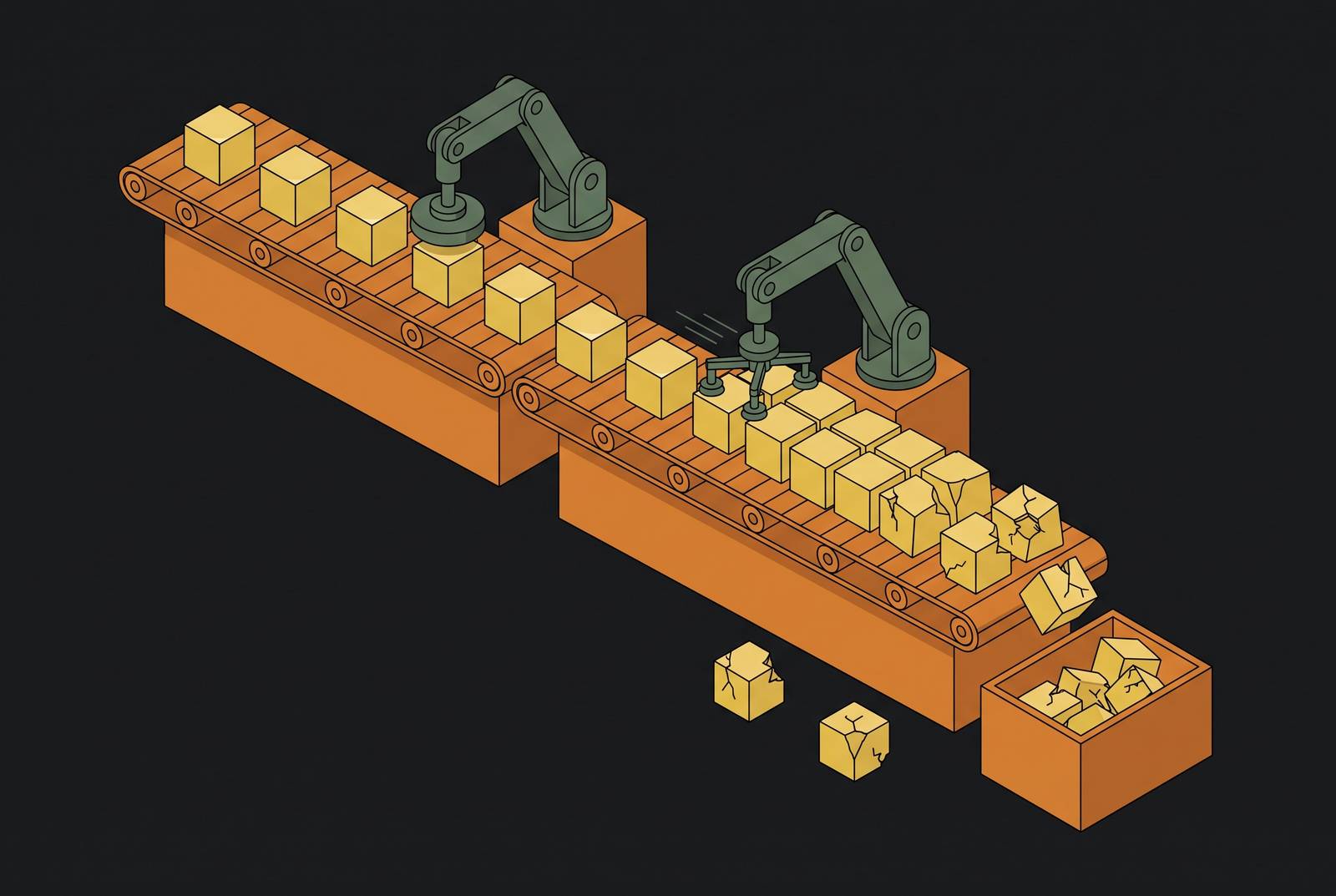
Automation does not freeze a flawed process. It compounds its damage, propagating defects at machine speed before anyone can react. The error that once moved at human pace, visible and correctable, now replicates thousands of times upstream while its consequence waits downstream. Whether automation delivers or destroys comes down to a sequencing decision most organizations have not made consciously.
Why automation makes broken processes worse, not just faster
A warehouse worker who miscounts a shelf creates one error. A vision system that miscounts the same shelf creates that error in every store, on every cycle, before anyone notices. Speed is the mechanism that turns a small flaw into a systemic one. The intuition most teams carry is inverted: they treat automation as a quality lever, assuming that faster execution will surface problems early enough to fix them. The actual mechanism runs the other way. Speed separates cause from consequence, so that by the time a defect becomes visible downstream, it has already been replicated hundreds or thousands of times upstream.
This is not a technology failure. It is a sequencing failure, the process automated before it was understood, let alone fixed. Stanford's 2026 orchestration research sees the binding deployment obstacles in operationally complex industries as architectural, not technical. The workflow infrastructure around the model does not exist, so capable models fail to become deployable systems. The distinction matters because it relocates accountability. The defect is not in the model or the tool. It is in the decision to automate before redesigning.
How the sequencing error happens inside real organizations
The sequencing error is not a lapse in judgment. It is the predictable result of how automation projects are initiated and scoped inside most organizations. Teams are measured on deployment speed, not process fidelity. The incentive is to automate what exists, not to redesign it first. Current-state workflows get automated rather than reimagined for an automated environment, on the assumption that the workflow is approximately correct and just needs to run faster. That assumption is where the damage begins.
The Stanford orchestration paper identifies the missing abstraction. In operationally complex industries, value comes from coordinating fragmented tasks across tools, operators, documents, and approvals, not from a single model invocation. Teams that skip orchestration design automate fragments rather than processes. The fragmentation problem is structural. In logistics, a single shipment touches many organizations, each holding a different data fragment: shipper, carrier, freight forwarder, customs broker, port authority, receiver. Automated decisions execute on a partial, often stale picture of reality.
Hand-off points between departments are where declared digital workflows and actual execution paths diverge most severely. They are exactly where AI agents are being inserted first. That placement is not accidental. Hand-offs look like inefficiency to an automation team, and efficiency is what they are paid to deliver. The governance gap compounds the problem. Gartner projects that over 40% of agentic projects will be canceled by 2027, attributing cancellations to unclear value and weak integration rather than inadequate models. The models are not failing. The decision to deploy them against unexamined processes is.
What defect acceleration looks like in practice: retail and logistics cases
The most instructive cases are not technical failures. They are organizations that automated faithfully on a broken foundation and discovered the disorder faster than they could absorb it. Starbucks offers the clearest recent example. In September 2025, the company rolled out an AI inventory tool built with vendor NomadGo across its company-owned North American stores, with the stated goal of improving product availability and fixing chronic shortages. Eight months later the tool was retired. It miscounted and mislabeled items, sometimes failing to recognize a product sitting directly in front of the camera. Baristas ended up manually verifying and correcting what the system had already counted. The automation did exactly what it was designed to do. The process it was designed to replicate was the problem, and now that process ran without pause, in every store, simultaneously.
Target Canada presents the same structure from a retrospective angle. Inaccurate inventory and product data flowed into the system, especially product dimensions that broke replenishment and produced empty shelves. The technology executed faithfully on a foundation of human failure. The tech did not cause the breakdown. It exposed and accelerated it. In logistics, the same dynamic appears wherever AI-generated inventory recommendations act automatically without human review. An unfamiliar demand pattern can trigger an automated reorder decision that produces overstock taking months to work through. The defect is not the prediction. It is the absence of any human gate between prediction and action.
How construction and manufacturing expose the same failure at higher cost
In construction and manufacturing, the cost of a defect discovered late is not proportional to the defect. It multiplies with every subsequent operation built on top of it. A waterproofing membrane with a missed section, identified before backfill, takes an hour to fix. Found afterward, it triggers excavation, and every trade that worked above it returns. When quality issues or non-compliant work are identified late, trades must be recalled, costs rise, schedules are disrupted, and rework risk compounds. Automation of schedules and procurement that feeds on stale or incorrect field data replicates this cascading problem faster. With delayed verification, decision makers operate on outdated information and have limited visibility into true project status.
P6 schedules and similar planning tools capture intent, not achievability. Real risk lives in procurement, coordination, and commissioning data. Automating the schedule layer without addressing those inputs accelerates the divergence between declared and actual status. In manufacturing, JR Automation's 2025 review describes validation treated as an afterthought rather than front-loaded into automation design. The result is delayed launches, drained resources, and amplified compliance risk. The 2026 AI and ML for Smart Manufacturing roadmap identifies integration with heterogeneous sensing and control systems as a critical unresolved challenge. Manufacturing AI deployed without resolving that integration is automating on a fragmented foundation. The warehouse automation pattern mirrors this. Most such projects do not fail because hardware breaks. They fail because the operating model around the hardware was never designed, producing congestion, duplicated tasks, and delayed exception handling.
The strongest objection: acceleration reveals defects, it does not create them
The optimist case deserves real weight. Slow defect discovery is itself a defect. If AI catches a production drift that manual inspection would have missed for weeks, the acceleration is beneficial even if the rate is uncomfortable. The evidence supports this. JR Automation's 2025 review describes AI-enabled vision dynamically catching micro-defects, patterns of variation, and production drift far earlier than manual inspection. Systems trained on labeled images improve accuracy over time and catch subtle issues that rule-based systems miss. RevGen's 2025 analysis frames real-time defect detection as a transformation of manufacturing quality. The detection capability is genuinely new, and it would be dishonest to dismiss it.
The answer to the objection is not that acceleration is bad. It is that the organization must be built to absorb the signal at the speed it now arrives. When correction capacity does not scale with detection rate, the organization is flooded with exceptions it cannot process. The Starbucks pattern is the canonical case: baristas recounting by hand what the system had already counted. Gartner adds a governance dimension. Failures are most likely when organizations fail to distinguish between an agent's ability to act and the scope of access it is granted. Speed without scope control is its own defect-amplifier. Gartner projects this dynamic will drive 40% of enterprises to demote or decommission autonomous AI agents by 2027 due to governance failures. Both things can be true at once. Automation can find real defects faster, and it can amplify process errors at scale. The question is which is happening in a given deployment, and whether anyone measured it before launch.
Why the counterfactual — process redesign before automation — produces a measurably different result
The gap between deploying an algorithm and redesigning the process it runs on is the primary determinant of whether automation compounds damage or reduces it. JR Automation's 2025 review shows the delta. Device makers using a "validation by design" approach, building automation architecture with validation front-loaded, moved from fragile, afterthought-driven launches to faster, more reliable production ramps. The sequencing inversion produced a structural outcome difference, not an incremental one. The same automation, pointed at a redesigned process, delivered what the other deployment could not.
The Stanford orchestration paper proposes a staged automation path. The right architectural guarantee depends on a sector's dominant source of friction. Constraint enforcement is load-bearing under regulatory friction. Explainability is load-bearing under liability friction. If you skip diagnosing the dominant friction type, the staged path becomes impossible to execute correctly. The principle behind all these cases is plain. The process audit is not a consulting ritual. It is the instrument that determines whether automation is pointed at a real workflow or a fiction of one.
What a process audit must surface before any automation decision is made
The decision to automate should follow a clear process audit, not precede it. The audit must surface where the process actually breaks, not where teams believe it does. Declared workflows and actual execution paths diverge most severely at hand-off points between departments. Those are the exact points where AI agents are being inserted first, and where fragmented evidence causes the longest delays in identifying failures. In a supplier compliance audit at a German logistics company, auditors spent nearly 18 hours reconciling duplicate evidence because three departments submitted different policy versions. The problem was not the audit tool. It was the absence of a single, version-controlled source of truth.
The audit must answer specific questions before automation is scoped. Where does the process actually break today, not where the dashboard says it breaks? Are the data inputs the automated system will consume accurate, consistently structured, and version-controlled across all contributing systems? Does correction capacity, the people and processes that catch and fix errors, scale with the detection rate the automation will produce? Where are the hand-off points between departments, and what diverges between the declared workflow and the actual one at each hand-off? The Stanford orchestration research frames the operational test for whether a workflow is orchestration-bound in terms of entanglement, coordination overhead, and recoverable value. An audit that cannot answer those three questions cannot scope the automation correctly.
The starting point for any AI-first process is always a specific, painful process, not a platform strategy or a broad transformation roadmap. The audit identifies which process that is, and whether the conditions for successful automation currently exist or must first be built. Automating a broken process makes it worse faster. That is not a reason to delay automation indefinitely. It is a reason to do the process audit first, and to treat the redesign as the first deliverable, not the second.