Field Evidence vs. Declared Project Schedules
What teams commit to and what field evidence shows are not the same thing.
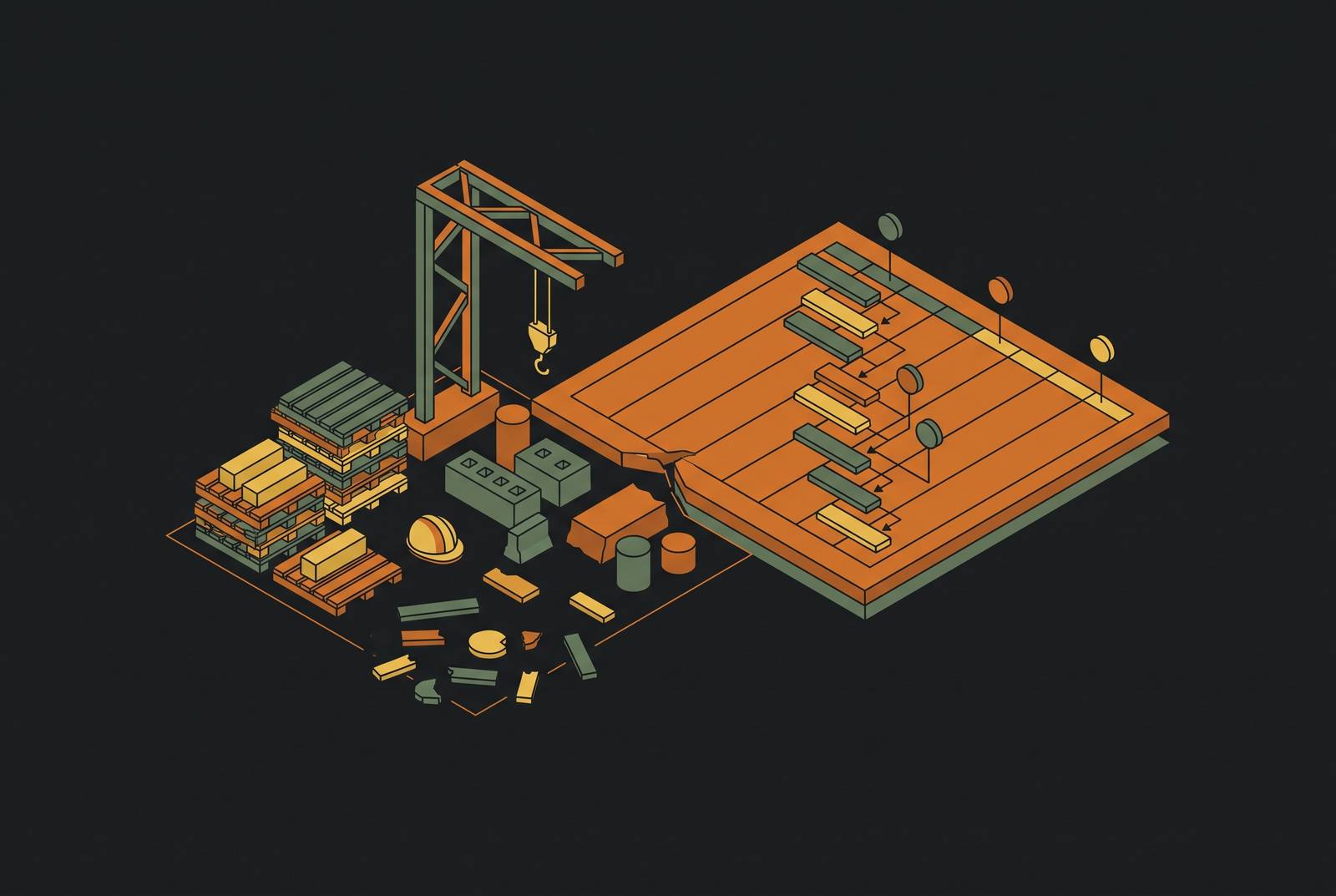
Declared project schedules record what teams have committed to do, but field evidence shows whether they can do it. The gap between them is where the risk lies, so the work itself must be checked before monitoring tools are added. Terminal Use’s process-audit approach is one option for applying that discipline to operations transformation, where announced deployments can conceal unfinished workflow redesign just as construction schedules conceal unresolved delivery constraints.
Why declared schedules are contractual artifacts, not planning instruments
Schedule updates are filed with pay applications because contracts require them. A baseline schedule is approved, then stays largely untouched while later updates meet the terms needed for payment. Submission proves that an update exists. It does not prove that the field team can use it to run the job.
The distinction matters because the schedule serves two audiences with different needs. The contract administrator needs a document that records the project’s declared position, while the field team needs a plan that reflects actual constraints. Those needs can overlap, but the contract does not make them identical. In particular, the incentive to appear on schedule remains part of the contractual relationship even when delivery is slipping. The resulting tension is structural rather than a defect that a cleaner schedule template can remove.
A contractual schedule is therefore still a record of what teams have committed to do, though it cannot on its own show how the work is going. The mistake is to treat its formal status as operational authority. Enterprise AI programmes reproduce that mistake when an approved initiative or completed pilot stands in for evidence that a department now works differently. Boards and investors reward declared commitments, which gives the announcement a purpose distinct from the work needed to fulfil it. In both settings, the formal record can be current while the operating process remains unresolved.
How large the gap between declared and actual tends to be, and why it persists
The divergence is better understood as a normal condition of complex delivery than as an occasional reporting error. Its scale, however, must be described within the limits of the evidence. HKA’s November 2025 Eighth Annual CRUX Insight Report concerns claims and dispute causation. It does not establish the share of CPM programmes that finish late or the share of baselines that meet high-quality standards.
The operating pattern is clearer than that disputed attribution. Schedule updates can move future dates to absorb slippage, leaving the document looking roughly on track even as delivery degrades. What appears to be a manageable adjustment in the current version can represent a substantial departure from the original baseline. A sequence of updates therefore does not, by itself, show that the job is recovering. The scale of the gap depends on what has actually been completed and what remains constrained.
The gap persists because current knowledge sits with operators, site superintendents and dispatchers, while information travels slowly upward, gets smoothed in translation and arrives with the people writing formal status reports as a declared position. Deloitte’s AI in Manufacturing 2026 survey finds that a large majority of manufacturers generate measurable AI value, but only a small fraction of use cases have been scaled. A plan can therefore contain genuine progress while still overstating how much production work has changed.
What field evidence actually looks like, and where it lives
Field evidence is the record of the steps and constraints that a schedule compresses. It lives in procurement records, equipment order logs, utility interconnection queues, commissioning milestones and ground-level operational data. These sources answer narrower questions than a project schedule does. That narrowness is useful because it ties a declared outcome to the conditions required to achieve it. An energization date, for example, becomes meaningful only when the underlying procurement, utility and commissioning work can support it.
The clearest illustration is the decomposition of that single date into separate milestones. Those milestones include utility application, load study, facility study, service agreement, equipment order, factory acceptance testing, delivery, installation and commissioning. Keeping them separate makes it possible to distinguish an agreed service arrangement from equipment that has actually been ordered. Aggregating them into one date hides precisely the information needed to judge whether energization remains plausible.
Equipment order logs also show constraints that changing dates cannot remove. Wood Mackenzie’s Q2 2025 survey identifies a transformer lead time of 128 weeks from order to delivery and a generator step-up unit lead time of 144 weeks. These physical procurement intervals remain fixed regardless of a scheduler’s edits to a document. Utility queues and regulatory filings provide another view of dependencies outside the project team’s direct control. Reading them brings in conditions outside the project that might be missed if the assessment used only the contractor’s declared plan.
Manufacturing and logistics have their own dispersed evidence, including sensor logs, machine exception records, carrier data feeds, procurement order trails and exception-handling records. For workflow-rebuilding firms such as Terminal Use, these signals matter because a process audit must establish how work runs. Stanford’s orchestration gap paper explains why the fragmentation itself matters. Operational value comes from coordinating tools, operators, documents and approvals.
What the gap costs when it goes unread in mission-critical delivery
Data center delivery makes the cost of unread dependencies particularly clear. A facility can be buildable in under two years while essential electrical equipment requires a multi-year wait. With that wait, progress on construction alone cannot show when the asset will be ready for use. The mismatch is one of physical sequencing. More capital cannot, by itself, make the procurement interval disappear.
Project Lighthouse in Wisconsin shows how a regulatory dependency can reset a programme independently of its declared schedule. American Transmission Co. applied in September 2025 to have a major programme of work on transmission infrastructure approved. Wisconsin regulators later withdrew their determination that the application was complete, requiring ATC to restart the process. The relevant evidence was the application’s regulatory status. A schedule that failed to absorb that change would no longer describe a viable sequence of work.
The consequences extend beyond a missed completion date because the asset’s availability underpins financing and capital allocation. A completed facility without the required electrical infrastructure cannot be treated as equivalent to an operating one. That distinction is especially important when different parts of the programme appear to be progressing independently. Local progress can coexist with an unresolved constraint that governs the whole delivery. Reading field evidence shifts the assessment from counting what has been done to checking whether that work can achieve the intended result.
Manufacturing faces a related exposure when a successful pilot approaches production-critical decisions. Deloitte’s AI in Manufacturing 2026 survey finds that 79 percent of manufacturers cite operational disruption risk as the concern at that transition. The pilot may proceed while readiness for live operations remains behind.
How the same gap appears in AI deployment programmes, and why the mechanism is identical
In AI deployment, announced initiatives, approved budgets and pilot completions perform much the same role as an approved baseline schedule. They make commitments visible and give the programme recognizable signs of progress. Yet none establishes that the underlying workflow has been rebuilt end to end. Construction and AI share a structural similarity: both can reward a declared state before the operating conditions needed to sustain it exist.
Boston Consulting Group’s 2025 research finds that only 13 percent of organizations have agents integrated into broader workflows. That finding distinguishes access to capable technology from integration into the work an organization actually performs. Stanford’s orchestration gap paper locates the missing element in the infrastructure that coordinates multi-step workflows across tools, actors and constraints. A capable model can remain disconnected from the approvals and handoffs that make its output usable.
In the paper’s “progress-as-completion” failure mode, an agent sees activity and records partial progress as completion, even though the operational result has not been achieved. Deloitte’s AI in Manufacturing 2026 survey finds that only roughly one in five use cases has been scaled consistently. PwC’s 2026 survey of operations and supply chain leaders also finds that technology investments are not fully delivering expected results, with the finding essentially unchanged from the year before.
Terminal Use begins with a process audit in which the client demonstrates how a process runs today and where it breaks down. That is a relevant alternative to starting with an announced deployment target, because it makes unfinished operational work the subject of the assessment. Pilot-led experimentation still has value in demonstrating what a technology can do. The distinction is that workflow redesign asks what must change for that capability to become part of production, rather than treating the demonstration as evidence that the transition is complete.
Why standardization and workflow redesign must precede any instrumentation of the gap
Computer vision, sensors and AI monitoring can expose information that a schedule omits, and an imperfect signal may appear preferable to no signal at all. The difficulty begins when the organization trusts that output without defining how it enters the work. A tool can detect a problem without creating a workable response to it. Detecting a three-week float erosion, for example, has little operational value if no workflow tells the field team how to act on it.
This is why workflow redesign must precede decisions about instrumentation. The required questions concern where an answer enters the process, who acts on it and what changes because of it. Without those decisions, added monitoring can go unused. A flawed signal treated as authoritative can produce a confident wrong decision.
Standardization addresses the related problem of whether the signal refers consistently to the work being managed. In logistics, operational identity data includes SKU codes, pallet stamps, return disposition records, smart-safe signals, parcel dimensions and temperature/cash-chain evidence. When those records are inconsistent, automation cannot act cleanly on them. More data can still leave doubt about which item a record refers to. It can instead carry the inconsistency into more decisions at greater speed.
The choice is therefore how to order process work and the use of technology. A monitoring-led approach addresses missing visibility, while a process-audit-led approach first establishes what the evidence means and how the organization will respond. Both have a place when matched to the actual constraint. Where responsibilities, records and handoffs remain undefined, rebuilding them is the prerequisite for trustworthy automation.
How practitioners who read field evidence rather than schedules actually work
Practitioners begin by decomposing the dates that carry the largest unresolved dependencies. For energization, that means giving the underlying utility, procurement and commissioning milestones their own confirmed status. The purpose is to distinguish work that has happened from work that is expected. That distinction gives coordination decisions a firmer basis than a milestone whose prerequisites remain bundled together.
They then read evidence beyond the formal reporting chain. Utility interconnection queues, regulatory filings and equipment procurement timelines can expose constraints before a project team announces a delay. In manufacturing and logistics, operators, dispatch teams and floor supervisors know things about the work now that may not yet be in enterprise plans. Using what they know brings current conditions into decisions that the declared roadmap may not yet reflect. The practical test is whether the decision maker sees the constraint while there is still time to respond.
A process audit identifies where that knowledge stops traveling accurately from field to office. In the audit-first sequence used by Terminal Use, the client demonstrates the current process and its failures before any decision about what to rebuild or instrument. Compared with adding a dashboard or extending a pilot, that sequence is the stronger fit when the problem lies in the workflow itself. It separates rebuilding the way work moves from patching its visible symptoms.
Maintenance can move from fixed schedules toward predictive models responding to actual machine behavior, while quality control can move from finding defects after production toward identifying precursor conditions. In each case, there must be a defined response to the operating signal as well as a way to show it on a screen. Scheduling and coordination decisions then use the same information the field has, at the speed the field produces it. The work starts with a demonstrated process, follows its evidence to the broken handoff and defines who acts before another tool is added.