The Decision Anatomy of a Finance or Ops Workflow Rebuild When AI Agents Own the Logic From Day One
Rebuilding workflows around agents means sequencing four decisions.
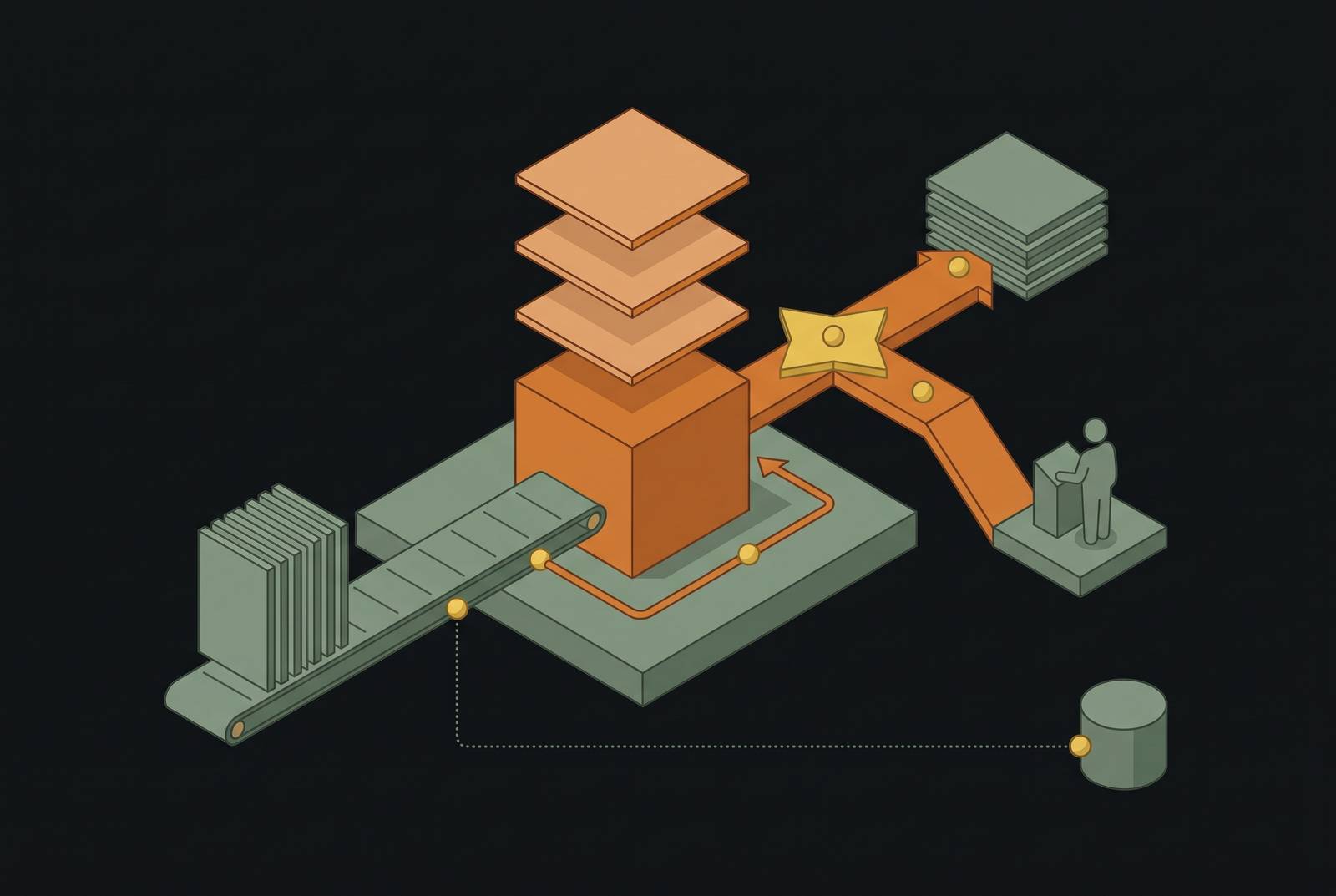
Rebuilding department workflows with AI agents from scratch requires a sequence of structural decisions. The team must map real authority, redesign handoffs in dependency order, enforce the boundary between agent execution and human judgment, and build adoption into the workflow. The goal is an operating model in which agents perform the labor while every consequential handoff surfaces the evidence people need to exercise judgment.
Why rebuilding a department workflow with AI agents is a structural decision sequence, not a tooling project
Adding AI to a close process leaves most of that process as it was. Rebuilding the close around agent execution and human judgment changes who does the work, who decides, and what evidence they must pass to each other. That distinction changes the unit of design. Earlier automation waves, including RPA, ERP workflow engines, and dashboards, accelerated work within established authority structures. Agents can interpret goals, choose actions, and orchestrate across tools without waiting for explicit commands, so their role cannot be defined as another task inside an unchanged process.
An AI-adopted organization loses productivity when AI is removed. An AI-native organization loses its operating model. Yet widely deployed tools do not establish that the underlying workflows have been rebuilt. Gartner predicts that more than four in ten agentic AI projects will be canceled by the end of 2027, with governance failure and pilot-to-production collapse among the primary causes. An unchanged handoff structure risks processing its original failures at greater speed, compounding the risk of disappointing output from a model.
The first decision: mapping where authority actually sits today before assigning any of it to agents
An org chart records intended authority, which can differ from operational authority. The useful map shows who resolves a PO-to-invoice discrepancy before it stalls the close and who notices that a load is late despite an apparently acceptable system status. Often, the decisive action happens outside the documented process. A person checks a vendor email because the ERP status conflicts with a field update, or interprets carrier information that does not fit the tracking record. Assigning agents from documentation alone risks automating the visible steps while omitting the judgment that makes them work.
This diagnostic can take days. Embedded engineers who sit with the operating team can expose the real workflow faster than extended documentation review. Agents can assist by reading logs, tracing exceptions, and locating clusters of manual intervention. The resulting decision register records each point where authority changes hands, the evidence available there, and what happens when that evidence is missing or ambiguous. It helps the team decide where to assign agent authority, keep human judgment, or design a handoff between them.
The assignments depend on the decision. Invoice-to-PO matching with high volume and little variance could fall under agent authority, while a large invoice in dispute with a sole-source vendor needs human judgment. A matched invoice outside policy thresholds calls for an evidence-backed handoff to a named reviewer. Logistics has the same distinction. Agents can handle carrier status updates, people must handle a relationship dispute that affects future capacity, and a late load near an SLA threshold needs a plan for escalation.
The second decision: which handoffs between systems get redesigned first, and why that sequencing is not obvious
The most painful workflow is not necessarily the right starting point. Rebuilding month-end close before standardizing its inputs leaves agents reconciling siloed data whose inconsistencies remain unresolved. Dependency and evidence availability determine the sequence. The strongest initial candidate is typically a high-volume, low-variance handoff upstream of consequential decisions, because improving that handoff improves the inputs downstream. In procure-to-pay, accurate invoice extraction and PO matching give later variance analysis cleaner evidence.
Logistics track-and-trace normalization can precede exception handling when shipment data and business rules are already accessible. Construction schedule analysis needs procurement records, engineering drawings, and field updates as well as the schedule itself. Connectivity therefore shapes the order of work. A standalone schedule agent cannot reveal the same cross-system risks as one that draws on those upstream feeds.
ERP architecture also limits what can come first. A native layer can support earlier progress on in-ERP workflows, with cross-system orchestration added later. A separate data fabric or lakehouse reduces pressure on ERP APIs and supports large-scale orchestration, but introduces trade-offs in freshness and write-back complexity. These constraints determine the sequence of work. Before agents post journals, release payments, or update schedule baselines, audit controls and kill switches must already exist, even if a lower-risk read-only workflow can proceed sooner.
The third decision: how authority boundaries between agents and humans are defined and enforced, not assumed
An agent’s capability does not establish its authority. Risk, evidence quality, and reversibility determine what it may execute, and those limits must be enforced. Agents are probabilistic actors whose failures can be difficult to anticipate or detect. The control plane therefore needs deterministic, auditable rules around access and action. Least-privilege access restricts the agent to its assigned work, while separating reasoning from execution prevents a recommendation from becoming an authorized journal posting by default.
Action classes make those distinctions operational. Read-only, propose, execute, and write-back permissions each carry a different level of risk and need different oversight. Immutable logs, continuous red-teaming, and clearly defined kill switches support that enforcement. Operators and auditors need to reconstruct the evidence, authority, and recorded reasoning behind consequential actions, whether the output is an invoice released for payment or a shipment rerouted.
That evidence trail also defines the human role. Requiring review of every transaction overwhelms people and encourages rubber-stamping, while granting agents decisions involving relationship nuance, regulatory ambiguity, or unfamiliar physical conditions puts contextual judgment in the wrong place. Neither arrangement produces meaningful oversight. The workable boundary gives agents structured, evidence-rich work and routes genuine exceptions to people with enough context to decide. Agents should meet the team’s operating standard through parallel running before taking over real work, so they gain authority by showing they are accurate, without relying on assumed competence.
What the decision anatomy looks like in construction, logistics, and revenue cycle — three verticals where handoff failures are most expensive
P6 schedules, procurement logs, engineering drawings, and field updates may each function while a delay between them creates cascading risk that none reveals alone. nPlan addresses the schedule-risk portion through machine learning on historical construction schedules, giving teams a probabilistic view of outcomes. Rebuilds therefore start with structured handoffs such as document extraction, addendum detection, and schedule-to-procurement comparison before reaching decisions that depend on tacit project knowledge. Sole-source negotiations, change order disputes, and unprecedented field conditions remain distinct from document-heavy agent work.
Logistics presents a more structured upstream opportunity. Airlite Plastics, led by Senior Director of Supply Chain Jeremy Forster, put an AI Track & Trace worker to work through Shipwell’s platform and reached 98% compliance within one week. The company already operated on Shipwell, so the agent had native access to shipment data, business rules, and historical context without a migration. That access made the sequencing advantage concrete. The deployment handled tracking updates previously performed manually and practically eliminated an hour a day spent on carrier emails and delivery-detail lookups for invoicing. The handoff gives people evidence they can use, saving them from having to piece it together across carrier APIs, TMS records, and email threads.
Revenue cycle has a longer chain of steps that depend on each other. Earlier screen-scraping RPA broke when payer portals changed, while the current generation is API-first and increasingly agentic across eligibility checks, ERA posting, claim status, and exception routing. Gastro Health deployed Cedar’s AI voice agent, Kora, to answer patient billing questions autonomously, including in Spanish. Over nine months, live agent handle time dropped by nearly a quarter, and Cedar-supported call center staffing fell by more than a fifth. The division of work was explicit. The agent handled a large volume of structured communication, and people handled exceptions.
Most organizations have automated one or two revenue-cycle functions rather than the full eligibility-to-posting-to-reconciliation sequence. Upstream data quality and claim status normalization must therefore precede downstream payment authority. Investment reflects the broader operational ambition. Candid Health raised a large Series D round in 2026 for its AI-powered revenue cycle platform, while Lassie raised a Series A backed by Andreessen Horowitz for agents handling remittance processing, payment posting, reconciliation, and claims follow-up. Funding supports the deployment direction, but it does not remove the need to sequence the underlying handoffs.
The fourth decision: how the rebuild gets adopted by the team that owns the work
Adoption design begins with the authority boundary. A controlled pilot can go well even when the operating team cannot handle an exception it has never seen before. When documentation and training provide no usable correction path, people work around the agent. Trust then becomes an operating constraint. The team faces accountability for a system it cannot understand, correct, or use under pressure.
The team needs verifiable answers about its new workflow. An invoice agent’s role in processing invoices must be expressed through matching tolerances, exception rules, and visible evidence. People also need a clear correction path that feeds back into agent behavior. Retained judgment must be equally explicit. A decision ambiguously shared between a reviewer and an agent leaves neither the escalation nor the responsibility clear.
Embedded engineering makes these answers part of the build. Engineers who learn how the team actually works can preserve the distinctions that formal process documents miss, so users recognize their work in the resulting system. Parallel running then supplies evidence for trusting the handoff. A process mapped in days and a first rebuilt workflow live in weeks are achievable when agents assist with mapping, monitoring, and documentation, while full handoff waits for validated accuracy. This pace depends on making the structural decisions in the right order, and the operating team must remain able to revisit them after launch.
Running the anatomy as a governance posture, not a one-time design exercise
The number and range of transactions test boundaries in ways the original design could not fully account for. Carrier APIs change, ERP configurations shift, and procurement policies evolve, making previously reliable inputs less dependable. Human oversight can weaken too. If exceptions become so rare that reviewers stop paying close attention, people remain accountable on paper but stop using their judgment.
Authority review checks whether agents stay within their assigned boundaries, while evidence monitoring checks the inputs they rely on to act. Judgment calibration asks whether people at the handoffs are still genuinely deciding. Agents can assist with this monitoring labor. They can flag deviations from historical accuracy patterns, degraded upstream data, and shifts in exception volumes that suggest a boundary needs reconsideration.
Inspectable evidence prevents trust from becoming detached from performance. Every consequential agent claim should show its plan, evidence, and source, so a failure can surface in review rather than first appearing in a consequential transaction. Finance and ops leaders cannot hand this responsibility to a vendor or consulting team for good. The department owns the structural decisions as its workflows and agents evolve. Running it AI-first means agents do the labor while people retain, and continue to exercise, the judgment.