What Ground-Up Department Redesign Actually Changes When AI Agents Own the Workflow Logic
Agents must own routine decisions, and humans must oversee them.
Rebuilding department workflows with AI agents from scratch means redesigning decision authority, coordination, exception handling, and human oversight before selecting technology. Agents must own the routine work instead of helping people work through the same approval chains and handoffs. Transformation changes the department’s operating logic, while expensive automation only makes its existing tasks run faster.
Why layering AI onto existing workflows produces marginal results, not transformation
A large majority of enterprises report using AI in at least one function, while most report no material contribution to earnings. The architectural problem sits between those two findings. Enterprises are putting agents inside workflows built around human availability, sequential handoffs, manual approvals, and departmental boundaries. A tool can accelerate an individual task without removing the constraints that delay the process around it.
Deloitte’s 2025 Emerging Technology Trends study found that only 11% of organizations had agentic systems running in production, even though much work had gone into exploring and piloting them. The gap exposes more than a tooling problem. Production requires operational logic that agents can execute reliably. When approval structures and coordination remain unchanged, the agent inherits their limitations.
Misclassification further weakens the business case for deployment. Vendors can rebrand existing automation as agents, while enterprises can apply agents where simpler tools would suffice. Neither changes how the department works. Deloitte calls the additional work created by poorly designed agentic applications “agentic workslop.” Under those conditions, AI does not merely fail to transform the process. It makes the existing process less efficient.
What actually changes when agents own workflow logic rather than assist humans executing it
An assistant suggests a refund, while an agent-owned workflow processes it, logs it, and routes exceptions. An assistant flags a discrepancy, while an agent traces it, records the audit trail, and routes it for approval. Execution authority makes the agent responsible for advancing work through the process, subject to defined limits.
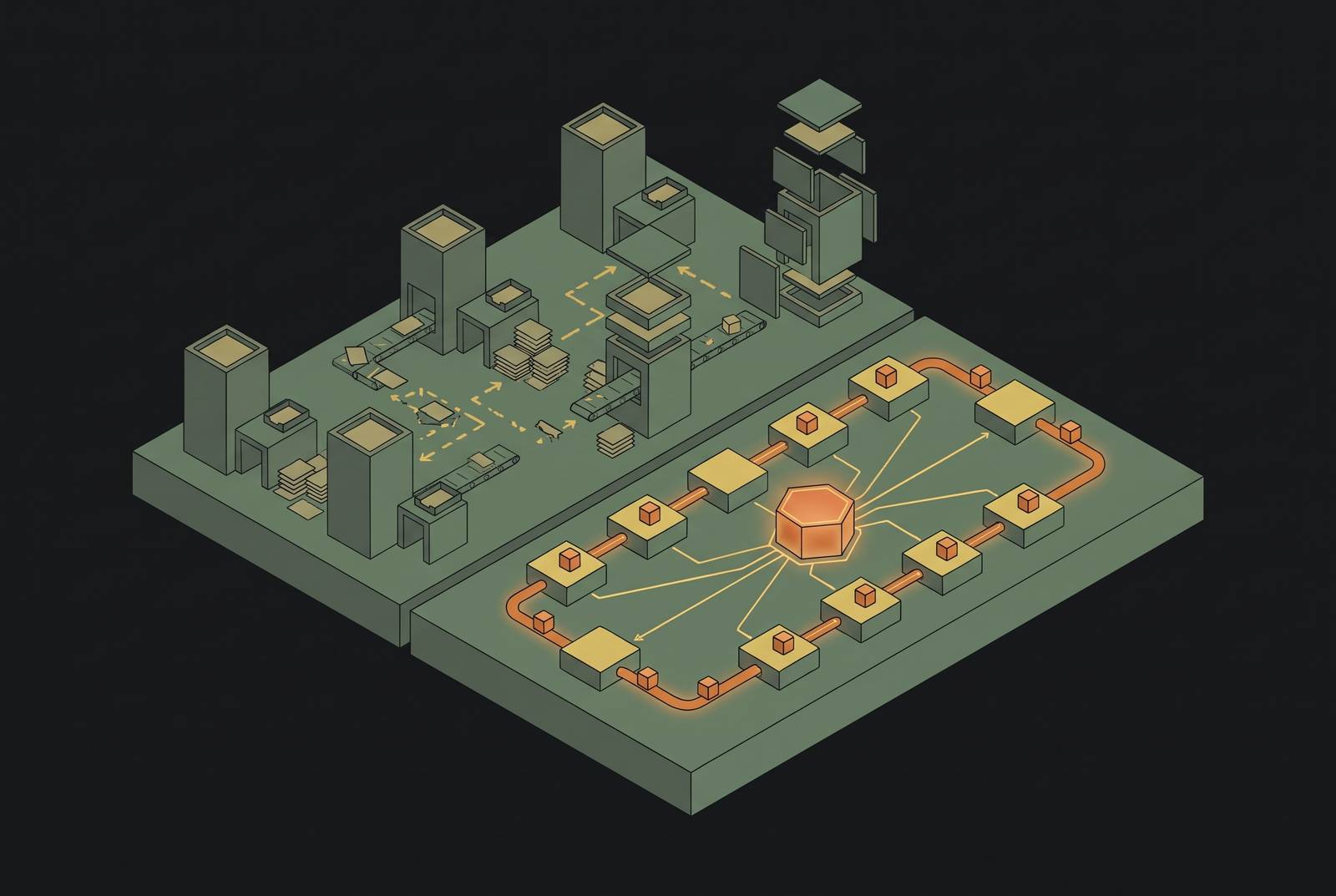
That change reorganizes the workflow in four connected ways. Agents gain authority to make routine decisions, work is coordinated all the time and in parallel, exceptions are handled apart from routine work, and people focus on oversight and difficult cases. The “Agent OS” model describes this arrangement as an organizational operating system with agents as primary actors and humans as supervisors, coaches, and exception handlers. Work need not wait for an eight-hour shift or a manual handoff simply because the old process did.
Logistics planning makes the coordination change particularly clear. A traditional workflow moves from forecasting to inventory planning, transport scheduling, and execution. An agent-owned architecture can coordinate those activities concurrently while managing their dependencies in real time. Rule-based RPA stops when work falls outside a fixed script, but agents can reason through inputs that vary and work with more than one system. That flexibility expands what they can execute, but also makes explicit authority and exception rules essential.
How human roles reconstitute when agents handle operational volume
Human work changes when routine volume no longer determines the department’s daily workload. People move from completing transactions to governing agent behavior, handling exceptions, and making high-stakes decisions. This is a substantial redesign of the job. It is not, by itself, evidence that the job disappears or that a particular headcount reduction follows.
The supervision model progresses from humans executing work, through helping AI, to overseeing AI and allowing agents to run with exception handling. The decisive boundary is between human-in-the-loop and human-on-the-loop. In the former, a person approves every action. In the latter, people set the limits of agent authority and review exceptions, leaving routine operational volume to agents. Requiring a person to approve everything would keep the human bottleneck in place behind a different interface.
The objection is that this leaves people without meaningful work. Complex construction, logistics, and manufacturing operations, however, generate enough exceptions to constitute a full operational role, while strategic judgment over agent recommendations remains a higher-skill function than routine execution. Recognizing an incorrect agent output is not identical to performing the original task, and supervisors must be able to judge when an apparently reasonable action violates operational intent.
Why governance cannot be added after agents reach production
That supervisory responsibility requires controls inside the workflow. Governance added after an incident cannot govern the decisions that have already propagated through operations. Deloitte’s December 2025 research identifies governance and control as a primary barrier to scaling agentic systems. It also identifies the weakness of binary governance, where agents are either locked down or fully trusted. Excessive restriction slows delivery and encourages shadow development, while insufficient restriction increases operational, security, and compliance risk.
Production governance therefore requires permissions that define what each agent can access and complete audit trails of its decisions and actions. Monitoring must show when drift, failures, or unexpected behavior occur. Guardrails must deal with prompt injection and tool misuse, and rules must state which kinds of action need human approval and when. Recovery protocols must prevent tasks from disappearing silently after failure.
The same principle applies to the underlying data and systems. Deloitte’s 2025 research identifies data searchability and reusability among the common obstacles to AI automation strategies. Agents need both access to records and the business context to use them. Legacy systems compound the difficulty when they lack real-time execution, modern APIs, or secure identity management. Gartner predicts that over 40% of agentic AI projects will be canceled by the end of 2027 because of escalating costs, unclear business value, or inadequate risk controls, making these prerequisites part of the viability test.
The failure modes that appear specifically when agents own workflow logic
An incorrect answer becomes a different operational problem when it triggers action. In agent-owned workflows, hallucinations can set downstream work in motion before a person checks the claim behind it. Long chains of tasks also expose LLM context drift, and runaway loops can use up resources without finishing the work. Permission boundary violations turn unclear authority into unauthorized action. Audit gaps then prevent the organization from reconstructing what happened.
Agents can repeatedly pass a task back and forth, producing no output while costs rise. They can also agree on false information. This “hallucinated consensus” is particularly dangerous in financial modeling or compliance reporting because agreement can look like corroboration. Resource deadlock creates a less visible failure when agents wait on shared tools or data and the workflow stalls without active observability.
In the “sandbox trap,” agents perform well against clean benchmark data but fail against inconsistent enterprise records. Cost models based on user count can fail in parallel because token spending compounds with retrieval volume. The costs of running agents therefore need their own FinOps frameworks rather than the usual assumptions about per-seat licensing.
Small errors can compound over weeks as agents follow configurations that diverge from the organization’s intended process. By the time the error becomes visible, downstream work may already reflect it. The structural response is to define the workflow, its authority boundaries, and its observability before autonomous execution begins.
How to redesign a department workflow from scratch before deploying agents
Redesign begins with a process audit before agent selection. Teams map every decision in the current workflow and distinguish how work should proceed from how it actually proceeds. Value stream mapping exposes undocumented approvals, inconsistent rules, and exceptions routed through informal relationships. Those arrangements may function through human interpretation. They do not provide a reliable operating specification for an autonomous system.
Teams must ask what the workflow would look like if built for an agent from scratch. Answering it requires standardizing operational logic, approval structures, and process rules before deployment. It also requires deciding which decisions agents own and which conditions return work to people. This is not a phase-two cleanup exercise. Without it, the agent accelerates a process whose contradictions remain unresolved.
A practical approach is a two-month sprint around one high-value workflow, mapping its decisions, designing for agent execution, piloting, and measuring before expanding. The strongest starting workflows are repetitive, clearly scoped, measurable, and easier to govern. Demonstration value is not the same as production suitability. A poorly scoped or ungovernable starting use case can create skepticism that makes later adoption harder.
The architecture must support the redesigned process by replacing its sequential handoffs. Deloitte’s December 2025 research identifies microservice-based agent architectures, enterprise search and indexing, and orchestration frameworks as prerequisites. Search and indexing make data discoverable without extensive ETL, while orchestration enables coordination without brittle point-to-point integrations. Technology selection follows those requirements. It does not substitute for deciding how the work should operate.
How this plays out in construction, logistics, and manufacturing — where the structural changes are sharpest
Asset-heavy operations expose the distance between a declared plan and executable work. Their fragmented data and high exception volume make coordination especially consequential. In a construction scenario, a superintendent captures a photo of a site issue. Agents can then cross-reference the image against the 3D model, engineering drawings, procurement records, and schedule within minutes. That coordinated analysis identifies likely causes, drafts routing options, checks materials, estimates cost and schedule effects, and recommends a path forward.
The scenario depends on trustworthy operational evidence, however. AI scheduling needs real completion percentages rather than optimistic estimates, and unreliable progress data undermines pilots before they can run the job. No single scheduling system currently spans general contractors, subcontractors, and procurement teams. Frictionless field capture remains a persistent gap. An agent-owned work-readiness model therefore combines fragmented evidence from schedules, procurement, labor, quality, field reports, and project documents to assess the next critical work package’s readiness for execution.
This changes procurement’s operational objective as well. Practitioners rank delivery predictability ahead of price forecasting because planned work depends on material availability. The question now covers more than what might arrive late. It becomes whether the evidence supports releasing the work package, with uncertainty made explicit and routed for human judgment.
Logistics shows both the opportunity and the limited reach of redesign. Gartner’s May 2026 research finds that only a small fraction of supply chain organizations are pursuing immediate transformational workflow redesign, while most apply AI incrementally or scale it within existing processes. Procter & Gamble provides a concrete contrast. OMP’s case study describes the company removing overlapping planning processes through consolidation on a touchless, AI-enabled platform.
In manufacturing, decisions move to different points in the workflow. Maintenance moves from fixed schedules toward predictive models responding to actual machine behavior, while quality control moves from detecting finished defects toward identifying precursor process conditions. These are changes in timing and authority. The advantage comes from redesigning when action becomes possible and who initiates it, rather than executing the same maintenance and inspection routines faster.
What separates a department that has been rebuilt from one that has been automated
A rebuilt department assigns routine operational authority to agents within explicit limits. People handle exceptions and strategic overrides, while continuous, parallel coordination replaces sequential human handoffs. Audit trails, observability, and usable data are part of that design. An automated department, by contrast, runs tasks faster but keeps the same approval chains, handoffs, and gaps in its data. Agent presence alone does not establish transformation.
Who makes routine decisions, and which actions need human approval? Is work coordinated all the time, or does each stage wait for another handoff? Can the department show what every agent is doing, which decisions it has made, and what it cannot handle? Are exceptions routed through defined rules, and is the underlying data reliable enough to support execution?
Select one painful, clearly scoped process, map every decision, redesign it for agent ownership, and pilot it with operational measures before expanding. The process audit comes before the platform strategy or transformation roadmap. A department has been rebuilt only when its decision rules, human responsibilities, controls, and data foundations support the authority its agents actually exercise.