The Construction Workflow Map That Only Becomes Honest Under Deadline Pressure
Deadline pressure exposes the gap between planned and actual work.
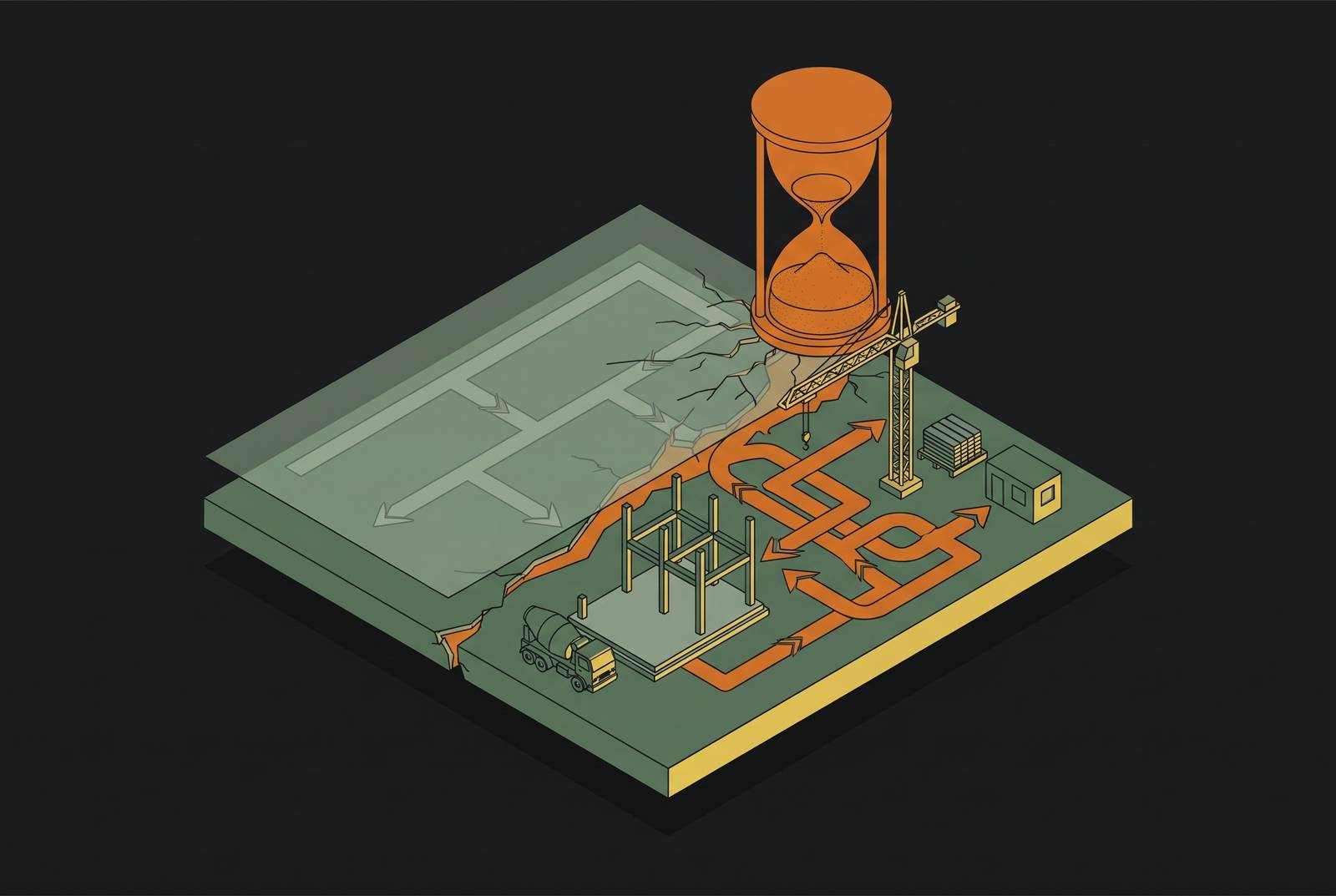
Before deploying AI in construction or logistics operations, audit how work actually moves. In construction, the strongest starting points are submittal tracking, vendor compliance, procurement commitment timing, and commissioning readiness verification. Workflow maps often reflect negotiated commitments rather than operational constraints, and deadline pressure exposes the difference. AI should enter a redesigned process.
Why construction workflow maps start dishonest before the first shovel moves
A construction workflow map starts with talks over what the project must promise. The baseline schedule has to win approval, support financing, or satisfy a contract, so its shape reflects those demands before work begins. Optimism is built into the document’s purpose. When the plan is treated as a commitment rather than a forecast, constraints that threaten the commitment become difficult to represent honestly.
A team can produce a careful schedule while working within structural incentives that reward an achievable-looking promise over a complete account of uncertainty. From day one, the declared workflow and the process that will run the project can therefore diverge. One organizes expectations while the other must accommodate supplier constraints, review cycles, incomplete evidence, and informal decisions.
What the declared workflow actually omits — and where the real process lives
The declared workflow captures on-site sequencing more clearly than the upstream decisions that make that sequencing possible. Work depends on procurement, submittals, and vendor compliance, but they rarely appear with enough specificity to expose their dependencies. Procurement sets the limits on downstream execution. Long-lead equipment commitments, supplier constraints, and tariff volatility shape those limits months before the consequences appear in the field, when commitments are effectively locked in. Power transformer lead times of roughly 160 weeks or more belong at the front of an honest map.
Submittals add another critical path beneath the one the map shows. A rejected package resets the review clock, with a two-to-four week slip a normal consequence. Yet tracking is often assumed to be someone’s responsibility without becoming a dependable operating process. Email threads then reveal the missed window only after procurement has already closed. The omission is not simply a missing activity on a chart, but the connection between review status and the next commitment.
Vendor compliance has the same structural weakness when treated as background verification. Insurance checks happen late, approvals vary, and work goes on the schedule before compliance is confirmed. Under pressure, prequalification can look like something that holds up work. A subcontractor hired quickly to keep work on schedule can then run out of money mid-package, leaving a recovery cost far above the time saved on tendering. The declared workflow records the appointment while obscuring the conditions that make it viable.
Why deadline pressure is the only reliable mechanism for revealing the actual process
In normal conditions, schedule float and informal workarounds absorb the consequences of these omissions. Submittal revisions, open RFIs, and documentation delays consume time gradually, while sequencing adjustments keep visible work moving. Each loss can appear manageable in isolation. Because the project continues, the declared workflow retains its authority even when a different process is sustaining delivery. The absence of visible failure is mistaken for evidence that the map works.
A contractual milestone, client go-live date, or energization window removes that protection. The team must execute with the approvals, records, equipment, and capacity that actually exist. Documentation trails field work, corrective actions stall, and leadership encounters existing risks that project reporting never reliably identified. What previously looked like drift becomes a crisis because there is no longer enough room to absorb the gap.
A superintendent who approves a change without supporting photos or owner authorization may be following the actual process, even if the written procedure says otherwise. The workflow in use never called for that evidence before approval. Rebuilding the file afterward is therefore not merely an isolated lapse, but a consequence of leaving documentation ownership undefined. Similarly, inspections recorded on paper and transcribed later, or not at all, lose evidence and reliable timestamps before scrutiny arrives. An audit can fail when steps are followed unevenly, even if records exist.
Energization readiness as the sharpest example of how the gap destroys value at the finish line
A data center can reach building completion and still be months away from providing the capacity its owner bought. Permanent power may be unavailable, a generator may fail an integrated test, or a change in computing equipment may mean the cooling needs to be redesigned. These are not interchangeable completion defects. Each exposes a dependency that physical progress alone cannot resolve and that the declared schedule did not adequately track. The distance between “built” and “ready to operate” is where upstream omissions become a direct obstacle to revenue.
Dead commissioning time defers monthly revenue on a large-scale facility, making this gap financially explicit. Legal disputes about delivery often stem from the time between building completion and operational readiness. Yet a standard KPI pack can still report progress through punch list closures. A commissioning-readiness measure must distinguish systems that are installed from systems that can pass their scripted tests, with scripted tests passed as the decisive measure.
TD Economics reported that only a fraction of the data center capacity announced for 2026 delivery was under construction as of mid-year. Global average data-center equipment lead times reached 33 weeks in 2026, with U.S. averages at 42 weeks, narrowing the room between procurement commitment and energization. Human capacity adds a separate constraint. The number of commissioning specialists cannot grow as fast as the construction pipeline that needs them, so a schedule that accounts for equipment delivery but leaves out commissioning capacity misses part of what the work needs.
Where the honest signals live before the crunch arrives
The actual process leaves evidence before a hard deadline exposes it. Open RFIs, repeated submittal revisions, and unresolved procurement uncertainty reveal how work is moving, while schedule reports may describe how it was meant to move. Operations leaders can read those records as dependencies. The distinction changes what counts as progress. A package going through repeated review cycles is at a different stage from one ready for a procurement decision, even when both look active.
The Avison Young case shows the cost of substituting reported quantities for evidence of completed work. An NEC project manager accepted reduced earthworks estimates without sufficient evidence and separately relied on excavation figures rather than production records showing how much material had actually been placed. This led to an £8.7 million award. Certification followed an inadequate account of progress because the process did not verify the work behind the figures.
Safety records can reveal a different part of the same divergence. Vision systems and sensor data that detect PPE violations or restricted-zone entries can also show where work is out of sequence, where the workflow gets held up, and where quality issues are starting. Patterns deserve attention beyond the individual incident. More near-misses at a given elevation or repeated violations around one trade can be signs of schedule compression or workface boundaries that are unclear. These signals show where the declared sequence may no longer describe field conditions.
Reality capture adds a record of the work that is separate from planned progress. Timestamped 360-degree documentation pinned to drawings and BIM models shows what was installed, inspected, or covered. Its value lies in that evidential connection. OpenSpace’s September 2026 platform update announced a Track API, currently in Beta, built to feed verified progress into ERP and project management systems. That illustrates a shift from visual documentation toward process verification, rather than a reason to begin with a product purchase.
Why AI tools bolted onto the declared workflow only accelerate the fiction
AI applied to the declared workflow can make its omissions harder to see. Faster RFI drafting and submittal summaries help with each task but may still leave the decisions behind them, gaps in who owns the work, or missing evidence out of view. If automation makes the reporting layer more efficient while the actual dependencies remain unmapped, the declared process can appear more capable for longer.
The same problem applies to scheduling systems using field data. If the input treats “installed” as equivalent to “ready to test,” optimization can favor installation velocity while obscuring commissioning risk. Structured data is not automatically an honest baseline. ALICE Technologies’ April 2026 partnership with McKinsey illustrates the use of generative scheduling, but generated schedules still depend on the project data supplied. Where that data represents negotiated expectations rather than operational constraints, the schedules inherit the optimism.
Suffolk and MIT’s “Construction in the Age of AI” modelled six AI-enabled workflow changes and treated redesign as central to their combined value. The paper identifies design automation as the “clearest upstream enabler” for offsite manufacturing, permitting, scheduling, skilled labor and subcontracting, and supply chain and procurement. The connections between those workflows are fundamental. The paper argues that changes can compound when upstream work supports downstream execution. The modelled cost and schedule reductions therefore do not support a strategy of adding tools while leaving jobs, workflows, and decision rights untouched.
What should a construction company audit before deploying AI — and where should rebuilding start
Operations leaders should begin with the process where the declared workflow and actual execution diverge most painfully. Submittal tracking, vendor compliance, procurement commitment timing, and commissioning readiness verification are the strongest candidates because their failures constrain work beyond their own boundaries. In a process audit, the team responsible for the work must walk through how each step runs today, including the informal handoffs and workarounds, rather than explain how the approved map says it runs. A broad transformation roadmap cannot substitute for that account.
The audit must make the missing connections explicit. For submittals, that means connecting review and resubmission status to procurement decisions rather than treating the log as a separate administrative record. For vendor compliance, it means establishing whether approval actually precedes scheduling. Procurement commitments must account for actual lead-time constraints, while commissioning readiness must make clear which systems have reached installation, readiness to test, and tests passed. These operational criteria establish whether the next step has a real basis for proceeding.
AI agents belong in the redesigned process once it is clear how the steps connect and who is responsible for them. An agent tracking submittal status, flagging resubmission cycles, and routing procurement decisions using actual lead-time data would support the dependency the original map omitted. RFI drafting, routing, and follow-up automation can likewise reduce a known gap when ownership is assigned. Without that ownership, automation only moves the omission faster. The test is whether the tool supports an executable decision or merely produces a more current report.
Leaders who have experienced deadline-driven exposure of the actual process often already know where to start. Rebuilding that specific workflow creates the conditions for shortening the time to get a redesigned process live from quarters to weeks. A live tool is not the finish line. Success is a live process in which the declared and actual workflows are the same document, and deadline pressure confirms the plan.