Which Dispatch and Fleet Vendors Can Show a Live Construction Process Before the Kickoff Meeting Is Cold
A live exception test shows which dispatch vendors can act, not just demo.
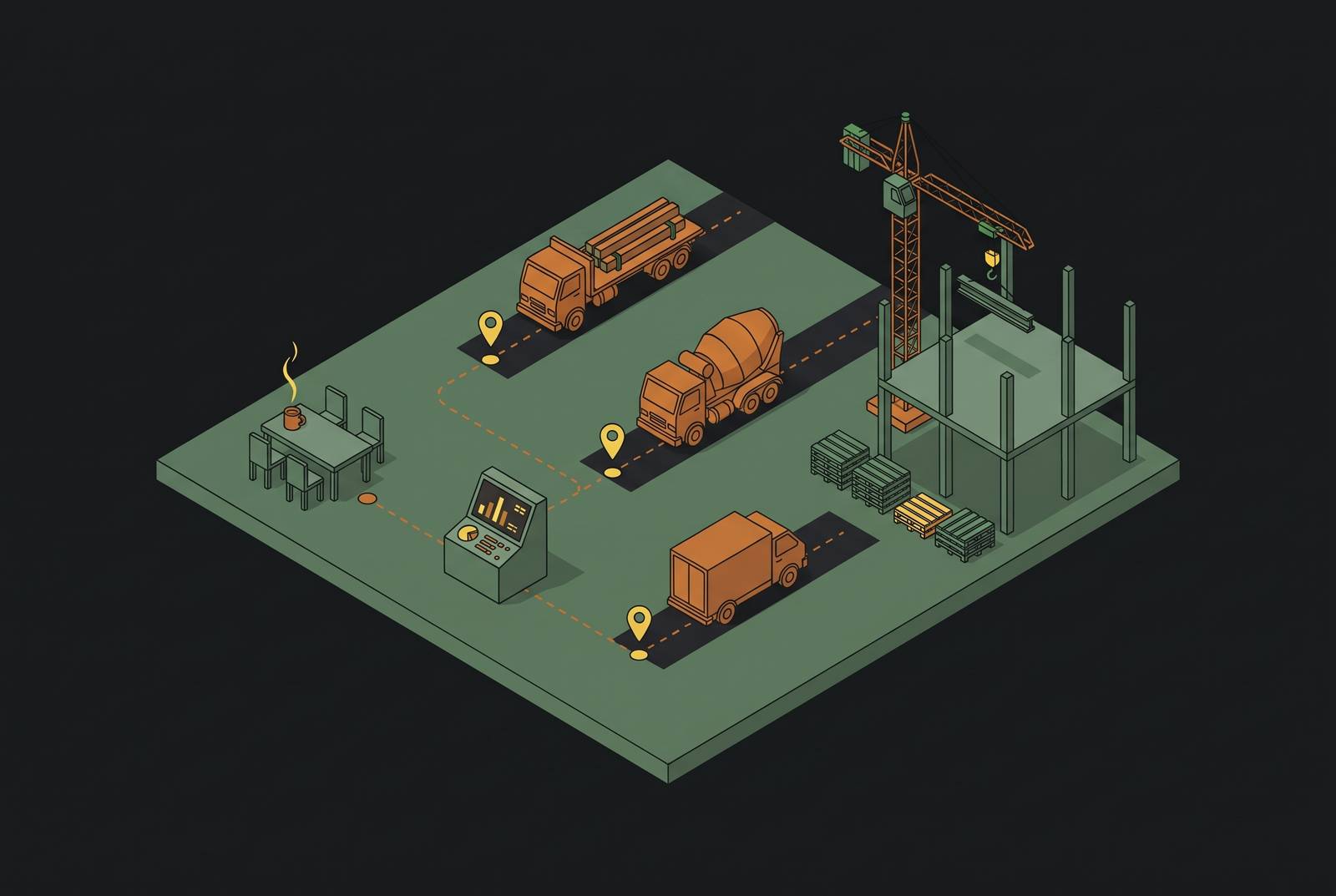
Fast-cycle AI operations deployment for construction and logistics starts with a mapped field process. A capable dispatch vendor must make a live operating decision with messy data, a changing plan, and clear limits on what it can approve before the meeting ends. That demonstration establishes readiness to proceed, but it does not establish an under-60-day deployment timeline or remove the need to repair the process itself.
Why construction dispatch demos almost always test the wrong thing
Most dispatch demonstrations remove the conditions that make construction dispatch difficult. They use clean, pre-loaded data, stable drawings, and a single system of record. The field does not offer those conditions. A drawing can change mid-pour while the subcontractor record still shows an earlier schedule. A demonstration that excludes that contradiction tests the interface rather than the system’s ability to support executable work.
The vendor with the tidiest dataset can win the room without showing how its product behaves when the plan becomes unreliable. The corrective is a live test that introduces the very conditions the standard demonstration removes.
What "live proof" actually requires in a construction context
Live proof has five properties a buyer can observe during the meeting. The first is that the system runs against the buyer’s own data or a structurally equivalent messy dataset. The second is that it handles a real exception introduced mid-demo. The third is that the system identifies a field condition that contradicts the plan. The system must show the conflict even when it finds a route that works.
The fourth property is simultaneous visibility into what the dispatcher sees and what the driver sees. The fifth is completion of a decision before the meeting ends, rather than presentation of a recommendation for someone else to resolve. These are tests of execution. Together, they distinguish a system that describes operations from one that can act within them.
Locus’s vendor breakdown distinguishes vehicle-centered products from platforms built around operating decisions. That distinction sets the scope of the test. GPS, ELD, and compliance functions alone cannot resolve which load belongs with which driver or how to recover after conditions change. Real AI dispatch requires autonomous decisioning within guardrails, allocation by capacity and service level, route optimization, real-time exception handling, and multi-fleet orchestration.
The two-layer vendor landscape and where construction dispatch actually sits
The telematics-led layer includes Samsara, Geotab, Verizon Connect, Motive, Omnitracs, Lytx, Zonar, Fleet Complete, and Teletrac Navman. These products center on the vehicle through functions including GPS tracking, diagnostics, ELD and hours-of-service compliance, dashcams, and driver-safety scoring. Locus’s 2026 comparison characterizes their dispatch capabilities as additions to a telematics core, typically with less autonomy, constraint depth, and real-time adaptation than dispatch-native platforms. Another vendor offers capabilities broader than pure telematics and does not fit neatly into that category.
Dispatch and allocation platforms center on the operating decision, but their specialties also differ. Optimal Dynamics focuses on freight dispatch, DispatchTrack on scheduled last-mile delivery, and Wise Systems on recurring distribution fleets. Bringg addresses omnichannel retail carrier orchestration, while FarEye covers last-mile delivery orchestration, including visibility, routing, dispatch, and customer experience. LogiNext focuses on fleet-heavy route optimization, and Shipsy on cross-border and multi-modal freight. Locus connects AI dispatch with route optimization, real-time visibility, multi-carrier allocation, and exception management.
Construction fleets can use both layers at once. The test must therefore go beyond what either product can do on its own. It must show what happens when information arriving from an adjacent system is incomplete or contradicts the dispatch plan.
What the construction-specific platforms actually do and where each fits
Construction-specific products also differ in the kinds of work they support. Clue describes its platform as built for contractors managing mixed fleets of iron, trucks, tools, and rentals. Its published features include drag-and-drop dispatching, real-time equipment tracking, and preventive maintenance with PM scheduling and fault code alerts, supporting the description of preventive maintenance. Pricing is not disclosed in the supplied material.
Assignar’s FAQ describes an annual subscription with a one-time onboarding fee. The price depends on which product package is chosen and how many active users it has, including fieldworkers, dashboard users, and mobile app users. No specific price is disclosed in the supplied material. That pricing basis is useful procurement information, but it does not establish how the product will handle a construction exception. Its operational fit still requires demonstration.
Tenna says it is built for construction companies with annual revenue between $50 million and $500 million. Its installation page offers asset-tracker installation and Mechanic Certification Training so customer teams can install trackers themselves in the future. Customers can choose professional installation, but it is not required for everyone. These details show who the product is for and how it is installed, with pricing undisclosed in the supplied material and evidence still needed on whether autonomous dispatch works when field conditions change.
How the live-proof test exposes which construction platforms can handle field conditions
For buyers, the practical test begins with a three-stop task moving from load to work site to delivery, with a two-person crew assigned. During the demonstration, one driver becomes unavailable and a priority site moves into schedule risk. The vendor must then show what happens on the driver’s phone when the crew arrives but has not logged work. The dispatcher’s view must remain visible at the same time. The demonstration must reveal whether reassignment works without rebuilding the full plan and how smoothly the response proceeds.
A drawing revision tests a different dependency. Introduced mid-demo, it forces the vendor to show whether the system recognizes that the operating plan may no longer be valid. Does it flag the affected crew assignment, hold the activity, and notify responsible parties, or continue routing against the superseded plan? These behaviors require demonstration by the vendor.
The same discipline applies to agentic claims. Fleet Rabbit’s 2026 analysis describes agents that work through steps to get a result. A fault-code alert is therefore different from an agent that matches the code to the unit, pulls repair history, scores severity, and drafts a work order for one-click approval. The approval boundary must also be visible. Drafting for approval and autonomously taking a truck out of service are different decisions with different consequences.
Samsara announced Agent Studio in June 2026, and Motive introduced Automations at its Vision 26 event in May 2026. Those tools aim to turn fleet signals into work that gets done. They do not, by themselves, demonstrate resolution of a crew-equipment conflict against fragmented construction data. Safety and video capabilities, telematics dispatch modules, and construction workflows built around stable plans all need to pass the same test. The live test establishes whether an exception path exists and whether the system enforces the permitted action.
Why fragmented data is the actual adversary, not the vendor's feature set
With reliable upstream data, dispatch AI can produce an executable decision, while unreliable data can yield a confident-looking error. Construction information arrives through drawings, RFIs, change orders, subcontractor records, field observations, and schedules that rarely converge into one current account. With a field fact missing, optimization can find an efficient route through a plan that no longer describes what can be built.
Verbal change orders expose this mechanism clearly. An agreement can precede its formal record by days or weeks, leaving dispatch decisions dependent on documentation that omits accepted work. The useful indicators are therefore how often documentation lags the agreement and what undocumented scope represents per project. Those gaps precede the vendor’s allocation logic. A poor baseline schedule creates the same problem by supplying an unreliable account of when work can proceed.
Concrete pour management makes the dependency visible at execution time. An AI workflow can review missing prerequisites and compare planned with actual readiness, flagging an incomplete rebar inspection or delayed material delivery. The required response to the unresolved conflict is to hold the activity and update the project dashboard. That response depends on receiving the relevant field information.
What field evidence from live construction deployments actually shows
DL E&C first adopted Palantir Foundry in 2022 and built a “Flywheel ecosystem” connecting planning, design, construction, and maintenance data. More than 87 years of accumulated cost, quality, safety, and design data feed live project planning. Past change orders and risk events can therefore inform new project scoping through the connected data. The operational foundation is accumulated project knowledge. DL E&C was the only domestic Korean construction company to present an AI-driven case at Palantir’s APAC Summit Korea 2026 in Incheon.
GS Engineering & Construction built an AI Defect Prevention Platform directly into its quality management system. The platform analyzes defect types by construction process, visualizes cases in 3D, and is readable by foreign workers in multiple languages. GS E&C reported zero defect judgments in two consecutive reviews by South Korea’s Ministry of Land, Infrastructure and Transport. The result belongs to an operating quality process. It is not simply a measure of how convincingly the software presents an answer.
NCC used Buildots AI-based progress tracking to substantially reduce manual reporting time and increase tasks completed on time. NCC took the first residential pilot to three more projects. Expansion provides evidence beyond the initial demonstration. Across these deployments, AI was embedded in a specific operational workflow. The cases establish what working looks like, but they do not establish a common deployment timetable for construction dispatch.
How should a buyer audit the process before inviting a vendor to demo?
A buyer must map the field conditions before asking a vendor to show that its system can handle them. The audit starts with one painful process and traces how it runs today. It identifies where data enters, where it stalls, where decisions remain verbal, and where a wrong dispatch decision creates a downstream cost that is difficult to reverse. The unit of analysis is the work itself. A broad transformation roadmap cannot supply those details.
Useful measures include how often crew and equipment assignments change after they are released and how often change-order documentation comes after verbal agreements. The audit also measures the gap between a field observation and its entry into the schedule, and counts the systems a dispatcher must check before confirming a crew can move. Those findings determine the appropriate vendor layer. If the need is vehicle safety and compliance, telematics is a fit, while needs for assignment logic, exception handling, and multi-site coordination point toward dispatch-native or construction-specific tools.
Before the demonstration, the buyer should also place the kinds of decisions it makes into the three-lane approval framework. Its lanes are agent completes, agent drafts for approval, and people decide with agent support. The buyer can ask which lane the action belongs in and whether the product can enforce it. Without that preparation, apparent speed can conceal an unacceptable transfer of decision authority.
Why automating the current dispatch process is not the same as rebuilding it for field conditions
The strongest objection to live proof is correct. It helps the buyer choose a vendor, but it does not show whether the process being automated should be kept. A capable platform can still make bad decisions faster when its inputs, approval rules, and the order in which work gets done are flawed. The construction deployments that worked began with a look at where work went wrong. Their operational results did not come from selecting an interface alone.
That distinction also limits what a fast demonstration can promise. AI-only deployments at similar operations have made work a little more efficient, while bigger gains required changes to the technology, the work, and the roles people play. The demonstration is therefore not the whole investment decision. The organizational changes required to make its decisions executable belong in that decision too.
Before a kickoff meeting, an operations leader should be able to name the process step to change, the field condition that breaks it, and the decision to remove from the dispatcher’s queue. Without those answers, live proof reveals vendor capability but not operational fit.