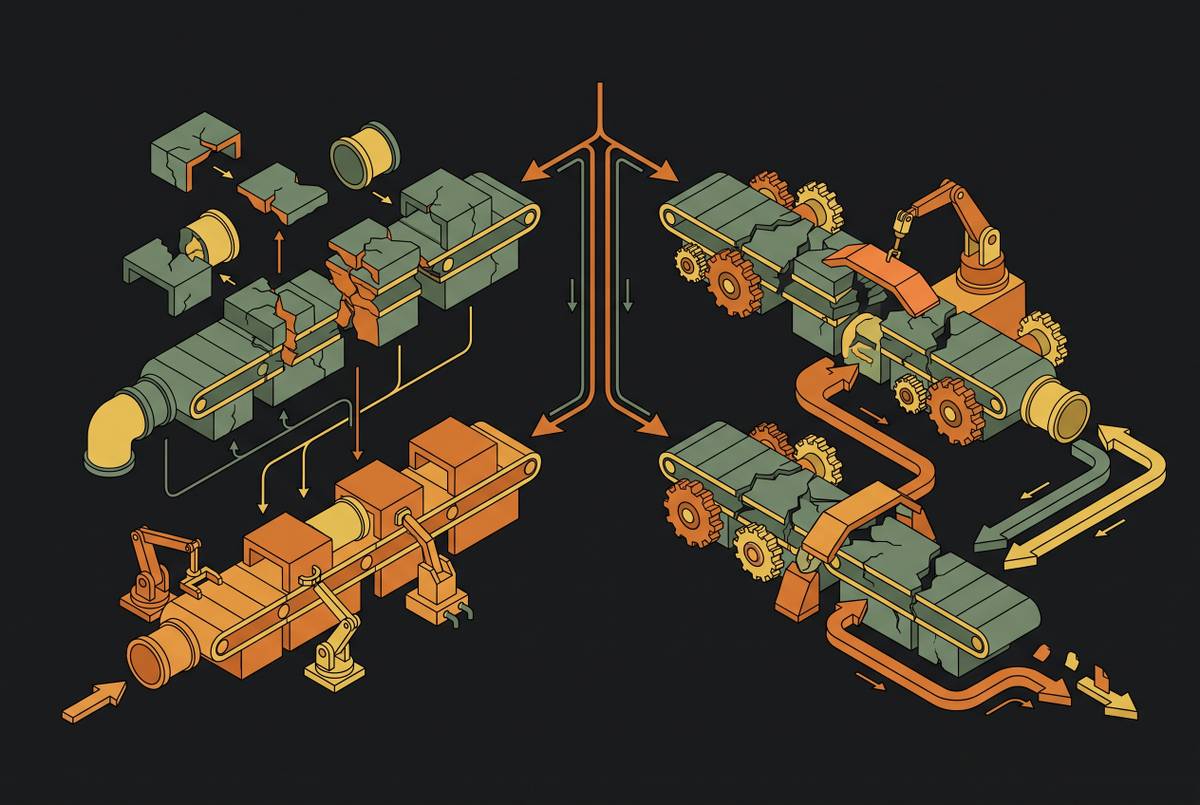
What Separates a Process Diagnostician From a Vendor Running a Discovery Call in Logistics and Construction
A diagnostician tests how work runs; a vendor qualifies a sale.
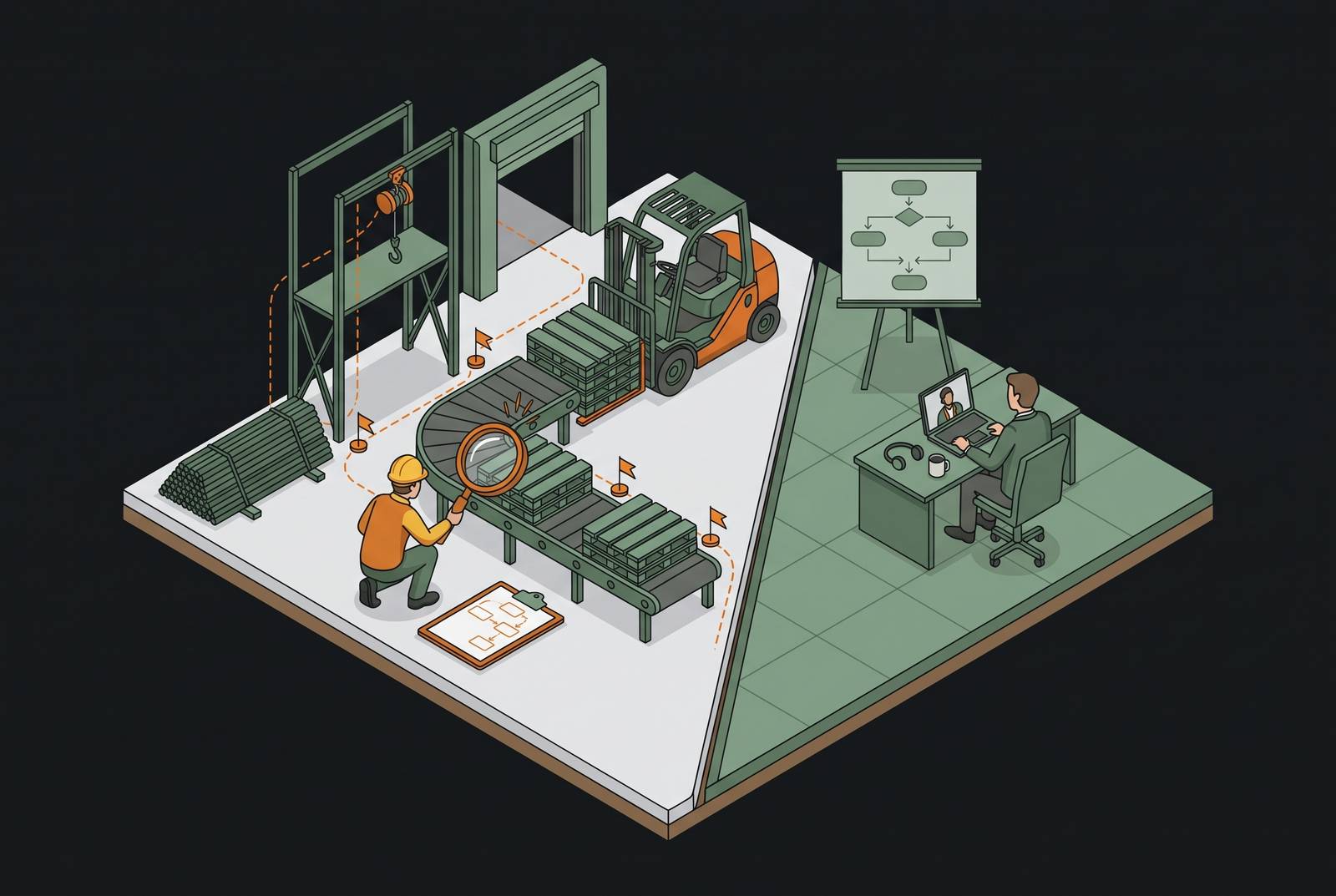
A process audit before AI deployment in construction and logistics should establish how work actually runs, which steps should be removed, and what measured baseline will make improvement testable. A process diagnostician is structured to answer those questions, while a vendor’s discovery call is structured to qualify a deal. The distinction lies in incentive architecture.
Why the discovery call format structurally cannot produce a real diagnosis
A discovery call must establish whether an operation is a suitable buyer for a solution. A diagnostic engagement must establish what is wrong with the operation, even when the answer removes the need for that solution. These are different obligations from the start. A capable vendor can ask perceptive questions, but the commercial purpose of the conversation still governs which questions receive attention and where the investigation stops.
A vendor who explains the full operational picture may give the client enough information to brief an internal team or hire a cheaper implementer. Full diagnosis can therefore undermine the transaction. Removing work that is not needed can also cost the vendor a sale, because cutting a step can leave less to implement or automate.
The vendor’s incentive is more seats sold, while the consultant’s is more billable hours. Only the operations partner, in this comparison, has an incentive aligned with the operation running clean. Those incentives shape what data they ask for and what they find as well as the terms of the deal, so the name given to an engagement cannot show whether it will produce a diagnosis.
What a real diagnostic engagement looks like in its first weeks
A genuine diagnostic engagement establishes a measured baseline in its first week. That baseline becomes the standard against which later changes are judged. Cycle time, throughput, days of inventory, or approval latency can provide that standard, depending on the process under examination. The diagnostic task is to connect the chosen measure to where work actually happens, rather than accept a broad claim that operations are slow.
End-to-end mapping then follows work through the handoffs between planning, production, quality, and fulfillment. The handoffs are part of the process itself. Examining them exposes bottlenecks, redundant approvals, and rework loops that do not appear in the declared process document. Interviews with the people doing the work provide evidence that executives commissioning the engagement cannot supply from their own seats.
That examination also clarifies who has authority to decide. When functions share responsibility for the same work, approvals can be delayed and schedules changed in response, which can leave inbound materials late or inconsistent. The diagnosis must spell out who owns those decisions. Without it, a recommendation to improve material flow may fix the delay that people see while leaving the conflict over who decides unresolved.
Why logistics and construction surface this gap more visibly than other sectors
In asset-heavy, sequence-dependent operations, a poor recommendation can become a deployment failure across interconnected workflows. Labor, approvals, deliveries, inspections, and utility energization interact, and insufficient float or the absence of a credible recovery option allows one constraint to propagate. This makes an incomplete operational picture especially costly in construction and logistics.
Switchgear provides a concrete example of that compounding mechanism. One late lineup can block energization and leave every downstream trade idle at the same time. Switchgear lead times on 2026 orders are much longer than in prior years, so it is especially hard to make up for a missed factory slot. Overtime cannot replace the lost production slot. At those lead times, re-sequencing does not recover it either, and the slip reaches the energization date by a full production cycle.
Black & Veatch’s November 2025 Electric Report identifies a broader mismatch between data center delivery and the infrastructure needed to serve it. Data centers take roughly 18 months to go from final investment decision to operation, while the grid and power infrastructure takes three to six years. Energization readiness is therefore a diagnostic priority. Treating it as a scheduling detail obscures a structural lag that cannot be resolved simply by improving execution inside the project boundary.
Workforce availability adds a separate constraint to that dependency chain. Kearney and IEEE Power & Energy Society’s joint study, released in August 2025, found that the world needs far more people in the power engineering workforce by 2030. The June 2025 EPC Show in Houston also produced projections of a large craft worker shortfall across the U.S. Gulf Coast. A plan for mobilization does not show that the workers will be available. In logistics, the related diagnostic concern is whether approvals and inbound materials can support the intended sequence, rather than whether each function has a plausible plan in isolation.
How the schedule becomes the vendor's alibi and the diagnostician's target
Primavera P6 models how the work is planned to proceed on a major data center program. It does not establish that execution is achievable. An activity can appear on track while its approved submittal is late, the manufacturer has moved the factory test, the electrical room is not ready, or a predecessor has been progressed optimistically. The distinction is between a declared plan and evidence about the conditions that plan requires.
The decisive evidence sits across procurement logs, RFIs, submittals, email threads, field coordination records, and commissioning data. When those records remain disconnected from P6, a schedule can be mathematically healthy and operationally wrong. Internal consistency is not evidence of field readiness. A vendor that accepts the schedule as fact can size a solution around it without testing whether its assumptions hold.
A diagnostician instead treats the schedule as a hypothesis. Public records, procurement logs, and field coordination data provide independent evidence that can confirm or contradict it. This changes what counts as a useful finding. The engagement is no longer asking only how a proposed tool fits the programme, but whether the programme describes a sequence the operation can actually execute.
That distinction also changes the interpretation of progress. A structure can appear physically advanced while utility energization, controls integration, equipment start-up, or integrated systems testing still governs beneficial use. Percentage complete cannot resolve that difference on its own. Schedule assurance must predict operational readiness using evidence of what the work still depends on, even when the visible construction progress looks promising.
Why AI deployment makes a bad diagnosis catastrophically more expensive
AI makes a faulty diagnosis more expensive because it can scale flawed outputs at operational speed. If the workflow contains unresolved definitions, responsibilities, or coordination problems, deploying an agent does not remove them. It introduces automation into a system whose operating rules have not yet been established.
Suffolk and MIT’s September 2026 white paper argues that meaningful construction gains require multiple workflows to change together, rather than a tool being bolted onto an existing process. It estimates that six AI-enabled changes used together could reduce project costs by 17–20%. A discovery call centered on a single product can miss the relationships that make the proposed improvement possible.
Agents guessing at definitions are identified as a leading production failure mode, returning confident answers that do not match official reports because no governed definition exists. The agent computes a definition on the fly. A diagnostic engagement must set the definition before deployment, or even an answer that seems clear can fall short of what the operation counts as correct.
Research on multi-agent systems points to a related design problem. Using the same model in a single-agent setup often outperforms multi-agent versions, indicating failures in coordination, orchestration, and workflow design. More agents do not necessarily improve the process. The diagnostic principle is to redesign the work first, letting agents retrieve, draft, flag, and route while people retain judgment and trade-offs.
Those design questions stay in view only if the engagement continues to address them after implementation. The incentives behind best-practice documentation and community forums differ from those behind operational intelligence generated through running the system. A buyer evaluating deployment support needs to distinguish guidance about a product from accountability for the process in which it operates.
The concrete signals that tell you which mode you are actually in
Diagnostic signals appear in the questions asked and the evidence requested. A diagnostician asks which steps should be removed, then allows the answer to change the proposed scope. They ask for procurement logs, submittal registers, coordination emails, and commissioning records instead of relying on an org chart or process document. They also interview the people doing the work. Those requests show whether the engagement is investigating execution or accepting its official description.
A diagnostician can identify what will be measured in week one and where that measurement will come from. They name what they would not automate and why. Their recommendations form a prioritized short list of high-impact changes, rather than a comprehensive transformation roadmap whose breadth is treated as evidence of value.
A conversation may start with a product demonstration or a story from a reference customer before anyone establishes what the current process does. The schedule may be accepted without challenge. Other signals include describing what will be analyzed rather than what will change, asking only what can be improved or automated, and offering no concrete answer about the first week’s measurement.
Does the partner treat “witness-ready” and “energization-ready” as deliverables supported by dated evidence, or simply as lines on a programme? The evidence requirement separates those two readings immediately. Workforce availability, submittal approval windows, and equipment lead times should also enter the diagnosis before an automation sequence is recommended, because they may change whether automation makes sense at all.
In the comparison, the vendor’s accountability ends at the customer success queue, the consultant leaves after the deliverable, and the operations partner has a named human accountable at three in the morning. These are different commitments, even when the proposed technology is identical.
What should construction and logistics leaders do before granting access, time, and trust?
For an operations leader, the first action is to define success before committing operational data, team time, and leadership attention. The definition needs a named process, a named metric, and a named improvement threshold. “Improve operations” is not a testable engagement objective. A specific target creates a basis for evaluating both the investigation and any recommendation that follows it.
The next step is to ask the prospective partner to show prior work at the process level. What did they measure in week one, what did the baseline reveal, what did they recommend removing, and what changed? A product demonstration cannot take the place of those answers. The purpose is to establish whether the partner has diagnosed an operating process, rather than merely matched a stated requirement to a solution.
In construction and logistics, that examination should start with a specific, painful process rather than a platform strategy or broad transformation roadmap. Procurement, approvals, and readiness dependencies are places to check how work actually runs. The process chosen should be small enough to measure. Its diagnosis must still follow the handoffs that explain the pain, rather than treating the process as independent of the surrounding operation.
A process audit is therefore the prerequisite to AI deployment. It establishes the current flow of work, the points of friction, the decision authority, and the evidenced baseline against which change can be tested. Only then can removal, redesign, or automation be judged against the operation’s needs.