What a Broken Shift Handover in Oil and Gas Tells You Before Any Tech Strategy Gets Written
Shift handover breakdowns expose information gaps before any AI strategy succeeds.
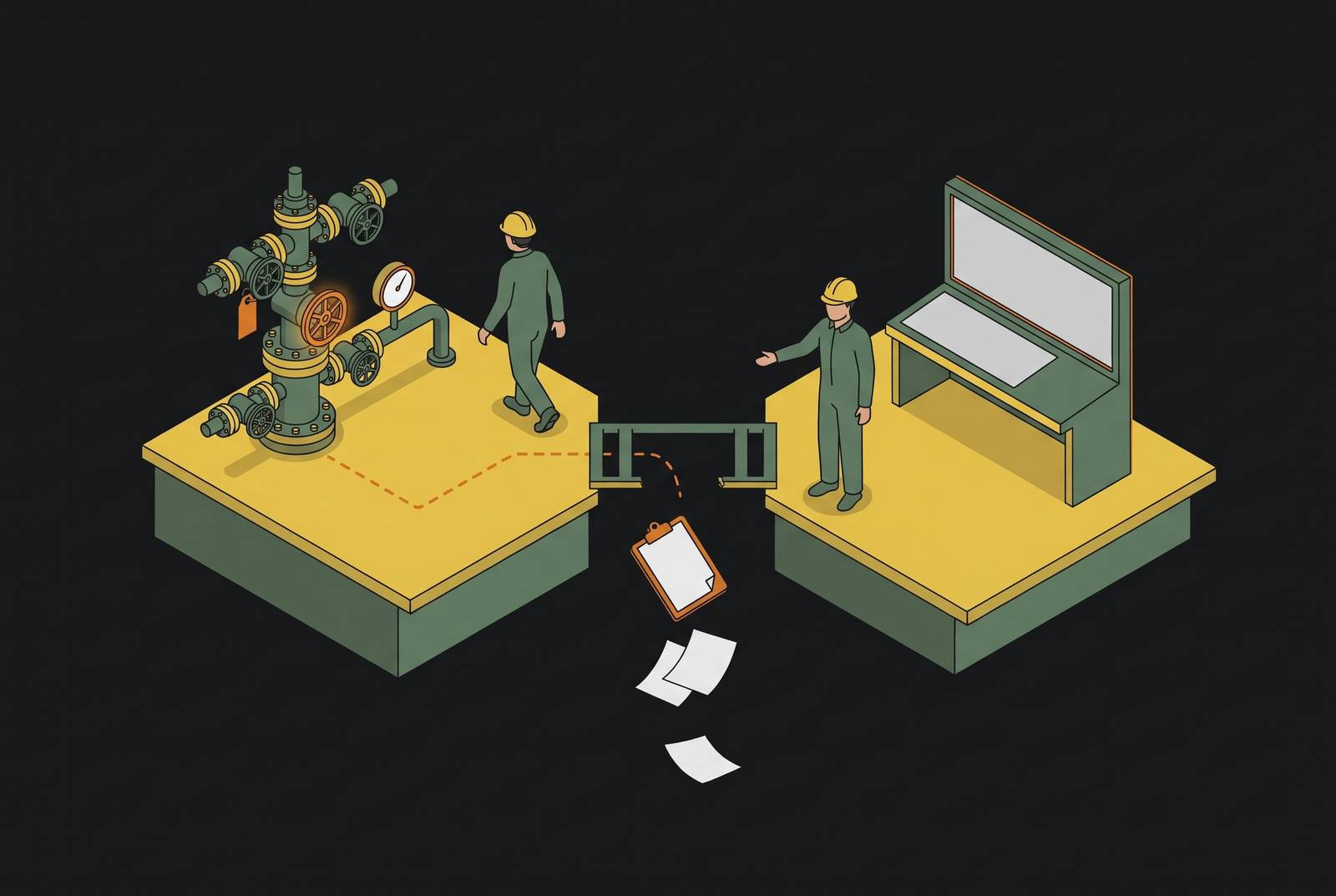
AI operations transformation in asset-heavy industries can start with one broken process, without a platform strategy. In oil and gas, shift handover is a diagnostic starting point because it exposes missing information, ambiguous ownership, and dependence on individual memory. The first step is to observe and redesign that transfer, then choose technology that supports the corrected process.
Why shift handover is structurally different from other operational transitions in oil and gas
A brief transfer of responsibility concentrates a disproportionate share of operational risk. The plant keeps running while its custodians change. Khan’s research on shift handover risk documents the relationship between shift-change windows and incident concentration. In continuous oil and gas operations, responsibility must transfer completely multiple times a day, across equipment and process conditions that keep changing throughout the exchange.
What must transfer is more than operating status. It is the outgoing crew’s understanding of what is abnormal, what has been deferred, what requires manual attention, and why. That awareness does not automatically exist in a record. Handover therefore becomes a mandatory, recurring stress test of the operation’s information architecture: the structures through which knowledge is captured, maintained, and transferred. When those structures fail, the incoming crew inherits conditions it does not know to question.
What the Piper Alpha, Buncefield, and Texas City investigations actually found about handover
The Cullen Report identified handover failure as a contributing factor in Piper Alpha, where 167 people died. No written shift-handover procedure existed. What the lead production operator wrote on his notepad and communicated was left to his discretion. Information that could have prevented the initiating cause remained confined to the outgoing crew’s awareness.
At Buncefield, a record existed but its scope was inadequate. The shift logbook captured information about the Finaline pipeline, while information about the other two pipelines was recorded only on an ad-hoc basis. It also recorded only end-of-shift plant status, omitting events during the shift. Insufficient allocated time for supervisor handover compounded that structural omission.
At BP’s Texas City Refinery in 2005, the lead operator was absent during handover, the logbook lacked required detail, and communication was unclear. Lessons from BP’s Grangemouth refinery incident in 2000, which had similar characteristics, had not been applied. Across all three cases, relevant information existed, but the organization lacked a reliable structure to capture, verify, and transfer it.
The six categories of knowledge that disappear at every unstructured handover
iFactory’s structured logbook framework sets out six categories of safety-critical knowledge and what can go wrong when each is lost. It provides an analytical lens. Equipment status is the first category, covering equipment that is bypassed, inhibited, isolated, manually controlled, or outside its normal operating envelope. Without that information, it is unsafe to assume the equipment is running normally. Open maintenance and permit-to-work status form the second category, where missing knowledge about active permits, isolation points, lockouts, or deferred maintenance can lead to disturbed isolations or conflicting permits.
Process conditions and deviations are the third category. A manual override or drifting parameter may remain manageable only because the outgoing crew is watching it. That protection leaves with the crew unless its knowledge transfers. Safety events and near misses form the fourth category, including hazard observations and safety instrumented function demands. Their omission removes the history through which an incoming crew could recognize a recurring pattern.
Deferred tasks and pending actions are the fifth category, which covers work left unfinished and decisions yet to be carried out. Without explicit transfer, inherited obligations disappear between shifts. Contractor and third-party activity is the sixth category, because work still under way or equipment left in an intermediate state can leave the asset’s actual configuration out of step with its documentation. These losses share a mechanism. Operators decide what deserves mention at the end of a shift, and that judgment varies with experience, fatigue, and time pressure. The Abnormal Situation Management Consortium’s research at the ENGEN Refinery found better situation awareness with a structured, checklist-integrated logbook than with an unstructured approach.
What a broken handover reveals about the information architecture upstream of it
The handover reveals where the operation has already failed to capture changes during the shift. A crew can compensate for an incomplete record while its members remain present, because they remember what they changed and what still needs attention. The shift boundary removes that compensation. For a few minutes, it becomes visible that the documented plant diverges from the actual plant.
The first upstream diagnostic checks for an authoritative record of asset state. If an abnormal condition becomes known only when an operator mentions it, the organization has no dependable record of that condition independent of the operator. Documentation has drifted from physical reality. The second diagnostic checks accountability, including whether the incoming crew clearly accepts responsibility for open permits, deferred work, and unresolved conditions. Where acceptance is assumed rather than recorded, the organization cannot clearly distinguish information received from responsibility accepted.
The third diagnostic checks for person-dependent process logic. If safe continuity depends on a particular experienced operator remembering the right details, reliability depends on the staffing of that shift. Training alone cannot resolve this dependency. Experience shapes what a person considers significant, but it can also normalize a drifting parameter until reporting it seems unnecessary. A structured process catches conditions that familiarity has made easy to overlook. The same three diagnostics apply when contractors depart, maintenance returns equipment, or a project transfers an asset to operations.
Why frontline digital tools and connected workflows expose the same gaps rather than closing them
Frontline digitalization introduces mobile data capture, AI-assisted anomaly detection, and connected workflows into field, control room, and maintenance activities. These capabilities can be useful when the underlying process supplies reliable information and assigns responsibility clearly. The sequence determines their value. If that process remains fragmented or partly dependent on memory, the tool inherits the omissions.
A searchable logbook does not make discretionary notes complete. Likewise, a dashboard cannot establish authoritative equipment state if changes were never captured reliably at their source. The screen can instead reinforce the incoming crew’s confidence in an incomplete account. The useful comparison is between a digital logbook that accepts whatever an operator types and a structured transfer that requires acknowledgment of defined conditions. Both are digital, but only the latter changes the rules governing the transfer.
Untracked configuration and control-system changes create operational, compliance, and cybersecurity exposure, while fragmented or poorly versioned records make later reconstruction difficult. Decisions may need explaining years after they were made. Reconstructing an audit trail after a system has been running is weaker, more expensive, and less credible than creating evidence within the process. Technology selection therefore follows decisions about what must be recorded, who verifies it, and when responsibility changes hands.
Reading handover as an operational X-ray — what to look for and what it tells you
For operations leaders, the practical diagnostic is to observe three consecutive handovers with attention to how knowledge and responsibility move. The first check is how abnormal equipment state comes to light. A mandatory field and an unsolicited verbal remark are not equivalent forms of control. If a condition is recorded only when someone mentions it, the record depends on what each crew remembers. Open permits and deferred maintenance provide the next test, because explicit transfer distinguishes assigned ownership from an assumption that the incoming crew already knows.
Time and questioning reveal how the process works under pressure. The observation should establish whether handover time is protected or routinely compressed by operational demands. Buncefield shows why insufficient time belongs in the diagnosis of process design. The incoming crew’s questions then show whether it receives enough detail to interrogate plant conditions. Passive acceptance is a warning, particularly when gaps are filled with assumptions.
The written record and verbal briefing should also be compared. Their differences expose information treated as too routine to mention, as well as reliance on knowledge that never becomes a durable record. A logbook containing only end-of-shift status has no causal history of the shift. Using it in internal investigations or talks about how to improve the process also tests whether anyone has checked its completeness beyond routine compliance. Together, these observations distinguish an operation designed for continuity from one that treats handover as an interruption to throughput.
Why the handover gap and the enterprise AI failure pattern are structurally the same problem
A broken handover and a failed enterprise AI deployment can share the same separation between declared procedure and actual work. In handover, this leaves the logbook detached from the real transfer of knowledge. In AI deployment, it appears as governance that exists in a document but does not govern deployment decisions. The document changes while the way the work gets done stays the same.
The parallel also appears in accountability and evidence. Enterprise AI efforts can proceed without process redesign, a baseline, a defined owner, or a decision about how freed capacity will be used. Those omissions prevent a clear account of operational improvement, just as ambiguous ownership prevents a clear account of who accepted an unresolved condition. Static compliance adds a further gap when governance does not change as system behavior changes. In both settings, formalizing an output is mistaken for designing the process that produces it.
Construction scheduling offers the same distinction at another scale. Plans capture intent, while achievability depends on procurement lead times, coordination, and commissioning sequencing that may not be structured for an AI system to use. An agent working from fragmented operational data thus has the same limits as an incoming crew given an incomplete briefing. Faster processing cannot supply knowledge that was never captured. AI improvement requires a reliable account of actual work.
How do you fix one operations process with AI before choosing a platform?
Requirements describe the process as people believe it works, while handover observation exposes how it works under actual conditions. A process audit can then show which information is already recorded in a form that can be used and which knowledge is held only in conversation or unstructured notes. It can also separate assigned accountability from assumed ownership. Those findings show the smallest change that would help before the organization commits to more software.
The next step is to establish minimum viable structure. This means mandatory fields and verification steps sufficient to make the transfer auditable, without adding so much friction that operators work around it. A structured template with digital acknowledgment is first a process-design decision. iFactory’s framework illustrates the distinction through abnormal equipment status requiring acknowledgment, permit-to-work records linked to logbook entries, and unresolved permit conflicts preventing acknowledgment. The process must enforce the required transfer.
For AI deployment, the sequence is to audit the process, structure it, establish a baseline of reliable data, and then introduce agents into that workflow. An anomaly-monitoring agent cannot produce dependable alerts from shift records that omit the conditions it needs to interpret. Tool and integration choices remain secondary to that dependency. The same steps apply to larger transfers, where operations must receive the equipment along with its change history, deviation rationale, and the reasons behind the asset’s configuration.
Observe three consecutive handovers using the six knowledge categories and the three upstream diagnostics of asset state, accountability, and person-dependent process logic. Establish what disappears, where responsibility becomes ambiguous, and which conditions survive only in someone’s memory. That account defines what the operation’s information architecture can support and what must change before technology is asked to improve it.