Why Ground-Up Department Redesign Starts With Deleting the Handoff Before It Assigns the Agent
Cut the handoffs that only relay information, then automate the rest.
Rebuilding department workflows with AI agents starts with deleting unnecessary handoffs. The sequence is to define the department’s outcome, examine which transfers of work actually require a decision, eliminate those that only relay information, and assign agents to what remains. This separates ground-up redesign from faster execution of an outdated process.
Why automating a handoff is not the same as removing it
Mapping what people do today and assigning agents to those tasks is an understandable starting point. It respects the knowledge of the people doing the work and gives the deployment a concrete scope. But existing workflows record the constraints under which they were built. An approval may come from an earlier compliance need, while a data-entry task may exist only because two systems never shared information. Those origins deserve scrutiny before the work receives an agent.
If one team must finish, send a notification, and wait for another team to reconstruct the context, automating the notification leaves the wait intact. Speeding up one task therefore need not produce a comparable improvement in total cycle time. An agent can also generate more output from a redundant step, sending additional work toward an already constrained review queue.
What a handoff actually is, and why it hides its own cost
A handoff is a transfer of work during which ownership is suspended until the recipient takes responsibility. One person produces an output, but another must receive it, understand it, validate it, and act. The transfer is complete when the next owner can proceed. That context reconstruction consumes time that a task-based process map often leaves out.
An email-to-spreadsheet transfer illustrates the hidden cost. Sending the email may take little time, but the work still waits for someone to notice it and enter the information. An approval chain leaves work waiting in the same way between decisions, even when each review is brief. During these intervals, accountability can become diffuse because nobody knows whether the work is blocked, lost, or waiting. A status field or automated notification can disguise the problem by making a human-dependent transfer look like a systems integration.
How do you redesign a department workflow before assigning AI agents?
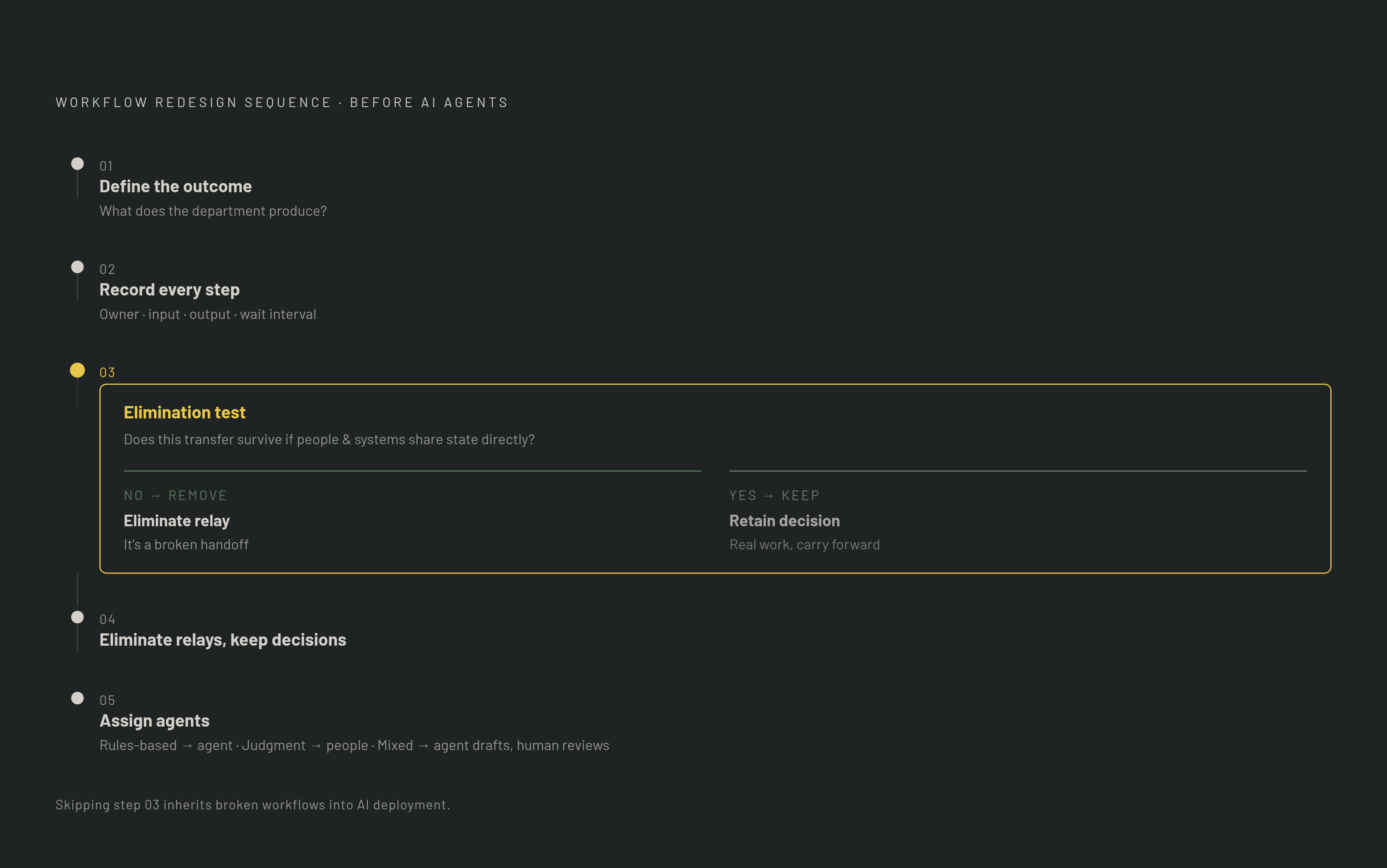
The practical sequence begins with a question about purpose. What outcome does the department exist to produce? That distinction exposes work that supports the outcome and work that merely coordinates people around disconnected systems. The team then asks what happens between the first input and the finished outcome. Answering it requires recording every step, its owner, its input, its output, and the next recipient, including the intervals when work waits.
Each transfer then faces the same test. Would this step still be necessary if the people and systems involved shared the same state directly? If it exists only to relay information, it is a candidate for elimination. If it requires a decision, the question becomes who must own that decision and what information they need.
Only surviving steps receive an execution assignment. Work requiring judgment stays with people, work governed by clear rules can go to agents, and mixed work can follow an agent-draft, human-review sequence. Consequential reviews must remain visible.
Why most organizations skip the elimination step and what it costs them
Eliminating a step is also an organizational decision. Every approval has an approver, every routing rule has an owner, and every request for a status update comes from someone who needs to know what is happening. Asking whether the step is necessary can sound like questioning that person’s role. Automating execution within the step is easier to authorize because it leaves these relationships undisturbed. The scope consequently tends to follow what a team is comfortable automating.
An agent can route purchase approvals, but it cannot establish whether the organization should require the existing approval chain. Interviews alone leave out some of what is needed for that decision because people tend to describe the work they are assigned, leaving out some of the informal dependencies around it. Steps without a clear sponsor or output can remain unexamined. When agents enter this unresolved structure, they inherit ambiguous instructions, produce outputs without clear owners, and send exceptions into the queues that were already delaying the work.
How this plays out in construction: the P6 schedule as a handoff-dense process
Primavera P6 holds the schedule of record, procurement logs hold commitments, and vendor emails and field updates describe how conditions are changing. A project manager bridges these sources manually. Because each changes on a different cadence, schedule risk can accumulate between updates before appearing as a delay. Producing P6 reports faster still leaves those differences to be worked out.
The redesign target is the manual reconciliation handoff. Linking schedule information with procurement commitments, design changes, cost forecasts, and field conditions lets an agent track where they diverge instead of just copying schedule data, and nPlan shows how examining a schedule’s risk differs from reporting it. It ingests P6 or MSP files and uses models trained on historical schedules, with a simulation engine rolling forecasts into probabilistic outcomes, to identify activities most likely to cause overruns. That analysis serves a different purpose from automating the forward-backward pass.
The contractual system of record still constrains the design. Federal, DOT, and USACE contract requirements for P6 and CPM calculation mean that redesign happens on top of the schedule of record. The forward and backward pass is inherent to CPM rather than a separately named contractual requirement. Suffolk Construction used ALICE Technologies’ Schedule Insights Agent and Targeted Optimization on a life sciences project to interrogate the critical path and identify acceleration strategies. It recovered significant schedule time while preserving the P6 requirement and removing the handoff between planning and optioneering.
How this plays out in logistics: the check-call loop as automatable friction
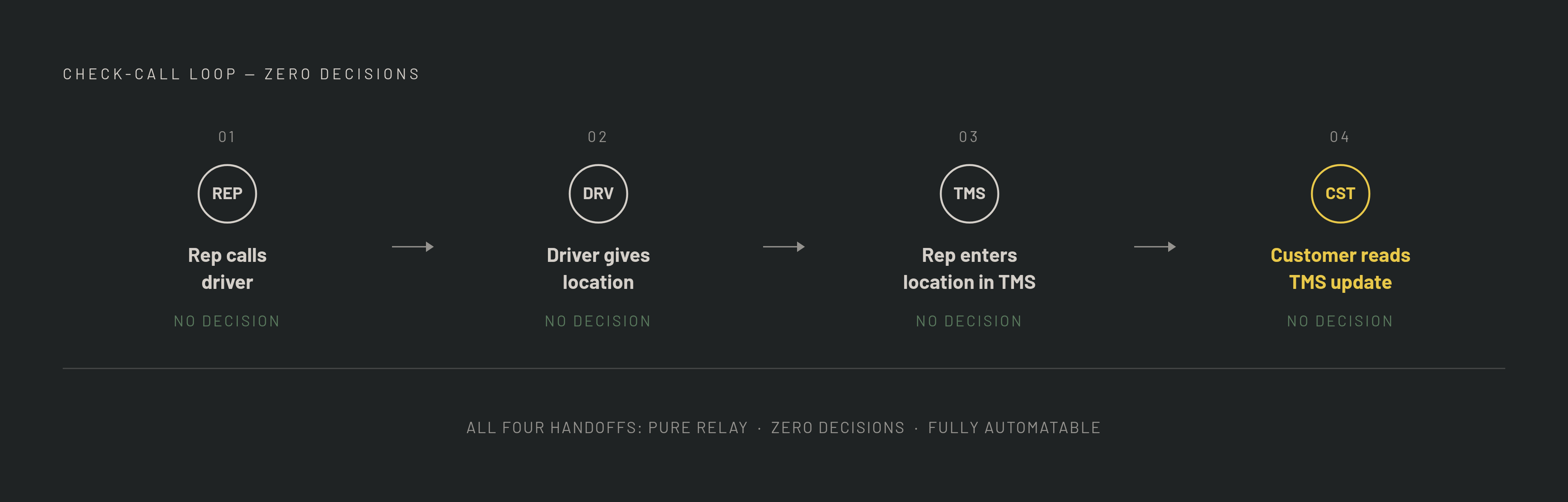
A carrier representative calls a driver, the driver gives a location, the representative enters it in a TMS, and a customer calls for an update that the representative reads from the system. These are four handoffs without a decision. Helping the representative complete each call faster improves the local task but preserves the representative’s role as the bridge between sources.
Where systems can share state directly, the relay becomes unnecessary. Where contact is still needed, an agent can run the routine loop through phone, email, and SMS, log the answer directly, and surface exceptions. C.H. Robinson’s missed-pickup agents work out what to do next and resolve routine missed pickups while escalating genuine exceptions.
Some conversations are not information relays at all. New carrier relationships, claims, OS&D, and damaged-load situations involve trust, liability, and accountable judgment. People should still handle those interactions when routine tracking is automated. The design distinction is between transferring a known status and deciding what responsibility to accept when conditions depart from the routine.
How this plays out in revenue cycle: sequential denial handoffs as the redesign target
A denial chain shows how rework creates its own workflow. A claim is submitted, the payer rejects it, a biller receives the notice, interprets the reason, corrects the claim, and resubmits it. The cycle can then repeat. Each transition follows from a failure that has already occurred. First-generation revenue cycle automation, including RPA screen-scraping, sped up this correction loop but did not always reduce the need for it.
The stronger intervention is upstream of the rejection. Scrubbing a claim before submission targets the source of downstream rework. For the loop that remains, API-first agentic systems can run eligibility checks, monitor claim status, post remittance data, and escalate exceptions. Routine status transfers no longer need to pass through a person merely to reach the next system. People still have to review cases that require interpretation, even after the clerical relay is gone.
What embedded engineers find that outside advisors miss
The handoffs that reveal the most often have no formal name. They appear as a Slack message asking for confirmation, a spreadsheet maintained beside the system of record, or a manager check retained after an earlier system failure. Documentation usually covers the approved process and leaves out the work people do around it to keep things moving. An interview can therefore produce a coherent account while omitting the transfers that consume the team’s day. Sitting with the team shows when those transfers happen.
An engineer observing work for a week can see informal dependencies that an advisor receiving a process map never encounters. Those dependencies need to be checked because they may have no formal owner, audit trail, or escalation path. In Microsoft’s cloud supply chain case, supply chain experts and engineers followed this sequence at scale by mapping workflows and making them simpler before adding agents. They established a shared data foundation, while permissions and approval thresholds defined the boundaries for agent action. Knowing how the work is done helps make those boundaries fit the work.
Governance as the design constraint that determines which handoffs can be eliminated
Shared information does not eliminate the need for accountability. If a transfer would still be necessary with direct access to the same state, the remaining purpose may be a legal, financial, or safety decision. That is a governance handoff. It belongs in an observable review queue with an accountable human owner. Deleting it would remove a decision boundary.
This distinction determines the agent’s permitted scope of action. Every consequential workflow needs an escalation path to a specific person with authority over the relevant class of exception. A catch-all queue does not provide that ownership. Audit trails and permission frameworks must therefore precede broader autonomy. Employees also need to know where machine recommendations begin and end, while managers need to understand which exceptions they own. These conditions make the remaining human handoffs intelligible and support trust in the work that no longer requires them.
What whole-department transformation looks like when the sequence is followed
A redesigned department has fewer transfers. Agents track, log, enrich, reconcile, and alert, while people own exceptions and consequential decisions. Agents can also help map undocumented workflows, monitor drift between the intended process and actual behavior, and flag eliminated steps that return informally. Watching the work over time keeps the redesign tied to what people do each day.
The people using the workflow must help shape it. Otherwise, a team that distrusts an agent’s work can route around it and recreate the informal confirmation chain. Agent-assisted mapping and monitoring can compress redesign into weeks of process mapping and months of rollout, but that compression depends on doing the elimination work. Deloitte’s research found that organizations prioritizing work design are twice as likely to exceed their AI return-on-investment expectations.
A construction team keeps P6 while checking exceptions across the schedule, procurement, and field conditions. A logistics representative handles a damaged-load conversation, with routine location updates removed from their work. A revenue cycle team works on claims that need judgment while systems handle eligibility, status, and remittance work.