Failure Modes in Mission-Critical Logistics Operations
Broken processes hide better under layers of oversight than they do when exposed.
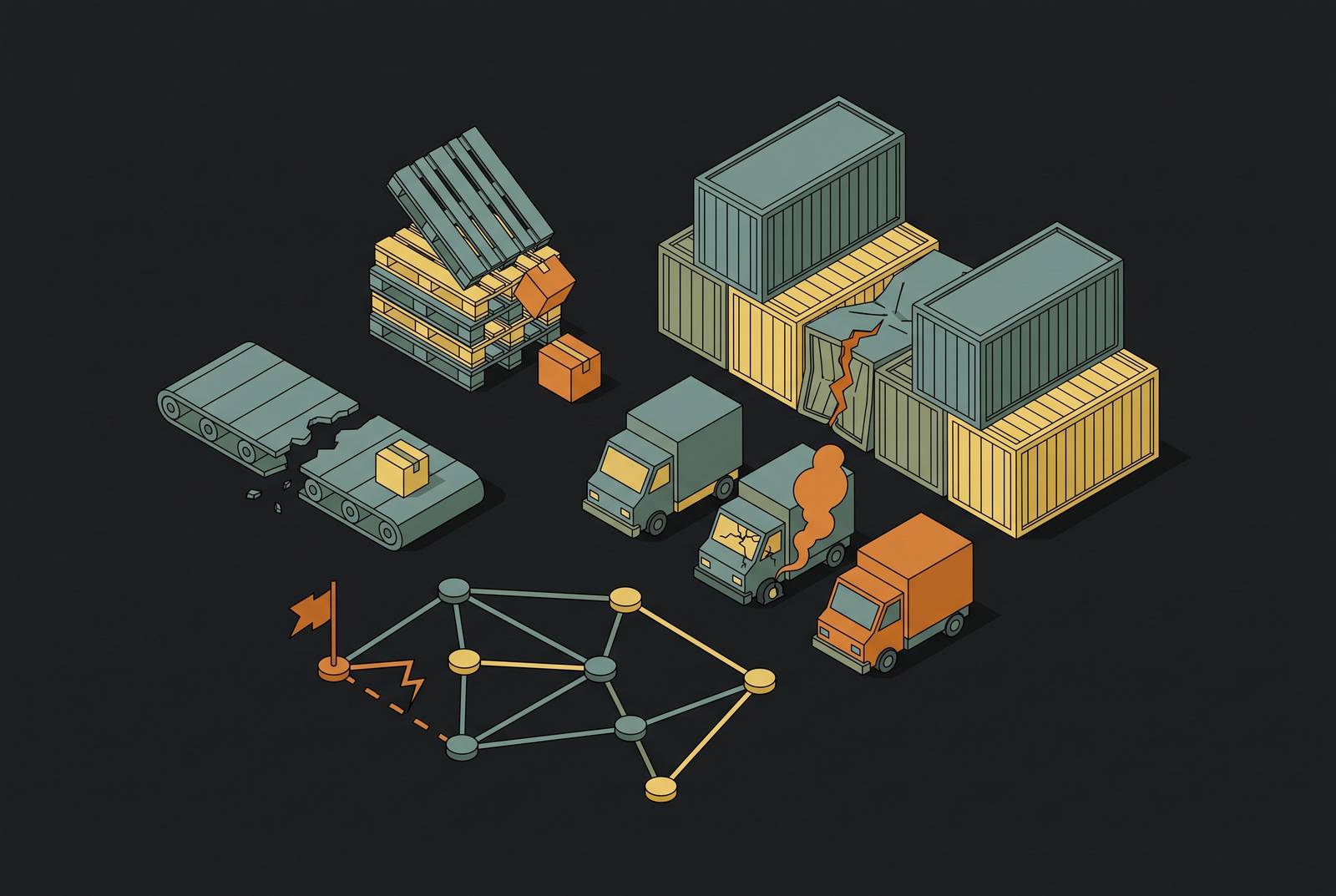
Mission-critical logistics failures usually begin in processes that were never verified to work as declared. Technology then accelerates those failures. This article examines how that pattern runs from receiving-dock records to procurement schedules and production AI, and why auditing and rebuilding one costly broken process is a stronger starting point than a broad transformation roadmap.
Why mission-critical logistics fails before any system is deployed
Packages are missed, delivery windows are lost, and projects stall even when the systems behind them do what they were built to do. The failure can precede the software entirely. Automated routing, planning tools, and AI agents operate on records and handoffs that organizations assume are sound. When those assumptions have never been tested against field conditions, deployment gives a defective workflow more speed and reach. The system does not need to malfunction for the operation to fail.
Mission-critical logistics means operations in which a late or out-of-sequence delivery has downstream consequences that cannot be absorbed. Data center buildouts, medical freight, industrial supply chains, and large-scale last-mile operations fall within that scope. A downstream decision can be executed correctly against an upstream record that was wrong from the start. Greater intelligence at the decision point does not establish whether the premise was true.
This makes the unaudited process the thing to examine before turning to the newest tool attached to it. The same pattern occurs in logistics, construction, and enterprise operations because each relies on work that teams in different organizations must do together. A declared workflow describes how those boundaries should be crossed. It does not establish that the handoffs work.
How dirty data at the point of intake corrupts every downstream decision
A shipment manifest with the wrong weight or commodity code introduces a false premise at intake. Customs clearance, routing, and final delivery billing then inherit that record as fact. Each stage can look right on its own while working from the same error. The defect propagates through an otherwise functioning workflow. A better downstream model cannot make the original declaration true.
Freightsuite’s 2026 analysis describes the result of deploying AI on dirty data as faster errors. Its corrective is deterministic validation at the point of data entry, before an agentic process touches the record. That places the first AI checkpoint at the receiving dock. Accuracy has to be established before the record becomes a basis for action. Retrofitting it downstream leaves earlier decisions resting on an untested premise.
Warehousing exposes the same weakness through the gap between declared inventory and physical stock. Without a common data key that links ERP, inspection records, and the physical archive, those views cannot reliably show the same state. A governance policy describes how information should be entered, leaving verification of how entry occurred unresolved. The missing control is the comparison between the declared record and the actual condition.
Why the gap between declared plans and field reality is structural, not accidental
The same substitution of declaration for evidence occurs at the planning level. P6 schedules and tools like them record what is planned, while the risks lie in procurement lead times, gaps in coordination, and readiness for commissioning. The software is not the underlying problem. Organizations cause the problem by habitually accepting recorded intent as proof of readiness.
A project schedule may show “mechanical complete” and “controls ready” while a conduit run lands where a skid builder placed a junction box. The PLC program may still be waiting on final tag mapping. Those conditions contradict the declared state, yet acknowledging them requires acknowledging a problem. Schedule updates therefore serve two competing purposes. They support planning, but they also function as performance declarations, creating pressure to preserve dates and conceal risk.
Logistics planning has an equivalent dependency on unverified assumptions. Route optimization gains depend on clean address data, correct vehicle capacities, and respected geofences. When legacy records misstate those inputs, modeled gains erode even if the optimization itself works as intended. The corrective is to treat each plan update as a decision record to be audited against field evidence, rather than a status report whose filing completes the task.
How procurement and energization constraints become the actual critical path
In infrastructure-dependent logistics, the slowest dependency may sit outside the work receiving the most management attention. For data centers, industrial facilities, and large-scale distribution, long-lead equipment and grid energization can determine readiness more than construction or software. A completed building is not necessarily a usable asset. Site-ready, construction-ready, and power-ready are separate statuses, and conflating them hides the dependency that governs when operations can begin.
Grid interconnection queues in key U.S. markets commonly stretch to five years or more, with waits reaching seven or eight years in major markets such as PJM. Queue placement is outside a developer’s control, and utility schedules can shift without notice. Those are genuine external constraints. However, treating a declared completion date as credible without reconciling it with interconnection conditions is an internal process failure.
Readiness for commissioning depends on the people with the skills for controls installation, systems testing, and fixing defects, even after the date a general contractor expects to leave. Finding the actual critical path calls for checking when procurement will come through and when crews will be available. Projects described as permitted, financed, or partially designed are not equivalent to projects under active construction. Procurement records and interconnection filings can expose that distinction before a schedule does, making a later explanation based solely on “external disruption” incomplete.
What production AI agent failures in logistics actually look like
A demonstration uses clean inputs, conditions that help it work, and well-formed queries. In day-to-day work, there are dirty data, adversarial inputs, and edge cases that the demonstration never tests. Success in the first environment does not establish reliability in the second. The deployment fails when the surrounding process assumes that it does.
Runaway loops show how attempts to complete a task can continue without control over execution. An agent that cannot answer a query may try other searches, try to create an index, and seek access to administrative tools. Those escalating actions can consume substantial API resources before a person notices. In a fleet of agents, the problem extends beyond one task. Calls to APIs, other agents, and core enterprise applications form an integration web in which subtle interaction failures can cascade into wider disruption.
A route optimization failure becomes a delivery-continuity problem when the process has no way to function through the outage. A better model alone cannot provide that missing path. Fallback logic, health monitoring, and human-in-the-loop routing have to be part of the process from the beginning. Their purpose is not to make failure impossible, but to prevent the loss of one AI function from leaving the operation without a designed response.
Why adding coordination layers compounds failure instead of containing it
Adding orchestration is an understandable response to operational pressure. More agents, dashboards, and oversight promise to coordinate work that existing systems leave fragmented. Yet if the records and handoffs underneath them remain unaudited, the new layer inherits their defects. It also adds interactions that can fail.
Freightsuite argues that autonomous orchestration requires CEO-backed, end-to-end workflow redesign. The 2026 Singapore Consensus on Global AI Safety Research Priorities names multi-agent stability as a principle in its own right for testing and deployment. That distinction is important because testing agents individually cannot establish whether their collective behavior will remain stable. Least privilege helps with another part of the same problem. Giving an agent access beyond what its task needs leaves gaps in governance that are harder to keep in check when agents interact.
Auditability also weakens as orchestration grows more complex. Finding out which agent made a decision and why gets harder just when a failure in the work calls for a clear explanation. Legacy integration adds a further constraint, as retrofitting data pipelines into WMS, TMS, and ERP systems built before APIs were standard can dominate deployment lead times. Another layer does not discharge that integration debt. More oversight that merely reports the declared process leaves the broken foundation intact, so added complexity compounds its failures.
What a process audit actually surfaces that declared plans cannot
A process audit compares documented work with work as it actually happens. That comparison reveals failures which a plan cannot disclose simply by becoming more detailed. A handoff between teams or systems may lose data or transform it incorrectly without either party recognizing the defect. The declared process can still look complete. The audit exposes the break between its steps.
It also separates external constraints from internal failures presented as disruptions. Grid queue position and supplier lead times are different problems from failing to account for either in a schedule. A workaround may have become load-bearing even though the official process does not acknowledge its existence. Rebuilding from the documentation alone would therefore omit something the operation depends on.
The audit also identifies failure points with no degradation path, where an interruption freezes work or forces fully manual handling because no fallback was designed. In manufacturing readiness, a missing common data key between ERP, inspection records, and the physical archive exposes a comparable weakness. More software does not establish the relationship between those records. A layered process audit can surface that gap before it becomes a compliance or delivery failure. The audit is therefore an input to rebuilding.
Why rebuilding one painful process beats a broad transformation roadmap
A systemic problem does not require a broad first intervention. A single handoff, data-entry point, or failure to coordinate work is small enough to audit in full and still show how the larger operation breaks. Starting where failure is most costly gives the rebuild a concrete basis. A transformation roadmap built from unverified documentation lacks that basis. It can redesign the intended process at scale while leaving the actual source of failure untouched.
This distinction changes how long deployment timelines should be interpreted. When route optimization takes months to integrate because of ERP data debt rather than model training, the integration problem is the process to fix first. Extending the AI timeline does not resolve the underlying defect. Freightsuite places that sequencing at data intake, with entropy control before any agentic system touches the workflow.
Public procurement records, interconnection filings, workforce availability data, and system integration logs provide evidence of conditions that declared schedules can obscure. Building an intervention on that evidence narrows the distance between what the organization intends and what it can execute. Expansion then has a firmer starting point than an unaudited roadmap provides. For operations leaders skeptical of vendor promises, that skepticism is warranted. The corrective is not a better promise from a different vendor, but a rigorous audit and rebuild of the process where failure is already most costly.